
Part 12 · Module 8
Content and Construct Validity
Learn how content and construct validity provide evidence that an instrument measures the intended construct with relevant, comprehensive and interpretable scores.
Learning outcomes
After completing this lecture, you should be able to:
- Define content validity as relevance, comprehensiveness and comprehensibility.
- Calculate item- and scale-level content validity indices.
- Explain construct validity through structural validity and hypothesis testing.
- Plan convergent, discriminant and known-groups hypotheses.
- Distinguish validity evidence from reliability coefficients.
- Use R code to summarise content and construct validity evidence.
Overview
Validity concerns the degree to which evidence supports the interpretation of scores for an intended purpose.
It is not a permanent label attached to an instrument.
The same questionnaire may be valid for:
- one population;
- one language;
- one use;
- one score interpretation;
and inadequate for another.
COSMIN organises validity evidence into:
- content validity;
- structural validity;
- hypotheses testing for construct validity;
- cross-cultural validity or measurement invariance;
- criterion validity when a defensible gold standard exists [1].
Why this matters
A reliable instrument can measure the wrong construct consistently.
A high Cronbach alpha or ICC does not establish validity.
Content validity is foundational because missing or irrelevant content cannot be repaired by sophisticated statistical modelling.
Construct validity requires a network of prespecified hypotheses rather than one favourable correlation.
When to evaluate validity
Evaluate content validity:
- during instrument development;
- during translation or adaptation;
- before relying on internal consistency.
Evaluate construct validity whenever score interpretation depends on a latent construct without a true gold standard.
Validity evidence should accumulate across studies. Messick’s unified validity framework emphasises evidence supporting score interpretation rather than a permanent instrument label [2].
Research question and variables
Content-validity questions include:
- Are items relevant?
- Is important content missing?
- Are instructions, items and response options understandable?
Construct-validity hypotheses include:
- strong correlation with closely related constructs;
- moderate correlation with related but distinct constructs;
- weak correlation with unrelated constructs;
- expected differences between known groups;
- expected factor structure.
Data structure
Validity evidence sources
simulated data| Dataset | Variables |
|---|---|
| Expert content review | Item, expert, relevance rating 1–4 |
| Patient cognitive interviews | Comprehension, interpretation, missing content |
| Construct study | Instrument score and comparator measures |
| Known-groups study | Instrument score and prespecified group |
| Structural study | Item-level responses for factor analysis |
Quantitative indices should not replace qualitative patient and expert feedback.
Statistical assumptions
Content validity
COSMIN defines content validity through:
- relevance;
- comprehensiveness;
- comprehensibility [3].
Patients are essential because experts may overlook wording, burden or missing lived-experience content.
Item content validity index
If experts rate relevance from 1 to 4 and ratings 3–4 count as relevant:
Scale CVI average
Universal agreement
Chance agreement and panel size should be considered.
Worked example: content validity
Construct validity
Construct validity is evaluated through patterns predicted by theory.
Convergent validity
The instrument should correlate strongly with measures of similar constructs.
Discriminant validity
Correlations with distinct constructs should be lower.
Known-groups validity
Groups expected to differ should show differences in the predicted direction and magnitude.
Structural validity
The item response structure should support the proposed dimensional model.
Exploratory factor analysis explores potential dimensions.
Confirmatory factor analysis evaluates a prespecified model.
Worked example: construct validity
Worked analysis in R
content_data <- read.csv(
  "data/part-12-content-validity-data.csv"
)

validity_data <- read.csv(
  "data/part-12-construct-validity-data.csv"
)

content_data$relevant <- as.integer(
  content_data$relevance_rating >= 3
)

item_cvi <- aggregate(
  relevant ~ item,
  data = content_data,
  FUN = mean
)

scale_cvi_average <- mean(
  item_cvi$relevant
)

universal_item <- aggregate(
  relevant ~ item,
  data = content_data,
  FUN = min
)

scale_cvi_universal <- mean(
  universal_item$relevant
)

construct_correlations <- cor(
  validity_data[
    c(
      "instrument_total",
      "related_construct",
      "moderately_related",
      "unrelated_construct"
    )
  ]
)

known_group_test <- t.test(
  instrument_total ~ known_group,
  data = validity_data,
  var.equal = FALSE
)

item_cvi
scale_cvi_average
scale_cvi_universal
construct_correlations
known_group_test
Selected analysis output
I-CVI
Items 1–8 and 10 = 1.00
Item 9 = 0.00

S-CVI/Ave = 0.90
S-CVI/UA = 0.90

Construct correlations
Related = 0.937
Moderately related = 0.810
Unrelated = 0.152

Known-group mean difference = 4.973
Welch t = 4.640
p < 0.001
Visualising construct hypotheses
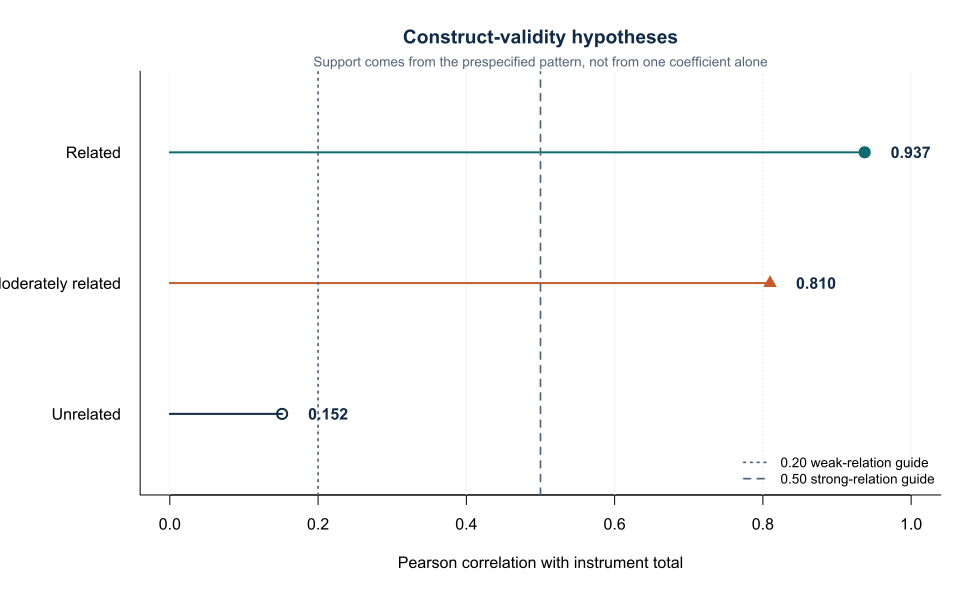
The figure should display confidence intervals in a publication analysis.
Cognitive interviews
Content validation should include cognitive interviews examining:
- how participants interpret each item;
- whether recall periods are workable;
- whether response options fit;
- whether important content is missing;
- whether wording is offensive or burdensome.
The 2025 COSMIN content-validity guidance emphasises relevance, comprehensiveness and comprehensibility [4].
Structural validity
Factor analysis should follow the scoring model.
For ordinal items, estimators based on polychoric correlations may be appropriate.
Report:
- factor model;
- estimator;
- loading pattern;
- residual correlations;
- fit indices;
- model modifications;
- cross-validation.
A good-fitting model does not compensate for poor content validity.
Cross-cultural validity and invariance
Translated or adapted instruments should preserve:
- meaning;
- item function;
- response interpretation;
- score comparability.
Measurement invariance can be assessed across:
- language;
- sex;
- age;
- clinical group;
- time.
Without sufficient invariance, group score comparisons may be biased.
Criterion validity
Criterion validity requires a defensible gold standard.
Many constructs such as quality of life, fatigue and health literacy have no gold standard.
Correlation with another imperfect questionnaire is construct validity evidence, not criterion validity.
Hypothesis testing
A strong hypothesis states:
- comparator;
- expected direction;
- expected magnitude;
- subgroup difference;
- rationale.
Example:
The new fatigue score will correlate at least 0.60 with an established fatigue instrument and below 0.30 with social desirability.
Post hoc reinterpretation of unexpected correlations weakens evidence.
Interpreting validity evidence
Presenting the results
Suggested reporting
Report:
- construct definition;
- intended population and use;
- development process;
- patient and expert involvement;
- content-validity methods;
- item-level results;
- prespecified construct hypotheses;
- structural model and estimator;
- cross-cultural testing;
- all supportive and contradictory evidence.
COSMIN treats content validity as a central measurement property when selecting instruments [1], [3], [4].
Common mistakes
Knowledge check
What are the three main aspects of content validity?
Answer and reasoning
Relevance, comprehensiveness and comprehensibility.
Does a high S-CVI/Ave excuse one irrelevant item?
Answer and reasoning
No. Item-level problems can be concealed by the average.
What makes construct-validity evidence strong?
Answer and reasoning
A prespecified pattern of relationships and group differences supported across studies.
Why is correlation with another questionnaire not automatically criterion validity?
Answer and reasoning
The comparator is usually another imperfect construct measure rather than a gold standard.
What does measurement invariance support?
Answer and reasoning
Comparable score meaning across groups, languages or time points.
Key take-home messages
References
- Mokkink LB, Terwee CB, Patrick DL, Alonso J, Stratford PW, Knol DL, et al. The COSMIN checklist for assessing the methodological quality of studies on measurement properties. Qual Life Res. 2010;19(4):539–549. https://doi.org/10.1007/s11136-010-9606-8
- Messick S. Validity of psychological assessment. Am Psychol. 1995;50(9):741–749. https://doi.org/10.1037/0003-066X.50.9.741
- Terwee CB, Prinsen CAC, Chiarotto A, Westerman MJ, Patrick DL, Alonso J, et al. COSMIN methodology for evaluating the content validity of patient-reported outcome measures. Qual Life Res. 2018;27(5):1159–1170. https://doi.org/10.1007/s11136-018-1829-0
- Mokkink LB, Terwee CB, Patrick DL, Alonso J, Stratford PW, Knol DL, et al. Content validity: judging the relevance, comprehensiveness, and comprehensibility of instruments’ content. J Clin Epidemiol. 2025;183:111759. https://doi.org/10.1016/j.jclinepi.2025.111759
- Mokkink LB, Prinsen CAC, Bouter LM, de Vet HCW, Terwee CB. The COnsensus-based Standards for the selection of health Measurement INstruments and how to select an outcome measurement instrument. Braz J Phys Ther. 2016;20(2):105–113. https://doi.org/10.1590/bjpt-rbf.2014.0143
These notes support learning and research planning and do not replace statistical consultation for a specific study.