
Part 13 · Module 1
Statistical Principles of Randomised Controlled Trials
Learn how randomisation, allocation concealment, estimands, prespecification, multiplicity and missing-data sensitivity preserve valid trial inference.
Learning outcomes
After completing this lecture, you should be able to:
- Explain how randomisation supports causal comparison.
- Distinguish sequence generation from allocation concealment.
- Define the five attributes of a trial estimand.
- Explain prespecification, blinding and control of multiplicity.
- Recognise intercurrent events and missing-data sensitivity analyses.
- Use R code to verify allocation and trial flow.
Overview
A randomised controlled trial estimates treatment effects by assigning eligible participants to interventions using a chance mechanism.
Randomisation supports causal interpretation because, before treatment, allocation is independent of measured and unmeasured prognostic factors in expectation.
Valid trial inference also depends on:
- concealed allocation;
- prespecified objectives and estimands;
- protection from post-randomisation bias;
- suitable analysis;
- complete follow-up;
- transparent reporting.
ICH E9(R1) formalises the estimand as the precise treatment effect aligned with the clinical question [1].
Why this matters
Randomisation can be undermined by:
- predictable allocation;
- selective enrolment;
- excluding participants after allocation;
- analysing treatment received rather than treatment assigned;
- switching outcomes after seeing results;
- unplanned repeated testing;
- informative missing outcomes.
A trial is not valid merely because the word randomised appears in the Methods section.
When to use this framework
Use these principles when designing, analysing or appraising parallel, factorial, cluster, crossover, non-inferiority and adaptive trials.
The details differ by design, but the central requirement is alignment among:
- objective;
- estimand;
- design;
- conduct;
- analysis;
- interpretation.
Research question and variables
The primary question is:
What is the effect of assignment to the intervention rather than control on follow-up outcome in all randomised participants?
ICH E9(R1) defines an estimand using five attributes:
- Population.
- Treatment conditions.
- Variable or endpoint.
- Intercurrent-event strategy.
- Population-level summary.
Intercurrent events include treatment discontinuation, rescue treatment, switching, death and protocol deviation.
Data structure
Core trial variables
simulated data| Variable | Role |
|---|---|
id | Randomised participant |
group | Assigned treatment |
site | Stratification factor |
baseline | Baseline outcome |
outcome_cont | Follow-up outcome |
protocol_deviation | Post-randomisation event |
loss | Missing follow-up indicator |
Statistical assumptions
Random sequence generation
Valid methods include:
- computer-generated random numbers;
- permuted blocks;
- stratified randomisation;
- minimisation with a random component.
Alternation, birth date and medical-record number are predictable and are not adequate randomisation.
Allocation concealment
Allocation concealment prevents investigators from knowing the next assignment before enrolment.
It differs from blinding:
- concealment acts before allocation;
- blinding acts after allocation.
Central web randomisation and pharmacy-controlled allocation are common concealment methods.
Prespecification
The protocol and statistical analysis plan should define:
- primary estimand;
- outcomes and time points;
- analysis populations;
- covariate adjustment;
- missing-data methods;
- multiplicity strategy;
- subgroup analyses;
- interim analyses.
ICH E6(R3) emphasises risk-proportionate quality, prespecified analysis and reliable trial results [2].
Multiplicity
Multiplicity arises from:
- several primary outcomes;
- several doses or groups;
- repeated analyses;
- multiple time points;
- subgroup searches.
Options include:
- one primary outcome;
- hierarchical testing;
- Bonferroni or Holm control;
- gatekeeping;
- alpha-spending functions.
Exploratory analyses can be reported without confirmatory claims.
Worked example
Worked analysis in R
trial <- read.csv(
  "data/part-13-trial-data.csv"
)

with(
  trial,
  table(group_label)
)

with(
  trial,
  table(group_label, site)
)

with(
  trial,
  table(group_label, loss)
)

with(
  trial,
  table(group_label, protocol_deviation)
)
Selected analysis output
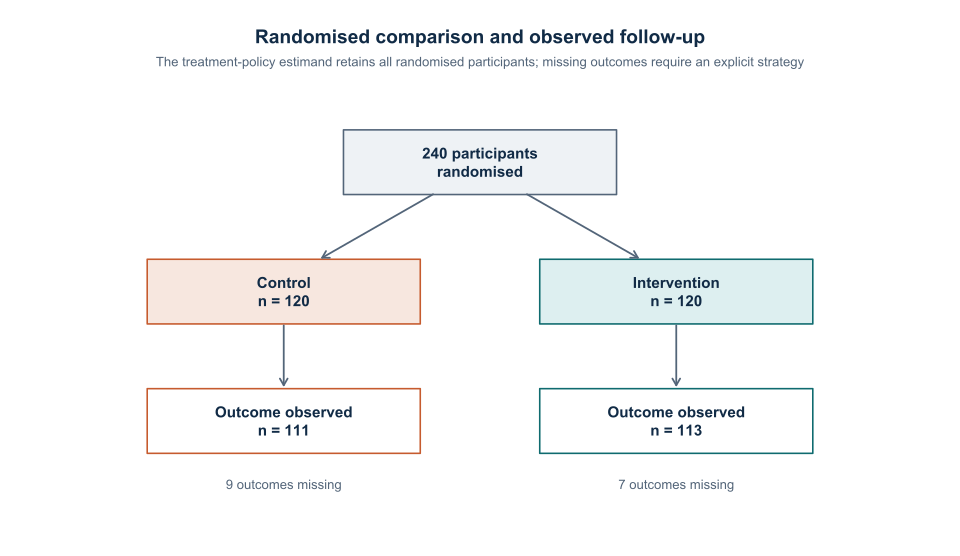
Control       120
Intervention  120

Randomisation is balanced within each of six sites.
Sixteen follow-up outcomes are missing.
Visualising trial flow and estimand
Interpreting the design
Presenting the results
Suggested reporting
Use CONSORT 2025 for completed randomised trials [3] and SPIRIT 2025 for protocols [4].
Report the estimand, sequence generation, concealment, blinding, analysis population, missing data, multiplicity and deviations.
Common mistakes
Knowledge check
What is the main statistical role of randomisation?
Answer and reasoning
It makes treatment assignment independent of baseline prognostic factors in expectation and supports an unbiased causal comparison under valid conduct.
What is allocation concealment?
Answer and reasoning
Preventing foreknowledge of the next treatment assignment before enrolment.
What are the five estimand attributes?
Answer and reasoning
Population, treatment conditions, variable, intercurrent-event strategy and population-level summary.
Why can missing outcomes threaten randomisation?
Answer and reasoning
The observed outcome comparison may no longer represent the randomised groups if missingness depends on prognosis or treatment.
What should be prespecified for interim analysis?
Answer and reasoning
Timing, information fraction, statistical boundaries, decision rules, access and data-monitoring procedures.
Key take-home messages
References
- International Council for Harmonisation. ICH E9(R1): addendum on estimands and sensitivity analysis in clinical trials. Geneva: ICH; 2019.
- International Council for Harmonisation. ICH E6(R3): guideline for good clinical practice. Geneva: ICH; 2025.
- Hopewell S, Chan AW, Collins GS, Hróbjartsson A, Moher D, Schulz KF, et al. CONSORT 2025 statement: updated guideline for reporting randomised trials. BMJ. 2025;389:e081123. https://doi.org/10.1136/bmj-2024-081123
- Chan AW, Boutron I, Hopewell S, Moher D, Schulz KF, Collins GS, et al. SPIRIT 2025 statement: updated guideline for protocols of randomised trials. BMJ. 2025;389:e081477. https://doi.org/10.1136/bmj-2024-081477
These notes support learning and research planning and do not replace statistical consultation for a specific study.