
Part 13 · Module 7
Cluster-Randomised and Crossover Trials
Learn how allocation level, clustering, treatment sequence, period and carryover determine analysis of cluster-randomised and crossover trials.
Learning outcomes
After completing this lecture, you should be able to:
- Identify the independent allocation unit in cluster trials.
- Explain ICC, design effect and few-cluster inference.
- Specify treatment, period and sequence effects in crossover trials.
- Recognise carryover and washout assumptions.
- Match analysis and sample size to the design.
- Use R code for cluster and crossover analyses.
Overview
Cluster-randomised trials allocate groups such as clinics or schools.
Crossover trials allocate sequences so each participant receives more than one treatment.
Both designs violate the simple independent parallel-group model.
Their analyses must represent the unit and timing of randomisation.
Why this matters
In a cluster trial, 480 participants in 30 clinics do not provide 480 independent treatment assignments.
In a crossover trial, two periods from one participant are paired, and treatment can be confounded with period or carryover.
Ignoring these structures produces incorrect standard errors and potentially biased effects.
When to use these designs
Cluster randomisation is useful when:
- intervention is delivered at group level;
- contamination is likely;
- service organisation is the target;
- individual allocation is impractical.
Crossover is useful when:
- condition is stable;
- treatment effect is reversible;
- outcome can be measured repeatedly;
- carryover can be prevented or modelled.
Research question and variables
Cluster trial variables:
- cluster;
- cluster treatment;
- participant outcome;
- participant and cluster covariates.
Crossover variables:
- participant;
- sequence;
- period;
- treatment;
- outcome.
Data structure
Design-specific data structures
simulated data| Design | Independent unit | Repeated structure |
|---|---|---|
| Cluster trial | Cluster | Participants within cluster |
| Crossover | Participant | Periods within participant |
Statistical assumptions
Cluster-randomised trials
A random-intercept model is:
The ICC is:
The approximate design effect is:
Few clusters require small-sample corrections.
Crossover trials
For two periods:
where is treatment effect, period effect and participant effect.
Sequence can be included as a between-participant factor.
Worked example
Worked analysis in R
cluster_trial <- read.csv(
  "data/part-13-cluster-trial-data.csv"
)

crossover <- read.csv(
  "data/part-13-crossover-data.csv"
)

library(lme4)

cluster_fit <- lmer(
  outcome ~ group +
    (1 | cluster),
  data = cluster_trial,
  REML = TRUE
)

summary(cluster_fit)

crossover_fit <- lmer(
  outcome ~ treatment +
    period +
    sequence +
    (1 | id),
  data = crossover,
  REML = TRUE
)

summary(crossover_fit)
Selected analysis output
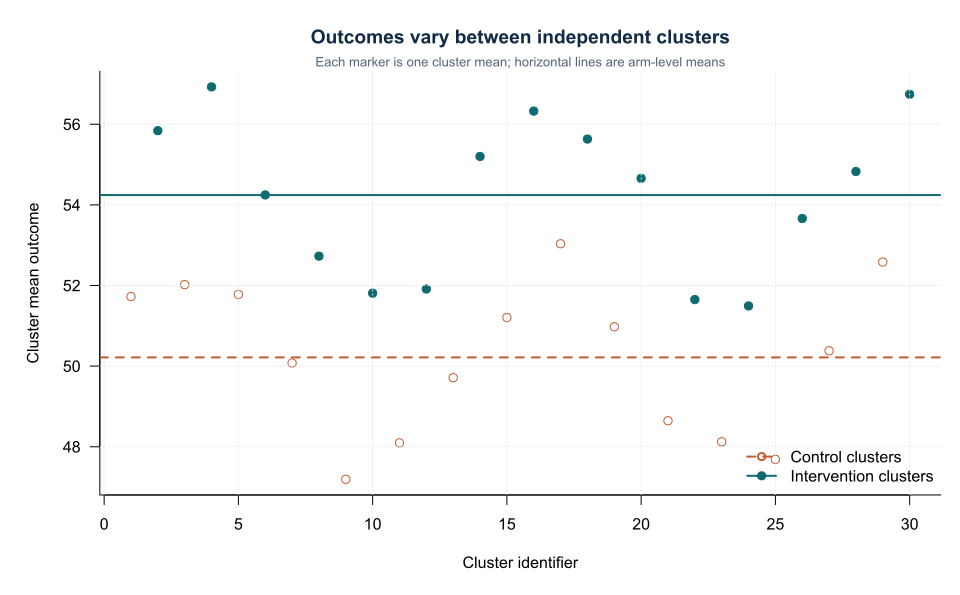
Cluster trial: intervention increases the outcome by approximately 4 units.

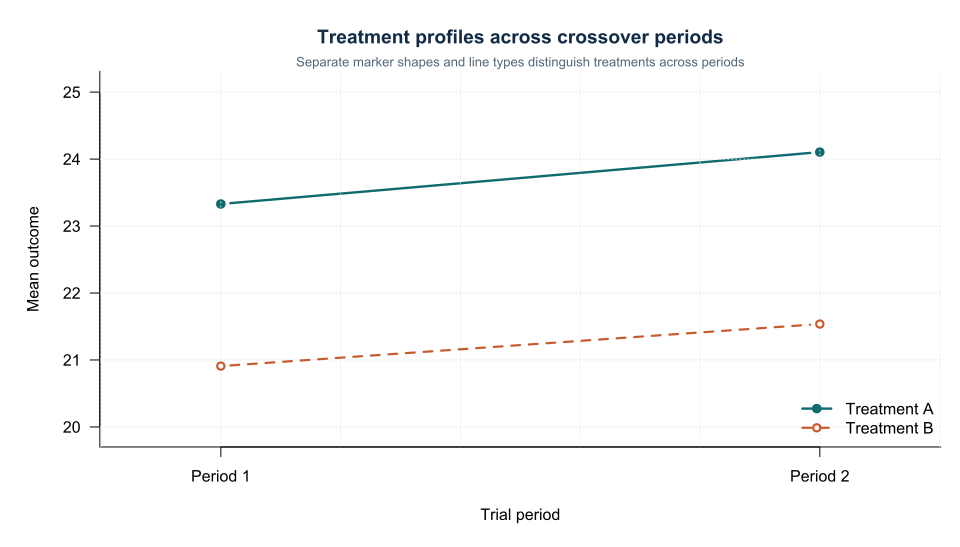
Crossover trial: Treatment A increases the outcome by approximately 2.5 units after accounting for period, sequence and participant.
Visualising cluster allocation
Visualising crossover periods
Carryover
Carryover occurs when a period-1 treatment affects period 2.
Prevention is preferable:
- sufficient washout;
- stable disease;
- short-lived treatment effect.
Testing carryover and discarding period 2 after a non-significant or significant result is problematic.
If carryover is expected, a parallel design may be more appropriate.
Recruitment bias in cluster trials
When clusters are randomised before participant recruitment, recruiters may know allocation.
This can change who enters each arm.
Blinded or standardised recruitment and clear eligibility criteria are important.
Interpreting the output
Presenting the results
Suggested reporting
Use the CONSORT cluster extension [1] and crossover extension principles [2].
Report allocation unit, cluster count, ICC, sequence, periods, washout, carryover assumptions and missing clusters or periods.
Design and analysis principles for cluster-randomised and crossover trials are developed in specialised texts [3], [4].
Common mistakes
Knowledge check
What is the independent treatment unit in a cluster trial?
Answer and reasoning
The randomised cluster.
Why include participant random effects in crossover analysis?
Answer and reasoning
Repeated period outcomes from one participant are correlated.
What does the period effect represent?
Answer and reasoning
Systematic outcome difference between periods unrelated to treatment.
Why can few clusters be problematic?
Answer and reasoning
Treatment inference depends on the number of independent clusters.
When should crossover be avoided?
Answer and reasoning
When effects are irreversible, disease is unstable or carryover cannot be controlled.
Key take-home messages
References
- Campbell MK, Piaggio G, Elbourne DR, Altman DG. CONSORT extension to cluster randomised trials. BMJ. 2012;345:e5661. https://doi.org/10.1136/bmj.e5661
- Dwan K, Li T, Altman DG, Elbourne D. CONSORT 2010 statement: extension to randomised crossover trials. BMJ. 2019;366:l4378. https://doi.org/10.1136/bmj.l4378
- Donner A, Klar N. Design and analysis of cluster randomization trials. London: Arnold; 2000.
- Senn S. Cross-over trials in clinical research. 2nd ed. Chichester: Wiley; 2002.
These notes support learning and research planning and do not replace statistical consultation for a specific study.