
Part 13 · Module 3
Intention-to-Treat and Per-Protocol Analyses
Learn how intention-to-treat and per-protocol analyses target different treatment effects and how intercurrent events, adherence and missing outcomes affect interpretation.
Learning outcomes
After completing this lecture, you should be able to:
- Define intention-to-treat, treatment-policy and per-protocol analyses.
- Explain how post-randomisation exclusions threaten comparability.
- Distinguish analysis set from estimand.
- Recognise adherence and protocol-deviation confounding.
- Plan missing-data and sensitivity analyses.
- Use R code to compare ITT and per-protocol estimates.
Overview
Intention-to-treat, ITT, refers to analysing participants according to randomised assignment.
Per-protocol analysis restricts attention to participants meeting prespecified adherence and protocol criteria.
They can estimate different effects.
Modern estimand terminology separates:
- the treatment effect being targeted;
- the analysis population;
- the statistical estimator [1].
Why this matters
Excluding participants after randomisation can break treatment comparability.
Adherence is influenced by:
- prognosis;
- toxicity;
- early response;
- access;
- clinician decisions.
A per-protocol comparison is therefore not automatically causal.
Conversely, an ITT analysis with extensive missing outcomes is not complete merely because participants remain labelled by assignment.
When to use these analyses
For superiority trials, a treatment-policy or ITT-type estimand is commonly primary.
Per-protocol analysis may be:
- supportive;
- primary for a clearly defined hypothetical adherence estimand;
- essential alongside ITT in non-inferiority trials.
The estimand and eligibility rules must be prespecified.
Research question and variables
The assignment-policy question is:
What is the effect of assignment to intervention, regardless of later adherence or deviations?
A per-protocol question might be:
What is the effect among participants who would adhere under either assigned treatment?
The second question involves a post-randomisation principal or hypothetical population and requires stronger assumptions.
Data structure
Post-randomisation trial variables
simulated data| Variable | Role |
|---|---|
group | Randomised assignment |
adherence | Post-randomisation adherence |
protocol_deviation | Eligibility for PP set |
loss | Missing outcome |
outcome_cont | Follow-up outcome |
Statistical assumptions
Intention-to-treat principle
A strict ITT analysis includes every randomised participant in the assigned group.
In practice, unavailable outcomes require modelling or sensitivity analysis.
Approaches include:
- likelihood-based models;
- multiple imputation;
- inverse-probability weighting;
- pattern-mixture sensitivity analyses;
- tipping-point analyses.
Single imputation such as last observation carried forward usually imposes unrealistic assumptions.
Modified ITT
Modified ITT often excludes participants who:
- never received treatment;
- lacked a baseline measure;
- lacked any post-baseline measure;
- were later found ineligible.
The term is ambiguous.
Every exclusion should be stated explicitly.
Per-protocol analysis
A PP set may require:
- minimum adherence;
- no prohibited medication;
- valid outcome timing;
- no major eligibility violation.
The rules should be defined before unblinding.
A PP effect can be biased because adherence is not randomised.
Causal methods for treatment adherence may require baseline and time-varying confounder adjustment.
Worked example
Worked analysis in R
trial <- read.csv(
  "data/part-13-trial-data.csv"
)

itt_data <- trial[
  !is.na(trial$outcome_cont),
]

itt_fit <- lm(
  outcome_cont ~ group +
    baseline +
    factor(site),
  data = itt_data
)

pp_data <- subset(
  itt_data,
  protocol_deviation == 0 &
  adherence >= 0.75
)

pp_fit <- lm(
  outcome_cont ~ group +
    baseline +
    factor(site),
  data = pp_data
)

rbind(
  ITT = c(
    estimate = coef(itt_fit)["group"],
    confint(itt_fit)["group",]
  ),
  PP = c(
    estimate = coef(pp_fit)["group"],
    confint(pp_fit)["group",]
  )
)

nrow(itt_data)
nrow(pp_data)
Selected analysis output
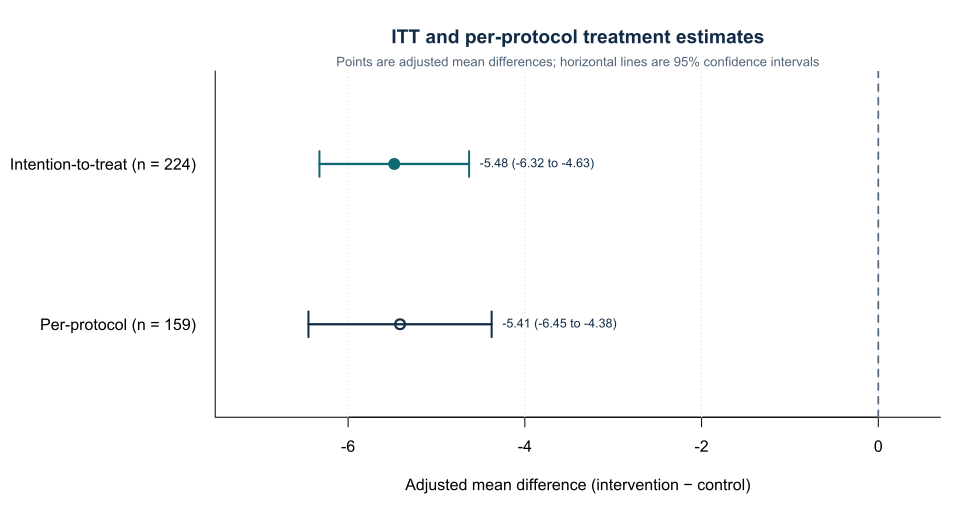
ITT adjusted mean difference = -5.478
95% CI = -6.324 to -4.631

Per-protocol adjusted mean difference = -5.412
95% CI = -6.449 to -4.376
Per-protocol n = 159
Visualising analysis populations
Non-inferiority considerations
In non-inferiority trials:
- non-adherence can dilute differences and favour non-inferiority;
- ITT alone may be anti-conservative;
- PP alone may be confounded.
Both analyses should generally support the conclusion, with discrepancies investigated [2].
Interpreting the output
Presenting the results
Suggested reporting
ICH E9(R1) recommends linking analysis sets and intercurrent-event strategies explicitly to the estimand [1].
CONSORT requires participant flow and reasons for exclusions [3].
Causal per-protocol estimation requires methods beyond ordinary restriction when adherence is prognostic [4].
Common mistakes
Knowledge check
What does ITT preserve?
Answer and reasoning
The comparison according to randomised assignment.
Why can PP be confounded?
Answer and reasoning
Adherence and protocol compliance are post-randomisation behaviours related to prognosis.
Does ITT solve missing outcomes?
Answer and reasoning
No. A valid missing-data analysis remains necessary.
Why report both ITT and PP in non-inferiority trials?
Answer and reasoning
Different biases can favour non-inferiority, and concordant analyses strengthen interpretation.
What is wrong with undefined modified ITT?
Answer and reasoning
Readers cannot know which randomised participants were excluded or what effect is estimated.
Key take-home messages
References
- International Council for Harmonisation. ICH E9(R1): estimands and sensitivity analysis in clinical trials. Geneva: ICH; 2019.
- Piaggio G, Elbourne DR, Pocock SJ, Evans SJW, Altman DG. Reporting of noninferiority and equivalence randomized trials. JAMA. 2012;308(24):2594–2604. https://doi.org/10.1001/jama.2012.87802
- Hopewell S, Chan AW, Collins GS, Hróbjartsson A, Moher D, Schulz KF, et al. CONSORT 2025 statement. BMJ. 2025;389:e081123. https://doi.org/10.1136/bmj-2024-081123
- Hernán MA, Hernández-Díaz S. Beyond the intention-to-treat in comparative effectiveness research. Clin Trials. 2012;9(1):48–55. https://doi.org/10.1177/1740774511420743
These notes support learning and research planning and do not replace statistical consultation for a specific study.