
Part 13 · Module 8
Adverse Events and Safety Outcomes
Learn how to define analysis populations, exposure, event incidence, recurrent events and uncertainty when reporting adverse events and safety outcomes.
Learning outcomes
After completing this lecture, you should be able to:
- Define adverse event, serious adverse event and treatment-emergent event.
- Select appropriate safety analysis populations and exposure periods.
- Distinguish participants with events from total event counts.
- Calculate absolute risks, risk differences and incidence rates.
- Recognise multiplicity and sparse-event limitations.
- Use R code to summarise safety outcomes.
Overview
Safety analysis describes:
- treatment exposure;
- adverse events;
- serious adverse events;
- discontinuations;
- laboratory abnormalities;
- deaths;
- events of special interest.
Safety outcomes are often multiple, recurrent and rare.
The analysis should distinguish the number of participants affected from the number of events.
Why this matters
A participant can experience several headaches but counts once in the participant incidence.
Comparing raw event counts can be misleading when exposure time differs.
Absence of statistical significance does not establish safety, especially for rare serious events.
When to use this framework
Use it for phase I–IV trials, pragmatic trials and post-authorisation studies.
The safety analysis population often includes participants who received at least one dose, analysed by treatment received, but this must be distinguished from the efficacy estimand.
Research question and variables
Key variables include:
- treatment received;
- first and last exposure dates;
- event term;
- seriousness;
- severity;
- relatedness;
- onset and resolution;
- recurrent event count;
- discontinuation;
- person-time.
Data structure
Safety data levels
simulated data| Level | Example |
|---|---|
| Participant | Any headache during follow-up |
| Event | Three headache episodes |
| Exposure | 84 treatment-days |
| Severity | Mild, moderate, severe |
| Seriousness | Regulatory serious criteria |
Severity and seriousness are not synonyms.
Statistical assumptions
Participant incidence
For an event:
Risk difference is:
Report event counts alongside participant risks when recurrence matters.
Exposure-adjusted incidence rate
When follow-up differs:
Exposure-adjusted rates require clear risk windows and recurrent-event assumptions.
They should not replace participant incidence automatically.
Worked example
Worked analysis in R
safety <- read.csv(
  "data/part-13-safety-data.csv"
)

risk_difference <- function(
  event,
  group
) {
  p1 <- mean(
    event[group == 1]
  )
  p0 <- mean(
    event[group == 0]
  )

  se <- sqrt(
    p1 * (1 - p1) /
      sum(group == 1) +
    p0 * (1 - p0) /
      sum(group == 0)
  )

  c(
    risk_control = p0,
    risk_intervention = p1,
    difference = p1 - p0,
    lower = p1 - p0 -
      1.96 * se,
    upper = p1 - p0 +
      1.96 * se
  )
}

rbind(
  headache = risk_difference(
    safety$headache,
    safety$group
  ),
  nausea = risk_difference(
    safety$nausea,
    safety$group
  ),
  serious_ae = risk_difference(
    safety$serious_ae,
    safety$group
  )
)
Selected analysis output
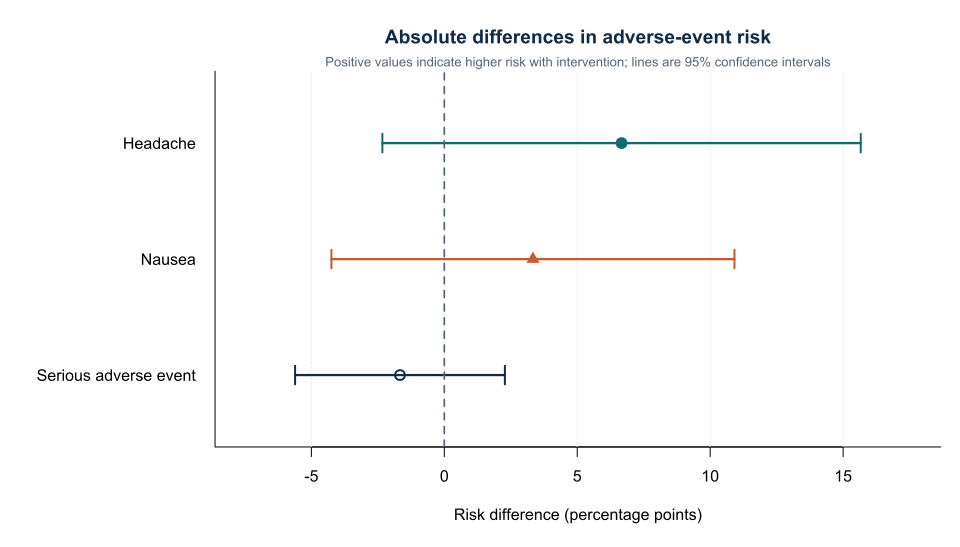
The intervention group has slightly higher simulated headache and nausea risks.

Serious adverse events are uncommon and confidence intervals are wide.
Visualising safety effects
Multiplicity
Safety analyses often contain hundreds of terms.
Formal adjustment can be useful for predefined safety outcomes, but routine p-value screening of every adverse-event term is misleading.
Prioritise:
- prespecified events of special interest;
- absolute risks;
- severity;
- timing;
- biological patterns;
- consistency across data sources.
Rare events
Individual trials are usually underpowered for rare harms.
Evidence may require:
- pooled trials;
- meta-analysis;
- pharmacovigilance;
- registries;
- long-term follow-up.
Zero observed events does not imply zero risk.
Interpreting the output
Presenting the results
Suggested reporting
Use CONSORT harms guidance together with CONSORT 2025 [1].
ICH E3 describes clinical-study-report safety displays [2].
Broader recommendations for safety planning and current trial reporting complement the harms-specific guidance [3], [4].
Common mistakes
Knowledge check
What is participant incidence?
Answer and reasoning
The proportion of exposed participants experiencing at least one event.
Why report total events as well?
Answer and reasoning
One participant can experience recurrent events, which participant incidence conceals.
Does p greater than 0.05 establish safety?
Answer and reasoning
No. Rare-event estimates may be highly imprecise.
When are exposure-adjusted rates useful?
Answer and reasoning
When observation or treatment exposure differs meaningfully across groups.
What should be prioritised statistically?
Answer and reasoning
Prespecified events of special interest, absolute risks, uncertainty and clinically coherent patterns.
Key take-home messages
References
- Ioannidis JPA, Evans SJW, Gøtzsche PC, O’Neill RT, Altman DG, Schulz K, et al. Better reporting of harms in randomized trials. Ann Intern Med. 2004;141(10):781–788. https://doi.org/10.7326/0003-4819-141-10-200411160-00009
- International Council for Harmonisation. ICH E3: structure and content of clinical study reports. Geneva: ICH; 1995.
- Crowe BJ, Xia HA, Berlin JA, Watson DJ, Shi H, Lin SL, et al. Recommendations for safety planning, data collection, evaluation and reporting. Clin Trials. 2009;6(5):430–440. https://doi.org/10.1177/1740774509344101
- Hopewell S, Chan AW, Collins GS, Hróbjartsson A, Moher D, Schulz KF, et al. CONSORT 2025 statement. BMJ. 2025;389:e081123. https://doi.org/10.1136/bmj-2024-081123
These notes support learning and research planning and do not replace statistical consultation for a specific study.