
Part 10 · Module 5
Screening Test and Programme Evaluation
Learn how to evaluate screening as a programme rather than a test alone, incorporating uptake, pathways, benefits, harms, overdiagnosis and resource implications.
Learning outcomes
After completing this lecture, you should be able to:
- Distinguish screening from diagnosis and distinguish test accuracy from screening-programme effectiveness.
- Apply core screening principles to decisions about target population, interval, test, referral and treatment pathways.
- Explain lead-time bias, length bias and overdiagnosis and why they can mislead evaluation of screening benefits.
- Plan evaluation of uptake, diagnostic resolution, benefits, harms, equity and resource use across the screening pathway.
- Identify designs and outcomes capable of evaluating whether a screening programme improves health outcomes.
Overview
Screening is the systematic offer of testing to people who do not seek care because of symptoms of the target condition, with the aim of reducing important adverse health outcomes through earlier detection and effective intervention. A screening programme is therefore much more than a test. It includes invitation, access, test delivery, result communication, diagnostic confirmation, treatment or prevention, follow-up, quality assurance and monitoring.[1,2]
A test can have excellent sensitivity and specificity yet perform poorly as a programme if uptake is low, positive results are not resolved, treatment is ineffective, harms outweigh benefits, or access is inequitable. Conversely, programme effectiveness cannot be inferred from earlier diagnosis alone because screening creates characteristic biases, including lead-time and length bias, and can detect conditions that would never have caused harm during a person’s lifetime.[2]
This lecture treats screening as a population intervention and distinguishes test performance from programme outcomes.
Why this matters
Screening involves offering an intervention to many people who feel well. The threshold for evidence and governance should therefore be high. Potential benefits must be weighed against false positives, false reassurance, anxiety, invasive follow-up, treatment complications, overdiagnosis, opportunity costs and inequitable access.[1,2]
Classic screening principles proposed by Wilson and Jungner in 1968 emphasised the importance of the condition, an accepted treatment, suitable facilities, a recognisable early stage, a suitable and acceptable test, an agreed policy for whom to treat, and continuing case-finding rather than a one-off project.[1] Modern programmes retain this systems perspective while giving greater explicit attention to informed choice, harms, equity, quality and resource use.[2] Later reconsideration of the classic screening criteria likewise emphasised that screening policy must address the programme, evidence, implementation and participant perspective rather than the test in isolation.[3]
Key concepts
Screening versus diagnosis
Screening offers testing to an asymptomatic or apparently well target population before clinical presentation. Diagnostic testing investigates people because of symptoms, signs, previous test results or clinical concern. The same laboratory or imaging test can have different roles in screening and diagnosis because prevalence, spectrum and consequences differ.
Screening test versus screening programme
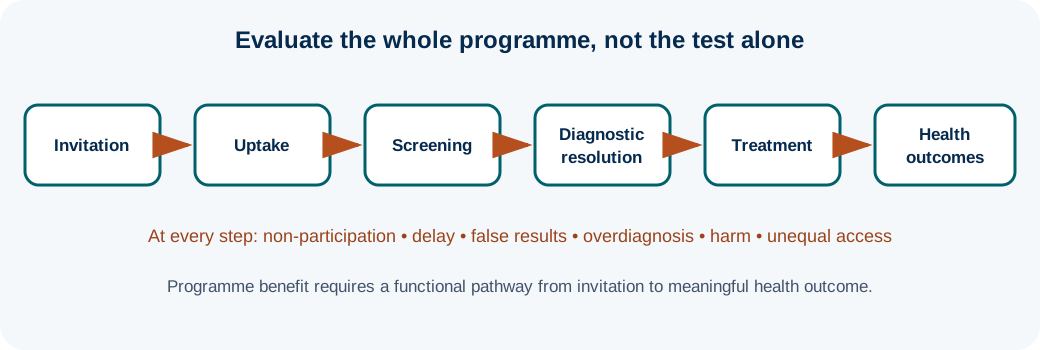
The screening test is one component. A programme includes the entire pathway and governance needed to convert test results into benefit. Programme failure can occur at any step.
Programme effectiveness
The ultimate objective is improvement in meaningful health outcomes, not simply detection of more disease. Depending on the condition, outcomes may include disease-specific mortality, advanced disease, serious complications, quality of life or incidence of preventable disease.
When screening may be justified
Questions before evaluating or implementing screening
- Is the condition an important health problem with a meaningful detectable preclinical phase?
- Is there evidence that earlier intervention improves outcomes compared with later clinical detection?
- Is the screening test sufficiently accurate, acceptable, safe and feasible?
- Is there a defined diagnostic and treatment pathway for positive results?
- Can the health system assure quality, follow-up and equitable access?
- Do expected benefits outweigh physical, psychological and opportunity-cost harms?
- Is the programme affordable and sustainable relative to competing health priorities?
These questions show why a screening policy cannot be based on test accuracy alone.
The screening pathway as the unit of evaluation
Population screening programme
Core structure: Eligible people are identified and invited, screening is delivered, results are acted upon, and programme performance and health outcomes are monitored over time.
Best suited for: Detecting a target condition or risk state earlier when effective intervention can improve meaningful outcomes.
Important limitations: Large numbers may be exposed to false positives and downstream procedures; long follow-up may be needed; overdiagnosis and screening-specific biases complicate interpretation.
A practical pathway is:
- Define the target population.
- Identify and invite eligible people.
- Achieve informed participation.
- Deliver a quality-assured screening test.
- Communicate results.
- Complete diagnostic resolution for screen-positive participants.
- Deliver indicated treatment or prevention.
- Monitor outcomes, interval disease, harms and equity.
- Repeat screening at the appropriate interval where justified.
Each step has a denominator. Programme dashboards should preserve these denominators rather than reporting only the number of cancers or conditions detected.
Measures across the programme
Illustrative screening evaluation framework
illustrativeTable 1. Examples of measures at successive stages
| Stage | Example measure | Why it matters |
|---|---|---|
| Reach | Invitation coverage | Who had an opportunity to participate? |
| Uptake | Participation proportion | Is the programme acceptable and accessible? |
| Test | Positivity and invalid-test rate | Workload and technical performance |
| Resolution | Diagnostic follow-up completion | Are positive results acted upon? |
| Detection | Detection rate and stage | What is being found? |
| Safety | Procedure complications | Downstream harm |
| Interval disease | Disease after negative screen before next round | Potential missed disease |
| Outcome | Advanced disease or mortality | Does the programme improve health? |
| Equity | Stage-specific measures by relevant groups | Are benefits and harms distributed fairly? |
Sensitivity and specificity may be estimated within the programme, but predictive values and workload depend strongly on prevalence and thresholds. Programme measures such as coverage, uptake and diagnostic-resolution rates provide information that test accuracy cannot.
Screening-specific biases
Lead-time bias
If screening detects disease earlier but does not delay death, survival from diagnosis appears longer simply because the clock started earlier. Comparing post-diagnosis survival between screen-detected and clinically detected cases is therefore not a valid demonstration of mortality benefit.
Length bias
Screening is more likely to detect conditions with a longer preclinical detectable phase. Slowly progressing disease can therefore be overrepresented among screen-detected cases, making prognosis appear better even without programme benefit.
Overdiagnosis
Overdiagnosis is detection of a condition that would not have become clinically important during the person’s lifetime. It is not the same as a false-positive test: an overdiagnosed condition may be biologically real but clinically unnecessary to find. Overdiagnosis can lead to overtreatment and long-term labelling.[2]
Healthy participant and attendance effects
People who participate may differ from non-participants in health behaviour, access and baseline risk. Comparisons of attenders with non-attenders can therefore confound programme effects.
Designs for evaluating screening benefit
Randomised trials comparing invitation to screening with usual care can provide strong evidence about programme effects when feasible. Cluster randomisation may be appropriate when implementation occurs at practice or geographic level. Observational evaluations can monitor mature programmes but require careful handling of secular trends, self-selection, changes in treatment and contamination.
The analysis should focus on the effect of the screening strategy or invitation policy, not merely outcomes among people who complied with screening. Intention-to-screen logic preserves the policy contrast analogous to intention-to-treat in trials.
Why incidence can initially rise after screening startsMMed extension
A programme often brings forward diagnoses from a reservoir of previously undetected disease, increasing observed incidence in early rounds. If screening also causes overdiagnosis, cumulative incidence may remain higher even after long follow-up. Interpreting programme data therefore requires time trends, comparator populations and knowledge of screening rounds rather than treating a rise in detection as either benefit or failure by itself.
Planning programme evaluation
Minimum programme-evaluation domains
- Target population, eligibility, interval and invitation method.
- Screening test, threshold, quality-control procedures and invalid-result pathway.
- Diagnostic confirmation and maximum acceptable time to resolution.
- Treatment or prevention pathway after confirmation.
- Benefits and harms to be measured at participant and population levels.
- Follow-up duration sufficient for the principal health outcome.
- Equity indicators across access, uptake, resolution and outcomes.
- Resource use, workforce capacity and downstream procedure burden.
- Governance for monitoring, audit and programme modification.
Ethical and governance considerations
Interface with statistical analysis
The statistical analysis depends on the question. Test accuracy uses diagnostic methods. Uptake and completion require proportions with clear denominators. Mortality or incidence outcomes may use time-to-event methods and clustered analysis when programmes are assigned by site. Repeated screening rounds require careful definition of person-time, interval disease and censoring.
Absolute effects are particularly important for population decisions: cases prevented, deaths prevented, false positives, complications and procedures per number invited or screened. Economic evaluation may combine these outcomes with costs and quality-adjusted life-years, but it should be based on the programme pathway rather than a test in isolation.
Distinguishing programme objectives from surrogate achievements
A screening programme can succeed at process measures while failing at health outcomes. High invitation coverage, rapid testing and increased early-stage detection may demonstrate operational reach, but they do not by themselves show that morbidity or mortality has fallen. Conversely, a programme may produce benefit even if a particular intermediate indicator changes less than expected. The evaluation framework should therefore identify which measures are process indicators, which are intermediate outcomes, and which are patient- or population-important endpoints.
False positives and downstream cascades
The burden of false-positive screening is not captured by the false-positive count alone. It includes repeat testing, invasive procedures, time off work, psychological distress, complications and incidental findings. These harms should be measured over the downstream episode, especially when the confirmatory procedure itself has risk. Programme planners need the number of downstream procedures per important outcome detected, not only the positive predictive value of the initial test.
False reassurance and interval disease
A negative result can delay presentation if participants or clinicians interpret it as a guarantee. Interval cancers or other interval conditions can reflect limited sensitivity, rapid disease biology, inadequate screening interval or incomplete coverage. Their investigation should distinguish true test limitations from programme failures such as delayed reporting or missed follow-up.
Overdiagnosis in more detail
Overdiagnosis cannot usually be identified for an individual patient with certainty. It is principally a population-level phenomenon inferred from excess cumulative diagnosis that does not translate into a corresponding reduction in clinically important disease after sufficient follow-up. Its magnitude depends on disease natural history, competing mortality, thresholds and the duration of observation.[4]
This makes communication difficult. Participants may hear “screening finds disease early” without hearing that some detected abnormalities would never have caused symptoms. Balanced information should avoid both exaggerating and dismissing this uncertainty.
Programme quality assurance
A screening programme requires continuous quality systems rather than one validation study. Quality indicators may include specimen adequacy, reader agreement, laboratory turnaround, referral timeliness, colonoscopy quality, treatment delay and completeness of cancer or outcome ascertainment. Acceptable ranges and escalation procedures should be defined before performance deteriorates. WHO cancer-screening guidance similarly frames evaluation around the complete organised pathway and the balance of population benefit, harm and implementation quality.[5]
Quality assurance across repeated screening rounds
- Maintain a current denominator of the eligible target population.
- Monitor invitation failure, participation and repeated non-response.
- Track invalid tests and repeat-test completion.
- Audit positive-result communication and diagnostic-resolution time.
- Link interval disease and adverse events back to the screening episode.
- Review threshold changes, device changes and laboratory changes as programme modifications.
- Monitor workforce capacity so increasing uptake does not lengthen diagnostic delays.
- Report equity indicators at each pathway stage rather than only overall coverage.
Equity as a programme property
A programme can worsen inequality even while improving average outcomes. Digital invitations may reach some groups poorly; travel distance may reduce diagnostic follow-up; time off work may make confirmatory procedures less accessible. Equity analysis should therefore examine the entire cascade: eligibility capture, invitation, uptake, valid testing, diagnostic resolution, treatment and outcome.
Importantly, equal uptake is not necessarily equal benefit if baseline risk and barriers differ. Equity goals should be specified explicitly, and targeted adaptations should be evaluated rather than assumed beneficial.
Resource and opportunity-cost considerations
Screening uses laboratory, imaging, endoscopy, pathology, counselling and treatment capacity that could be used elsewhere. A programme that identifies more low-risk abnormalities can crowd out care for symptomatic patients. Economic evaluation should therefore consider downstream resource use, not just the price of the screening test. Pilot implementation can test whether the system can absorb expected positive tests before population-scale rollout.
Evaluating repeated rounds and programme maturity
Screening performance changes between the prevalence round and later incidence rounds. The first round can detect a backlog of previously unrecognised disease; later rounds primarily detect conditions developing since the previous screen or missed earlier. Positivity, detection rate, stage distribution and predictive value can therefore differ even when the test and threshold are unchanged. Evaluation should identify the screening round rather than combine all rounds indiscriminately.
Repeated invitations also create a longitudinal participation pattern. Some people attend every round, some intermittently, and some never participate. Programme equity cannot be assessed from one-round uptake alone. Persistent non-participation may concentrate among groups already at higher risk or with poorer access. Linkage across rounds can show cumulative coverage and identify where alternative invitation strategies are needed.
Organised versus opportunistic screening
An organised programme has a defined eligible population, invitation system, quality standards, follow-up pathway and monitoring. Opportunistic screening occurs when tests are offered during healthcare encounters without a population-level call–recall system. Opportunistic activity can be valuable but makes denominators, coverage and equity harder to assess. Researchers should describe which system is being evaluated rather than use the word “programme” for any collection of screening tests.
Stopping, changing or de-implementing screening
Evaluation is not only about starting programmes. Changes in disease epidemiology, vaccination, treatment, test technology or opportunity cost can alter the benefit–harm balance. Governance should define how thresholds, intervals and target ages are reviewed and how a programme can be reduced or stopped when evidence changes. Once screening becomes routine, de-implementation can be politically and clinically difficult, making planned periodic review essential.
Pilot evaluation before population rollout
Before large-scale implementation, a pilot can test invitation systems, laboratory logistics, referral capacity, data linkage and quality indicators. The purpose is not to prove mortality benefit with a small sample; it is to determine whether the programme pathway functions as intended and whether a definitive evaluation is feasible. Pilot findings should include failures and bottlenecks, not only participation rates.
Programme data systems should support longitudinal linkage across screening rounds while protecting privacy. Without linkage, duplicate invitations, repeat positives, interval disease and cumulative harms are difficult to measure. Governance therefore needs to be designed with evaluation from the start rather than added after rollout.
Communication quality is measurable
Programme evaluation should test whether participants understand the meaning of positive, negative and indeterminate results and the next step. Communication failure can cause both unnecessary anxiety and loss to diagnostic follow-up. Measures can include successful notification, time to notification, comprehension, informed-choice indicators and completion of recommended assessment. These outcomes are especially important when screening is delivered digitally or across multiple services.
Screening evaluation should also document programme exclusions and exemptions. People who are medically ineligible, already under surveillance or outside the intended benefit window should not be mixed with non-participants when calculating uptake or coverage. Evaluation matters.
Worked example
From FIT accuracy to colorectal screening effectiveness
The team first maps the proposed programme from registry-based invitation through FIT completion, colonoscopy after a positive result and treatment. They define a primary population-health outcome and prespecify secondary process measures: invitation coverage, uptake, invalid FIT results, positivity, colonoscopy completion, procedure complications and interval cancers.
They recognise that comparing survival of screen-detected cancers with symptom-detected cancers would be strongly affected by lead-time and length bias. Instead, the evaluation compares a screening strategy with an appropriate non-screening or alternative-screening strategy and follows population outcomes over sufficient time.
Equity monitoring is embedded from the start: invitation, uptake and diagnostic resolution are compared across geographic and socioeconomic groups. This prevents a technically efficient programme from being declared successful while widening access gaps.
Suggested protocol or reporting wording
Common mistakes
Knowledge check
Why is a screening programme more than a diagnostic test?
Answer and reasoning
Because benefit depends on the entire pathway: reaching the target population, participation, test quality, confirmation, treatment, follow-up and monitoring. Failure at any stage can prevent an accurate test from improving health outcomes.
What is lead-time bias?
Answer and reasoning
Screening advances the date of diagnosis, so measured survival from diagnosis can increase even when the time of death is unchanged. This makes post-diagnosis survival an unreliable standalone measure of screening benefit.
How does overdiagnosis differ from a false positive?
Answer and reasoning
A false positive is a positive test in someone who does not have the target condition according to the reference definition. Overdiagnosis is detection of a real condition that would never have caused clinically important harm during that person’s lifetime.
A programme has 80% screening uptake but only 50% diagnostic follow-up after positive results. Is high uptake enough to call it effective?
Answer and reasoning
No. Diagnostic resolution is essential to convert screening results into appropriate management. High participation with poor follow-up can create anxiety and missed treatment opportunities without delivering expected benefit.
What comparison best reflects the policy effect of offering screening?
Answer and reasoning
A comparison based on assignment or invitation to the screening strategy, rather than only participants who comply, because compliance is related to other health behaviours and can confound observational comparisons.
Key take-home messages
Key take-home messages
- Evaluate screening as a programme and pathway, not as a test alone.
- Earlier diagnosis is not equivalent to improved health outcome.
- Account for lead-time bias, length bias, overdiagnosis and self-selection.
- Measure uptake, diagnostic resolution, harms, equity and resources as well as detection.
- Base screening policy on evidence that expected programme benefits outweigh harms and opportunity costs.
References
- Wilson JMG, Jungner G. Principles and practice of screening for disease. Geneva: World Health Organization; 1968. Public Health Papers No. 34. https://iris.who.int/handle/10665/37650
- World Health Organization Regional Office for Europe. Screening programmes: a short guide. Increase effectiveness, maximize benefits and minimize harm. Copenhagen: WHO Regional Office for Europe; 2020. https://iris.who.int/handle/10665/330829
- Andermann A, Blancquaert I, Beauchamp S, Déry V. Revisiting Wilson and Jungner in the genomic age: a review of screening criteria over the past 40 years. Bull World Health Organ. 2008;86(4):317–319. https://doi.org/10.2471/BLT.07.050112
- Welch HG, Black WC. Overdiagnosis in cancer. J Natl Cancer Inst. 2010;102(9):605–613. https://doi.org/10.1093/jnci/djq099
- World Health Organization Regional Office for Europe. A short guide to cancer screening: increase effectiveness, maximize benefits and minimize harm. Copenhagen: WHO Regional Office for Europe; 2022. https://iris.who.int/items/951c680c-8785-4370-b0e8-5548b50e147c
These materials support learning and research planning. They require adaptation to the study context and do not replace methodological, statistical, ethical, or regulatory consultation.