
Part 10 · Module 3
Participant Spectrum and Recruitment in Diagnostic Studies
Learn how participant spectrum, intended use and recruitment strategy determine the applicability and often the apparent performance of diagnostic tests.
Learning outcomes
After completing this lecture, you should be able to:
- Define participant spectrum and explain why diagnostic performance can vary across clinically relevant subgroups.
- Distinguish single-gate consecutive recruitment from diagnostic case-control or two-gate sampling.
- Align recruitment setting and eligibility criteria with intended test use and position in the clinical pathway.
- Identify spectrum-related selection mechanisms that threaten applicability or bias accuracy estimates.
- Plan and report participant recruitment transparently using screening logs and flow information.
Overview
A diagnostic test is used on people, not abstract disease states. The participant spectrum includes the distribution of target-condition severity, disease stage, symptoms, comorbidities, alternative diagnoses, age, prior testing and other characteristics that influence how difficult classification is. Changing that spectrum can change observed test performance.[1,2]
Recruitment is therefore part of diagnostic measurement. A test evaluated in unmistakable late disease and completely healthy volunteers has faced an easier problem than the same test used among mildly symptomatic patients with competing diagnoses. The first study may establish technical promise but cannot automatically support the second use.
This lecture explains how to align recruitment with intended use and how to distinguish a clinically representative single-gate design from two-gate or diagnostic case-control sampling.[2,3]
Why this matters
The phrase spectrum bias is sometimes used as though any difference between populations were a bias. More precisely, test performance can legitimately vary across participant characteristics, while biased sampling or exclusions can create estimates that do not apply to the intended population. Researchers should separate these ideas: variation in performance is an empirical property; bias arises when the design or analysis produces a systematically misleading estimate for its target question.[1,4]
Poor recruitment decisions affect both internal validity and applicability. They also affect predictive values because the frequency of the target condition changes across settings.
Key concepts
Intended-use population
The intended-use population is the group in whom the test will inform a decision. It includes more than a diagnosis label. Describe setting, symptoms or risk state, prior tests, referral stage and relevant exclusions.
Participant spectrum
Spectrum includes features that influence test signals or reference classification. Examples include disease severity, lesion size, duration, treatment status, age, renal function, pregnancy, technical image quality and prevalence of mimicking conditions.
Single-gate recruitment
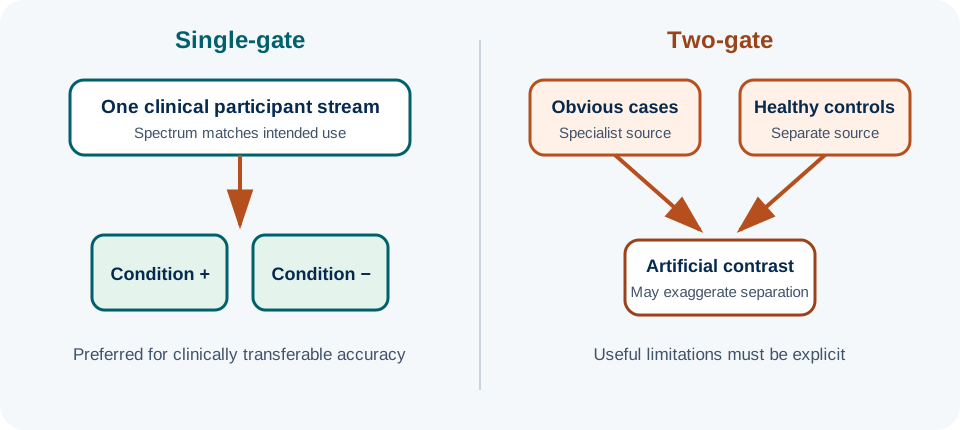
In a single-gate design, participants enter through one set of eligibility criteria before definitive target-condition status is known. Consecutive or random recruitment from this pathway can approximate the clinical spectrum and avoids constructing disease and non-disease groups through separate gates.[2]
Two-gate recruitment
A two-gate design applies different selection mechanisms to target-positive and target-negative groups. Classical diagnostic case-control studies often recruit known cases and separate controls. This can be efficient for early evaluation or rare conditions but may exaggerate accuracy and alter the meaning of predictive values.[2,3]
When to use different recruitment approaches
Choose recruitment according to the development stage
- Early technical or proof-of-concept work: deliberately selected groups may establish whether a signal exists, but limitations must be explicit.
- Clinical diagnostic accuracy: prefer one clinically defined entry pathway with consecutive or random recruitment when feasible.
- Rare target conditions: efficient enrichment may be necessary, but absolute predictive performance and applicability require caution.
- External evaluation: recruit from the population and workflow in which future use is claimed.
- AI or image-based studies: define whether sampling occurs at participant, image, lesion or examination level and avoid leakage between development and evaluation datasets.
The key is not that one approach is universally forbidden. The design must match the claim. A two-gate proof-of-concept study should not be written as though it estimated routine-care performance.
Research question and methodological fit
For the postpartum scenario, the target question concerns women attending routine follow-up. The appropriate source population is therefore women who would realistically be considered for the point-of-care triage strategy, not women selected after their final laboratory status is already known.
Eligibility might be based on previous gestational diabetes, postpartum interval, age range and ability to undergo both procedures. It should not exclude participants merely because their presentation is diagnostically inconvenient unless that exclusion reflects intended use.
Recruitment setting and pathway
Consecutive single-gate recruitment
Core structure: All potentially eligible participants pass through one clinical recruitment gate before reference-standard classification.
Best suited for: Estimating diagnostic performance and applicability in a defined clinical pathway.
Important limitations: Attendance patterns can still create selection; consecutive recruitment requires a reliable screening log; single-centre samples may not represent other settings.
A diagnostic pathway can be mapped as:
- Person becomes eligible for testing.
- Referral or attendance brings the person to the test setting.
- Index test is performed.
- Reference verification occurs.
- Results trigger downstream management.
Recruitment at different steps selects different populations. For example, evaluating a test only among people already referred to a tertiary centre may not represent primary-care triage.
Eligibility and exclusions
Eligibility criteria should preserve the intended spectrum
- Define the clinical entry point before target-condition status is known.
- Include the range of severity and alternative conditions expected in use.
- Justify exclusions based on safety, feasibility or intended use rather than convenience.
- Prespecify whether previously diagnosed or treated participants are eligible.
- Define how repeat attendances and recurrent episodes are handled.
- Record numbers screened, eligible, approached, enrolled and analysed.
Exclusions can change the test challenge. Removing people with comorbidity, borderline results, poor image quality or difficult specimens may improve apparent performance while reducing relevance. If such exclusions reflect the real product specification, report that limitation and the proportion of people to whom the test cannot be applied.
Describing spectrum empirically
Illustrative participant-spectrum table
illustrativeTable 1. Characteristics that help readers judge applicability
| Domain | Example information to report |
|---|---|
| Clinical stage | Routine follow-up, referred, specialist assessment |
| Target condition | Frequency and severity distribution |
| Alternatives | Common competing conditions or normal variants |
| Prior testing | None, screening positive, previously imaged, etc. |
| Demography | Age and other characteristics relevant to test performance |
| Technical factors | Device, specimen quality, reader expertise |
Note: Report variables that plausibly affect performance rather than a generic demographic checklist.
Bias, applicability and quality assurance
Other selection problems include excluding indeterminate tests after enrolment, enrolling only participants who complete the reference standard, selecting on prior test results, and restricting to a centre with unusually specialised expertise.
Appraising participant selection and applicability
- Was recruitment based on a clinically defined entry point rather than known final disease status?
- Were eligible participants enrolled consecutively or randomly, or was another method justified?
- Were exclusions likely to remove diagnostically difficult participants?
- Does the setting match the claimed role of the index test?
- Are disease severity and competing diagnoses sufficiently described?
- Are non-enrolment and missing verification visible in participant flow?
QUADAS-2 separates risk of bias in participant selection from concerns about applicability. A study can be internally well conducted yet poorly applicable to another population, or it can recruit the right population but introduce bias through exclusions after testing.[1]
Ethical and governance considerations
Interface with statistical analysis
Sensitivity and specificity can vary with spectrum. Predictive values also vary with target-condition prevalence, so values from enriched samples should not be presented as estimates for routine practice. Subgroup analyses can explore heterogeneity, but they should be prespecified and adequately supported rather than used to search for favourable performance.
For multi-centre studies, report performance by clinically important settings where feasible and model clustering when appropriate. In AI studies, strict separation of development, tuning and evaluation participants is essential; multiple images from the same person should not be split across datasets in a way that permits information leakage.
Transportability is a design question before it is a modelling questionMMed extension
External performance depends on differences in case mix, measurement processes, prevalence, workflow and referral mechanisms. Statistical recalibration cannot repair a study that never sampled the intended diagnostic challenge. Before asking whether a model or test transports, compare the source and target populations and identify which mechanisms are expected to change.
Spectrum dimensions that deserve deliberate attention
The most relevant spectrum variables differ by test. For imaging, lesion size, image quality and prior treatment may matter. For biomarkers, renal function, inflammation, pregnancy, medications and specimen timing may alter distributions. For symptom-based scores, disease duration and competing diagnoses may be crucial. Researchers should identify plausible effect modifiers before recruitment rather than collect a generic list of demographic variables and hope that subgroup analysis later explains heterogeneity.
Referral filtering
A patient arriving at a tertiary centre has already passed through earlier clinical filters. Referral can depend on symptoms, prior test results, clinician concern and access. Consequently, prevalence and disease severity may be higher than in primary care. A test developed or validated after this filtering may not transport backward to an earlier pathway stage, even if the same diagnostic label is used.
Prior testing and treatment
Previous testing can alter spectrum by preferentially referring positive or indeterminate patients. Treatment before the index test can change the biological signal and may also change the reference standard. Eligibility should state whether previously tested or treated participants are included and how these states align with intended use.
Technical spectrum
Applicability also includes operators and equipment. A test interpreted by expert subspecialists using research-grade equipment may not represent general clinics. Multi-reader and multi-centre studies can deliberately sample variation in expertise and devices, but the design should distinguish variability that is part of intended practice from preventable protocol inconsistency.
Recruitment documentation as a validity tool
A screening log is more than an administrative document. It can reveal that recruitment occurred only on selected days, that certain staff enrolled more complex patients, or that verification failure was concentrated in older participants. At minimum, preserve counts of potentially eligible, eligible, approached, consented, index-tested, verified and analysed participants with reasons for loss at each step.
When privacy rules prevent retaining detailed data on non-participants, the protocol should still seek aggregate information needed to judge selection, where ethically and legally permissible. Reporting only the characteristics of participants cannot show how participants differ from the source population.
Enrichment without misleading claims
Sometimes enrichment is scientifically reasonable. A study may deliberately oversample a rare disease to obtain enough target-positive participants for a preliminary estimate. In that case, state the sampling design, avoid routine-care predictive values, and interpret accuracy conditional on the enriched spectrum. Later evaluation in a representative clinical pathway remains necessary before broad implementation claims.
Planning multicentre recruitment
Multicentre diagnostic studies can improve generalisability only if centre variation is understood. Each site should use common eligibility and reference procedures while preserving data on referral source, equipment, operator expertise and target-condition prevalence. A central manual can standardise conduct, but forcing every centre to mimic a specialist reference centre may remove the very variation the study needs to evaluate.
Recruitment targets should not be allocated solely for convenience. If one high-volume tertiary centre contributes most target-positive cases and community sites contribute most target-negative participants, centre and disease status become entangled. The pooled estimate may then reflect site differences. Monitor recruitment by centre and target status, and interpret heterogeneity before presenting a single summary as universal.
Participant characteristics should be chosen because they help explain applicability or performance, not because reporting templates demand them. For example, disease severity, prior treatment or image quality may be more relevant to a test than many generic descriptors. State the rationale for subgroup variables before examining performance.
Recruitment period can change spectrum
Season, outbreaks, referral policy and service disruptions can change who attends. Recruitment dates and major pathway changes should therefore be reported. If a diagnostic study spans a policy transition or device rollout, consider whether participant spectrum differs before and after the change. A long recruitment period is not automatically more representative if the underlying clinical pathway is unstable.
For rare conditions, investigators may need several centres or a longer period rather than creating an artificial healthy-control group. This usually improves clinical relevance while preserving enough target-positive participants for useful precision.
Applicability should be stated as a boundary
At the end of the study, describe where the findings are most likely to apply and where uncertainty remains. A precise boundary—such as routine postpartum clinics with similar referral and laboratory pathways—is more useful than a generic claim that the sample was representative. Transferability of accuracy estimates depends on whether the new setting reproduces the clinical spectrum, test execution and diagnostic pathway that generated the original estimates.[5]
Worked example
Choosing between fast recruitment and clinically relevant recruitment
The research team rejects a two-gate plan that would recruit known dysglycaemia cases from endocrinology and healthy hospital staff as controls. Instead, all women attending defined postpartum clinics after gestational diabetes are screened consecutively during the study period.
The screening log includes women who decline, cannot complete the point-of-care test, or cannot complete the laboratory reference procedure. Eligibility is determined before reference results are available. Baseline reporting describes postpartum interval, prior pregnancy treatment, current symptoms, comorbidity and the distribution of reference classifications.
This approach may produce less impressive headline accuracy than an extreme-group study, but it more directly answers whether the test can distinguish the target condition in the population where it is intended to operate.
Suggested protocol or reporting wording
Common mistakes
Knowledge check
What distinguishes a single-gate diagnostic design from a two-gate design?
Answer and reasoning
A single-gate design applies one clinical entry pathway before final target-condition status is known. A two-gate design selects target-positive and target-negative groups through different mechanisms, often after status is known.
Why can severe cases plus healthy volunteers exaggerate apparent accuracy?
Answer and reasoning
They create greater separation between groups than the real diagnostic pathway, where mild disease and competing conditions make classification more difficult.
Is variation in test performance across settings automatically bias?
Answer and reasoning
No. Genuine performance variation can occur because populations and workflows differ. Bias refers to systematic distortion of the estimate for a defined target question. Applicability concerns whether the study estimate transfers to another target setting.
Why should technically failed tests remain visible in reporting?
Answer and reasoning
Failure may occur preferentially in certain participants and is part of real-world test usability. Removing failed cases can overstate both performance and feasibility.
Key take-home messages
Key take-home messages
- Define recruitment from the intended clinical pathway before final disease status is known.
- Participant spectrum can materially change observed test performance.
- Use two-gate designs cautiously and align claims with their developmental purpose.
- Report exclusions, non-enrolment, technical failure and verification flow transparently.
- Separate internal validity from applicability to the population where the test will be used.
References
- Whiting PF, Rutjes AWS, Westwood ME, et al. QUADAS-2: a revised tool for the quality assessment of diagnostic accuracy studies. Ann Intern Med. 2011;155(8):529–536. https://doi.org/10.7326/0003-4819-155-8-201110180-00009
- Rutjes AWS, Reitsma JB, Vandenbroucke JP, Glas AS, Bossuyt PMM. Case-control and two-gate designs in diagnostic accuracy studies. Clin Chem. 2005;51(8):1335–1341. https://doi.org/10.1373/clinchem.2005.048595
- Lijmer JG, Mol BW, Heisterkamp S, et al. Empirical evidence of design-related bias in studies of diagnostic tests. JAMA. 1999;282(11):1061–1066. https://doi.org/10.1001/jama.282.11.1061
- Rutjes AWS, Reitsma JB, Di Nisio M, Smidt N, van Rijn JC, Bossuyt PMM. Evidence of bias and variation in diagnostic accuracy studies. CMAJ. 2006;174(4):469–476. https://doi.org/10.1503/cmaj.050090
- Irwig L, Bossuyt P, Glasziou P, Gatsonis C, Lijmer J. Designing studies to ensure that estimates of test accuracy are transferable. BMJ. 2002;324(7338):669–671. https://doi.org/10.1136/bmj.324.7338.669
These materials support learning and research planning. They require adaptation to the study context and do not replace methodological, statistical, ethical, or regulatory consultation.