
Part 9 · Module 3
Random Sequence Generation and Allocation Concealment
Generate unpredictable random sequences and conceal allocation so recruitment cannot be influenced by upcoming assignments.
Learning outcomes
After completing this lecture, you should be able to:
- Distinguish random sequence generation from allocation concealment.
- Compare simple, blocked, stratified and minimisation procedures.
- Select secure implementation methods.
- Recognise predictable or manipulable allocation systems.
- Document roles, access controls and audit trails.
Overview
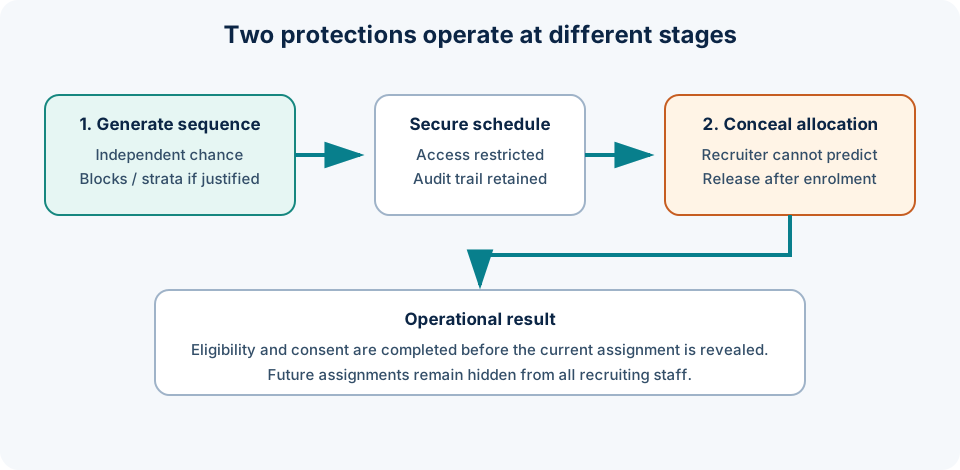
Random sequence generation determines the order of assignments; allocation concealment prevents recruiters and participants from knowing the next assignment before enrolment. These are separate safeguards. A mathematically random sequence can still produce biased groups if its implementation is visible or manipulable.
The study question, design, participant pathway, measurements and analysis must be specified as one coherent system. A recognised design label is useful only when the operational details preserve the comparison or prediction that the study is intended to support.[1–3]
Why this matters
Knowledge of an upcoming assignment can influence whether a borderline participant is recruited, when enrolment occurs or which diagnosis is recorded. Such selection bias destroys the independent assignment mechanism and is not repaired by blinding outcome assessors later.
Core concepts
Simple randomisation uses independent chance
Each assignment follows a fixed probability. It is unpredictable but can produce chance imbalance, especially in small trials.
Blocking controls local balance
Permuted blocks maintain approximate balance during enrolment. Fixed small blocks become predictable if prior assignments are known. Random block sizes and secure concealment reduce guessing.
Stratification targets a few prognostic factors
Separate schedules within centre or major baseline categories can improve balance. Too many strata create sparse cells and operational complexity. Analysis should account for stratification factors.
Minimisation balances several factors adaptively
The next assignment depends partly on current imbalance, usually with a random element. It requires central implementation and clear reporting; deterministic minimisation may be predictable.
Concealment is an operational system
Central web or telephone services provide strong concealment when access is controlled. Sequentially numbered opaque sealed envelopes can work only with tamper-evident preparation, strict ordering, audit and no access to the schedule. Open lists and shared spreadsheets are unacceptable.
When to use this approach
Designing the allocation system
- How large is the trial and how much imbalance is tolerable?
- Which prognostic factors truly warrant stratification?
- Who generates, stores and releases assignments?
- Can site staff infer blocks or access future allocations?
- What downtime, correction and audit procedures are needed?
Working through the key design decisions
Decision 1: How large is the trial and how much imbalance is tolerable?. This point should be resolved before recruitment, extraction or assignment begins. For random sequence generation and allocation concealment, the protocol should state the operational rule, who applies it, when it is applied and what source documents demonstrate compliance. The investigators should also consider how a different choice would change the eligible population, comparison, timing, measurement or interpretation. A pilot review of realistic records or participant pathways can reveal ambiguities before they become irreversible exclusions or post hoc analytical choices. The decision should be reviewed across sites and subgroups because a rule that works in one clinic may operate differently where referral, resources or disease spectrum differ. Any permitted exception should be explicit, dated and reported with its frequency and likely consequence.
Decision 2: Which prognostic factors truly warrant stratification?. This point should be resolved before recruitment, extraction or assignment begins. For random sequence generation and allocation concealment, the protocol should state the operational rule, who applies it, when it is applied and what source documents demonstrate compliance. The investigators should also consider how a different choice would change the eligible population, comparison, timing, measurement or interpretation. A pilot review of realistic records or participant pathways can reveal ambiguities before they become irreversible exclusions or post hoc analytical choices. The decision should be reviewed across sites and subgroups because a rule that works in one clinic may operate differently where referral, resources or disease spectrum differ. Any permitted exception should be explicit, dated and reported with its frequency and likely consequence.
Decision 3: Who generates, stores and releases assignments?. This point should be resolved before recruitment, extraction or assignment begins. For random sequence generation and allocation concealment, the protocol should state the operational rule, who applies it, when it is applied and what source documents demonstrate compliance. The investigators should also consider how a different choice would change the eligible population, comparison, timing, measurement or interpretation. A pilot review of realistic records or participant pathways can reveal ambiguities before they become irreversible exclusions or post hoc analytical choices. The decision should be reviewed across sites and subgroups because a rule that works in one clinic may operate differently where referral, resources or disease spectrum differ. Any permitted exception should be explicit, dated and reported with its frequency and likely consequence.
Decision 4: Can site staff infer blocks or access future allocations?. This point should be resolved before recruitment, extraction or assignment begins. For random sequence generation and allocation concealment, the protocol should state the operational rule, who applies it, when it is applied and what source documents demonstrate compliance. The investigators should also consider how a different choice would change the eligible population, comparison, timing, measurement or interpretation. A pilot review of realistic records or participant pathways can reveal ambiguities before they become irreversible exclusions or post hoc analytical choices. The decision should be reviewed across sites and subgroups because a rule that works in one clinic may operate differently where referral, resources or disease spectrum differ. Any permitted exception should be explicit, dated and reported with its frequency and likely consequence.
Decision 5: What downtime, correction and audit procedures are needed?. This point should be resolved before recruitment, extraction or assignment begins. For random sequence generation and allocation concealment, the protocol should state the operational rule, who applies it, when it is applied and what source documents demonstrate compliance. The investigators should also consider how a different choice would change the eligible population, comparison, timing, measurement or interpretation. A pilot review of realistic records or participant pathways can reveal ambiguities before they become irreversible exclusions or post hoc analytical choices. The decision should be reviewed across sites and subgroups because a rule that works in one clinic may operate differently where referral, resources or disease spectrum differ. Any permitted exception should be explicit, dated and reported with its frequency and likely consequence.
The approach should be chosen because its structure answers the research question, not because the available dataset happens to resemble a familiar table. The investigator should state the target population, time origin, comparison, outcome and intended measure before collecting or extracting data.
Design and participant pathway
Random allocation system
Core structure: Generate assignments using an unpredictable chance method and reveal each allocation only after irreversible enrolment.
Best suited for: Randomised trials requiring protection against selection during recruitment.
Principal threats: Alternation, open schedules, fixed predictable blocks, envelope tampering, premature release and unaudited manual overrides.
Roles should be separated where feasible: an independent statistician generates the schedule; a secure service stores it; authorised staff request allocation only after required fields are complete. The system should timestamp eligibility confirmation, consent, request and assignment. Corrections should never involve deleting an inconvenient allocation and re-randomising.
Protocol specification
Decisions to prespecify
- Name the sequence algorithm and allocation ratio.
- State block sizes or whether they vary, without exposing operational details to recruiters.
- List stratification factors and their categories.
- Describe the concealment platform and access roles.
- Define enrolment irreversibility and handling of erroneous randomisation.
- Preserve allocation logs and system validation records.
Protocol item 1: Name the sequence algorithm and allocation ratio. This item requires a reproducible definition rather than a broad intention. The study manual should identify the responsible role, data field or procedural record, permissible time window, quality check and response to deviations. Where judgement is unavoidable, assessors should receive examples and escalation rules, and a sample of decisions should be reviewed for consistency. The analysis dataset should retain enough provenance to distinguish planned exclusions, measurement failure, participant withdrawal and genuinely absent information.
Protocol item 2: State block sizes or whether they vary, without exposing operational details to recruiters. This item requires a reproducible definition rather than a broad intention. The study manual should identify the responsible role, data field or procedural record, permissible time window, quality check and response to deviations. Where judgement is unavoidable, assessors should receive examples and escalation rules, and a sample of decisions should be reviewed for consistency. The analysis dataset should retain enough provenance to distinguish planned exclusions, measurement failure, participant withdrawal and genuinely absent information.
Protocol item 3: List stratification factors and their categories. This item requires a reproducible definition rather than a broad intention. The study manual should identify the responsible role, data field or procedural record, permissible time window, quality check and response to deviations. Where judgement is unavoidable, assessors should receive examples and escalation rules, and a sample of decisions should be reviewed for consistency. The analysis dataset should retain enough provenance to distinguish planned exclusions, measurement failure, participant withdrawal and genuinely absent information.
Protocol item 4: Describe the concealment platform and access roles. This item requires a reproducible definition rather than a broad intention. The study manual should identify the responsible role, data field or procedural record, permissible time window, quality check and response to deviations. Where judgement is unavoidable, assessors should receive examples and escalation rules, and a sample of decisions should be reviewed for consistency. The analysis dataset should retain enough provenance to distinguish planned exclusions, measurement failure, participant withdrawal and genuinely absent information.
Protocol item 5: Define enrolment irreversibility and handling of erroneous randomisation. This item requires a reproducible definition rather than a broad intention. The study manual should identify the responsible role, data field or procedural record, permissible time window, quality check and response to deviations. Where judgement is unavoidable, assessors should receive examples and escalation rules, and a sample of decisions should be reviewed for consistency. The analysis dataset should retain enough provenance to distinguish planned exclusions, measurement failure, participant withdrawal and genuinely absent information.
Protocol item 6: Preserve allocation logs and system validation records. This item requires a reproducible definition rather than a broad intention. The study manual should identify the responsible role, data field or procedural record, permissible time window, quality check and response to deviations. Where judgement is unavoidable, assessors should receive examples and escalation rules, and a sample of decisions should be reviewed for consistency. The analysis dataset should retain enough provenance to distinguish planned exclusions, measurement failure, participant withdrawal and genuinely absent information.
A protocol should make these decisions before outcome-dependent choices become tempting. It should also distinguish the design population from the analysis population, document exclusions after enrolment or sampling, and explain how missing or indeterminate observations will be handled. Any deviation should be dated, justified and retained in the study record.[2–4]
Measurements, timing and analysis interface
Randomisation data should include participant identifier, site, stratification values, timestamp, assigned group, requester and any system message. Staff training should distinguish screening identifiers from randomised identifiers. The analysis should use the assignment issued by the validated system, even if treatment delivery was delayed or mistaken.
The analysis should reflect how participants or clusters entered the study, how observations are related, and how the effect or performance measure was defined. Statistical adjustment cannot repair a comparison that was invalid at the design stage. Conversely, a sound design can still be undermined by an analysis that ignores matching, clustering, censoring, sampling fractions or prespecified thresholds.
Worked example
Choosing a central allocation service
The trial uses a validated web service with centre and prior diabetes treatment as stratification factors and randomly varying block sizes. The statistician uploads an encrypted schedule and has no recruitment role. Allocation is released only after the recruiter confirms consent and baseline fields. Every request and correction is logged; downtime uses a separate central telephone process rather than local envelopes.
The example should be interpreted in the population and time frame created by the design. The numerical result does not by itself establish causation, transportability or clinical usefulness; those conclusions require additional assumptions and evidence.
Appraising methodological quality
Questions for critical appraisal
- Sequence: Was a genuine chance process used?
- Predictability: Could block or minimisation rules be guessed?
- Concealment: Was assignment inaccessible before enrolment?
- Roles: Were generation, recruitment and release appropriately separated?
- Audit: Can erroneous, duplicate or overridden assignments be reconstructed?
A reporting guideline can improve transparency, but it is not a substitute for sound design. Appraisal should ask whether the reported methods could generate an unbiased, clinically meaningful answer—not merely whether every checklist item has been mentioned.[3–6]
Suggested reporting
Reporting should identify the design in the title or abstract when appropriate, describe the source and flow of participants, define all key variables, report missing and indeterminate observations, and present estimates with uncertainty. The direction and denominator of every comparison must be explicit.
Randomisation-based inferenceMMed extension
The randomisation distribution can support inference that conditions on the actual assignment mechanism. Complex restricted schemes require the analysis and simulation to reflect the method used. Randomisation does not justify ignoring clustering, repeated outcomes or missingness.
Common mistakes
Knowledge check
Is alternation random?
Answer and reasoning
No. It is predictable and recruiters can influence who receives each assignment.
Why use varying block sizes?
Answer and reasoning
They preserve local balance while making the next assignment harder to infer.
What must happen before allocation is released?
Answer and reasoning
Eligibility and consent should be confirmed and enrolment made irreversible according to the protocol.
Who should access the full schedule?
Answer and reasoning
Only authorised independent personnel or the secure system; recruiters should see only the current released allocation.
Key take-home messages
Key take-home messages
- Generate assignments by chance.
- Conceal them until enrolment is irreversible.
- Use few, justified stratification factors.
- Protect schedules through access control and audit.
- Analyse according to the issued allocation.
References
- Schulz KF, Grimes DA. Generation of allocation sequences in randomised trials: chance, not choice. Lancet. 2002;359(9305):515–519. https://doi.org/10.1016/S0140-6736(02)07683-3
- Schulz KF, Grimes DA. Allocation concealment in randomised trials: defending against deciphering. Lancet. 2002;359(9306):614–618. https://doi.org/10.1016/S0140-6736(02)07750-4
- Hopewell S, Chan AW, Collins GS, et al. CONSORT 2025 statement: updated guideline for reporting randomised trials. BMJ. 2025;389:e081123. https://doi.org/10.1136/bmj-2024-081123
- Butcher NJ, Monsour A, Mew EJ, et al. SPIRIT 2025 statement: updated guideline for protocols of randomised trials. BMJ. 2025;389:e081477. https://doi.org/10.1136/bmj-2024-081477
- International Council for Harmonisation. ICH harmonised guideline E6(R3): Guideline for Good Clinical Practice. Geneva: ICH; 2025. https://database.ich.org/sites/default/files/ICH_E6%28R3%29_Step4_FinalGuideline_2025_0106.pdf
- Berger VW, Bears JD. When can a clinical trial be called “randomized”? Vaccine. 2003;21(5-6):468–472. https://doi.org/10.1016/S0264-410X(02)00478-7
These materials support learning and research planning. They require adaptation to the study context and do not replace methodological, statistical, ethical, or regulatory consultation.