
Part 12 · Module 5
Embedded and Multiphase Designs
Design advanced mixed-methods studies in which one strand is nested within a larger study or multiple linked phases address a programme of research.
Learning outcomes
After completing this lecture, you should be able to:
- Distinguish embedded mixed-methods designs from convergent and sequential core designs.
- Explain how qualitative or quantitative components can be nested within trials, cohorts and implementation studies.
- Design multiphase mixed-methods programmes with explicit links between development, evaluation and implementation phases.
- Identify timing, sampling, contamination and interpretive challenges in intervention-associated mixed-methods research.
- Develop integrated conclusions that separate intervention effectiveness, implementation, mechanism and context.
Overview
Some mixed-methods questions cannot be represented adequately by one of the three core designs alone. An intervention trial may have a dominant quantitative effectiveness question but also require qualitative work to understand implementation or participant experience. A service-improvement programme may move through qualitative development, pilot testing, a quantitative evaluation and later implementation research over several years. These structures are commonly described using embedded and multiphase mixed-methods designs.[1]
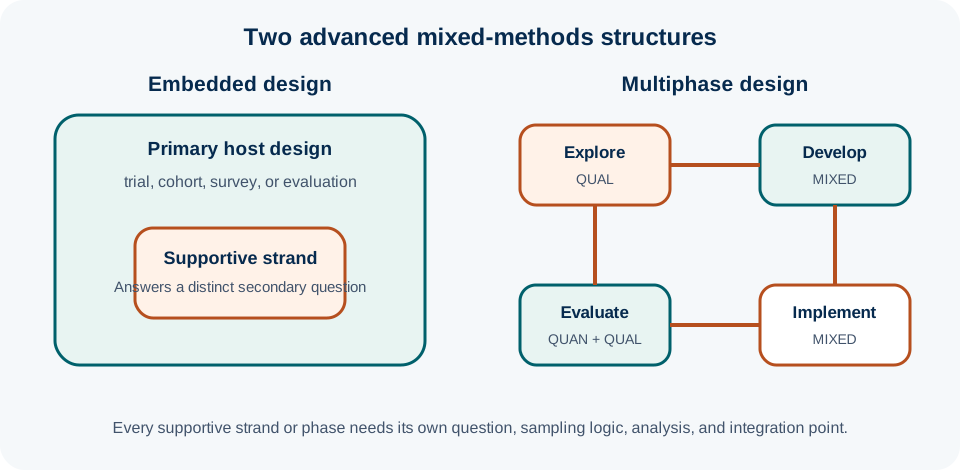
In an embedded design, one methodological strand is nested within a larger design that has a clear primary purpose. For example, qualitative interviews may be embedded within a randomised controlled trial to understand adherence, acceptability or mechanisms of impact. The embedded strand is methodologically important but does not redefine the trial’s primary estimand.
In a multiphase design, multiple linked qualitative, quantitative and mixed-methods phases address a broader programme of research. The sequence may move from problem exploration to intervention development, feasibility, effectiveness and implementation. Integration occurs not only within individual phases but also across phases as findings are carried forward into later decisions.[1,2]
Why this matters
Health interventions often fail or succeed for reasons not visible in the primary outcome alone. A trial can show that an intervention did not improve the outcome, but that result can represent very different realities: the intervention theory may be wrong, implementation may be weak, participants may not receive the intended dose, contextual barriers may prevent uptake, or the intervention may benefit only some settings.
Process evaluation can investigate implementation, mechanisms of impact and context, and mixed methods are often valuable for this purpose.[2,3] Contemporary guidance for complex interventions also emphasises context, programme theory, stakeholder perspectives and the interaction between intervention and system rather than focusing only on a single effectiveness estimate.[4]
At the same time, embedding extra methods can create new threats. Interviews can unblind staff, process measures can alter behaviour, qualitative sampling can become opportunistic, and exploratory explanations can be overinterpreted as proof of mechanism. The design therefore needs a clear hierarchy of questions and a plan for how component findings will interact.
Key concepts
Embedded designs have a primary host design
The host design determines the main study structure. Examples include:
- a randomised controlled trial with an embedded qualitative process evaluation;
- a cohort study with interviews nested among participants who experience contrasting trajectories;
- a diagnostic study with qualitative interviews examining test acceptability;
- an implementation study with a dominant quantitative outcome and embedded organisational case studies; or
- a qualitative case study with an embedded structured survey used for descriptive context.
The embedded component should answer a question that is related to, but not identical with, the host study’s primary question.
Timing can vary
The embedded strand may occur:
- before the main intervention study, to refine recruitment or delivery;
- during the study, to assess implementation, fidelity, exposure or context;
- after primary outcomes are known, to explain patterns; or
- across several time points.
Timing affects both what can be learned and the risk of influencing the host study. Interviews with intervention staff during a trial may prompt changes in delivery, which could be desirable in an adaptive implementation project but problematic in a tightly controlled efficacy trial.
Multiphase designs follow programme logic
A multiphase programme may look like:
qualitative exploration → intervention co-development → feasibility study → definitive evaluation + embedded process evaluation → implementation study → scale-up evaluation
Not every phase must use both qualitative and quantitative methods. What makes the programme mixed methods is the deliberate combination and integration of different forms of evidence across the overall research trajectory.[1]
Process evaluation is not synonymous with qualitative research
Process evaluations may combine quantitative fidelity indicators, exposure measures, recruitment data, routinely collected service data, observations, interviews and documentary analysis.[3] The methods should follow specific process questions. Qualitative data are valuable for understanding meaning and context, while quantitative process measures can estimate reach, dose, fidelity or variation between sites.
When to use this approach
Choose an embedded or multiphase structure when one mixed-methods design is not enough
Use an embedded design when a dominant study has a clear primary purpose but a secondary methodological strand is needed to understand process, experience, mechanism or context.
Use a multiphase design when the research problem unfolds across linked stages such as development, feasibility, evaluation and implementation, and findings from earlier phases materially shape later phases.
Avoid creating a multiphase label merely because a project has several work packages. The phases must form a coherent programme with explicit transfer of evidence and decisions.
Research question and methodological fit
For the postpartum intervention trial, separate the questions explicitly:
Effectiveness question: Does the intervention increase postpartum glucose-test completion compared with usual care?
Implementation question: To what extent are the intervention components delivered and received as intended across clinics?
Mechanism question: How do reminders, referral clarity and local testing options influence women’s ability and motivation to complete testing?
Context question: Which organisational and social conditions enable or constrain implementation?
Integration question: How do implementation, mechanism and contextual findings help interpret variation in the estimated intervention effect across clinics?
These are related but not interchangeable. An observed association between fidelity and outcome, for example, may be confounded by clinic characteristics and should not automatically be interpreted as a causal mediation effect.
Design, setting and study population
Embedded mixed-methods intervention design
Core structure: A dominant intervention or observational study contains a secondary qualitative or quantitative strand that addresses a complementary question. Integration links the embedded findings to interpretation of the host study.
Best suited for: Process evaluation, acceptability research, mechanism exploration, implementation studies and contextual interpretation of clinical or service outcomes.
Important limitations: Potential contamination of the host study, unequal methodological attention between strands, unclear timing, selective sampling after outcomes are known and overinterpretation of mechanism.
Multiphase mixed-methods programme
Core structure: Multiple linked studies or phases use qualitative, quantitative and mixed-methods approaches across a programme of development, evaluation and implementation.
Best suited for: Complex interventions, long-term implementation programmes, instrument or intervention development followed by evaluation, and health-system change involving several decision stages.
Important limitations: Methodological drift over time, changing populations and contexts, loss of traceability between phases, resource demands and difficulty maintaining one coherent programme theory.
Sampling and recruitment
Sampling should be justified separately for the host and embedded components.
In a cluster trial, the effectiveness analysis may include all eligible participants from participating clinics. The process evaluation might purposively sample clinics with variation in size, baseline performance, implementation fidelity and outcome patterns, then sample staff and participants within those clinics.
This creates a multilevel sampling structure. The team should specify whether integration will occur at participant, clinic or programme level. Interviewing 30 women from six clinics does not support claims about all trial participants or every clinic.
A useful process-evaluation sampling matrix can include:
| Level | Quantitative sampling | Qualitative sampling | Integration purpose |
|---|---|---|---|
| clinic | all trial clusters | contrasting high/low implementation clinics | explain site variation |
| staff | delivery logs for all relevant staff | purposive roles and experience | understand implementation processes |
| participant | trial outcome population | contrasting users/non-users | explain uptake and acceptability |
The table is illustrative.
Specify sampling across the host and embedded components
- Define the unit of randomisation or primary observation in the host study.
- Define the sampling frame for each embedded component.
- State whether sampling will use intervention arm, outcome, fidelity or context information.
- Include disconfirming or low-implementation cases where informative.
- Describe the level at which integrated conclusions will be made.
- Protect the host study from recruitment or assessment procedures that could alter its primary outcome.
Variables, constructs and measurements
Embedded process evaluations often measure concepts such as reach, fidelity, dose, adaptation, acceptability, mechanisms of impact and context.[3] These concepts require operational definitions.
For the postpartum intervention:
- reach: proportion of eligible women exposed to the intervention pathway;
- fidelity: whether discharge checklist, reminder and local-testing option were delivered according to protocol;
- dose or exposure: number and timing of reminders received;
- acceptability: women’s and staff members’ evaluations of the intervention;
- context: staffing, clinic opening hours, laboratory capacity, transport patterns and competing service changes; and
- outcome: actual completion of postpartum glucose testing.
Measurement should be guided by programme theory. Collecting every available implementation metric creates noise rather than explanatory value.
Procedures and data collection
Embedded designs benefit from an explicit process-evaluation logic model linking intervention components, implementation, mechanisms, context and outcomes.[3,4]
Data collection should be timed to answer those links. For example:
- delivery logs collected continuously;
- brief participant exposure measures collected close to intervention delivery;
- staff interviews conducted after sufficient implementation experience;
- observation conducted at selected sites;
- contextual changes documented throughout the trial; and
- outcome data analysed according to the host study protocol.
For multiphase programmes, the team should maintain a cross-phase decision log recording which finding led to which modification. Without this, later phases can appear disconnected from the programme that preceded them.
Maintaining coherence across intervention and implementation questions
Embedded and multiphase studies often involve different disciplinary teams, data systems and timelines. The programme should therefore maintain a cross-component question map that links each research question to its data source, sampling unit, timing, analysis and intended integration point. This prevents process measures from being collected simply because they are available and helps distinguish questions about intervention effectiveness from questions about implementation. Mixed-method implementation research has long emphasised the value of combining methods to understand implementation processes and stakeholder perspectives alongside quantitative outcomes.[5]
The host study and embedded component may also have different stopping rules. A trial follows its prespecified recruitment and follow-up plan, whereas qualitative sampling may evolve in response to emerging information. These differences are compatible if they are planned and if the qualitative component retains methodological independence. Early qualitative findings should not trigger unplanned changes to trial delivery unless the protocol permits adaptation or a safety or ethical issue requires action.
At programme level, a multiphase design should document decision thresholds between phases. A feasibility phase might specify criteria for recruitment, retention, fidelity and acceptability before progression to a definitive trial. A development phase might specify what evidence is required before an intervention component is fixed. Describing these links makes the multiphase design more than a retrospective story about how several studies happened to follow one another. Early health-research guidance on mixed-methods design likewise stresses explicit attention to sequence, priority and integration rather than method accumulation.[6]
Bias, validity and quality assurance
Other challenges include:
- contamination: process-evaluation activities expose control sites to intervention content;
- post-outcome cherry-picking: qualitative cases are selected only after seeing desirable trial results;
- fidelity-outcome confounding: high-performing sites may also implement better for reasons unrelated to the intervention;
- methodological subordination: the embedded qualitative component receives too little sampling, analysis or expertise because it is labelled “secondary”; and
- integration asymmetry: process findings are used only to explain null results but ignored when the trial is positive.
Appraise an embedded mixed-methods study
- Is the host study design appropriate for its primary question?
- Does the embedded component have a distinct and justified purpose?
- Are timing and sampling of the embedded component specified?
- Could the embedded procedures alter the host study?
- Are implementation, mechanism and context distinguished?
- Does integration genuinely inform interpretation of the host outcome?
- Are contradictory process and outcome findings retained and examined?
Ethical and governance considerations
Participants may also be enrolled in several components of the programme. Consent materials should clarify which elements are optional and whether declining an interview affects participation in the host trial. Data-linkage permissions should be proportionate to the intended integration.
Interface with statistical analysis
The host study’s statistical analysis follows its prespecified estimand and design. In a cluster-randomised trial, clustering must be addressed appropriately. Embedded process measures can be described quantitatively and may be explored in relation to outcomes, but post-randomisation variables require careful causal interpretation.
For example, analysing outcome by “received all reminders” can introduce selection bias because receipt may depend on post-randomisation behaviour or system functioning. A process evaluation can still describe this pattern, but it should not automatically call the comparison an intervention effect.
Where the research question genuinely concerns mediation, causal mediation analysis requires its own assumptions and design considerations. Qualitative evidence can illuminate plausible mechanisms but does not remove those assumptions.
Mechanism is not the same as statistical mediationMMed extension
A process evaluation may conclude that participants describe reminders as helping them organise testing. This is evidence about a plausible mechanism. A formal mediation analysis asks a different counterfactual question about how much of an intervention effect operates through a measured mediator. The two forms of evidence can inform each other but should not be treated as interchangeable.
Worked example
Interpreting a heterogeneous cluster-trial result
Host trial: Twenty-four clinics are randomised to intervention or usual care. Overall testing completion improves modestly, but effects vary between clinics.
Embedded quantitative process data: Intervention fidelity is high for automated reminders but variable for referral completion and local testing availability.
Embedded qualitative data: Women value reminders, but in low-performing clinics they still encounter unclear referral responsibility and cannot access local testing. Staff describe shortages and inconsistent laboratory scheduling.
Integration: Clinics with stronger implementation of the referral and local-testing components tend to have better outcomes, while reminders alone appear insufficient where structural access barriers persist. Because these site-level associations are observational and post-randomisation, the integrated conclusion is framed as an explanatory implementation pattern rather than definitive proof that one component caused the effect.
Next phase: The multiphase programme refines referral procedures and tests a scale-up package in additional districts, retaining implementation and contextual measures identified during the trial.
The numbers and findings are illustrative.
Suggested protocol or reporting wording
Common mistakes
Knowledge check
What distinguishes an embedded design from a convergent design?
Answer and reasoning
An embedded design has a clear host study with a dominant primary purpose and a secondary strand nested within it to answer a complementary question. A convergent design gives separate strands a coordinated role in addressing the mixed-methods question and merges them during the same broad study phase.
Why can comparing outcomes between participants with high and low intervention fidelity be misleading?
Answer and reasoning
Fidelity or receipt is usually measured after randomisation and may be related to participant behaviour, clinic resources or other prognostic factors. The comparison is therefore not protected by randomisation and may be confounded or affected by selection bias.
What makes a programme genuinely multiphase rather than merely a collection of studies?
Answer and reasoning
The phases are linked by an explicit programme logic: findings and decisions from earlier phases shape later development, evaluation or implementation, and evidence is integrated across the programme.
Why should process evaluation address context as well as fidelity?
Answer and reasoning
The same intervention can operate differently across settings because organisational capacity, competing services, social conditions and other contextual factors influence implementation and mechanisms. Fidelity alone may therefore be an incomplete explanation of variation in outcomes.
Key take-home messages
Key take-home messages
- Embedded designs nest a complementary strand within a dominant host design such as a trial or cohort.
- Multiphase designs integrate evidence across linked stages of a research programme.
- Process evaluation should distinguish implementation, mechanism and context rather than treating them as one concept.
- Protect the host study from contamination, reactivity and post-outcome cherry-picking.
- Process-outcome associations are often observational even when the host study is randomised.
- Maintain a cross-phase decision trail so later studies can be traced to earlier evidence.
References
- Fetters MD, Curry LA, Creswell JW. Achieving integration in mixed methods designs—principles and practices. Health Serv Res. 2013;48(6 Pt 2):2134–2156. https://doi.org/10.1111/1475-6773.12117
- Creswell JW, Klassen AC, Plano Clark VL, Smith KC. Best practices for mixed methods research in the health sciences. Bethesda (MD): National Institutes of Health, Office of Behavioral and Social Sciences Research; 2011, revised 2018. https://obssr.od.nih.gov/sites/g/files/mnhszr296/files/Best_Practices_for_Mixed_Methods_Research.pdf
- Moore GF, Audrey S, Barker M, Bond L, Bonell C, Hardeman W, et al. Process evaluation of complex interventions: Medical Research Council guidance. BMJ. 2015;350:h1258. https://doi.org/10.1136/bmj.h1258
- Skivington K, Matthews L, Simpson SA, Craig P, Baird J, Blazeby JM, et al. A new framework for developing and evaluating complex interventions: update of Medical Research Council guidance. BMJ. 2021;374:n2061. https://doi.org/10.1136/bmj.n2061
- Palinkas LA, Aarons GA, Horwitz S, Chamberlain P, Hurlburt M, Landsverk J. Mixed method designs in implementation research. Adm Policy Ment Health. 2011;38(1):44–53. https://doi.org/10.1007/s10488-010-0314-z
- Creswell JW, Fetters MD, Ivankova NV. Designing a mixed methods study in primary care. Ann Fam Med. 2004;2(1):7–12. https://doi.org/10.1370/afm.104
These materials support learning and research planning. They require adaptation to the study context and do not replace methodological, statistical, ethical, or regulatory consultation.