
Part 15 · Module 6
Preparing an Ethics Committee Submission
Prepare coherent ethics submissions by aligning the protocol, consent materials, recruitment documents, instruments, team information and governance plans.
Learning outcomes
After completing this lecture, you should be able to:
- Identify the core documents commonly required for ethics review.
- Check consistency across protocol and participant-facing materials.
- Write ethically relevant justifications rather than administrative statements.
- Prepare version-controlled responses to committee queries.
- Distinguish international ethical principles from institution-specific submission requirements.
Overview
An ethics submission is a coherent package rather than a single application form. The ethics committee needs enough information to judge the study’s scientific rationale, population, procedures, risks, consent process, privacy safeguards, investigator competence and governance arrangements.[1–3]
Exact forms and mandatory attachments differ by institution and jurisdiction. The safest teaching rule is therefore to explain the functions of the documents, then require researchers to check the current local submission system before filing.
Why this matters
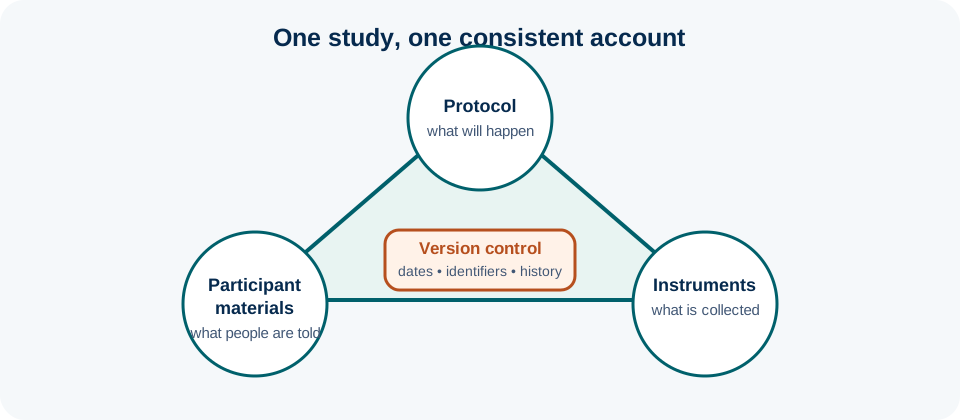
Many ethics queries arise because different documents describe different versions of the study: the protocol says one recruitment method, the information sheet says another, and the data form collects variables that were never justified. These inconsistencies are not cosmetic. They can change participant expectations, privacy risk and the scientific question.
A well-prepared submission reduces delays and, more importantly, forces the team to resolve contradictions before recruitment.
Core principles
A typical ethics package may include the protocol or proposal, participant information and consent materials, recruitment advertisements or scripts, data-collection instruments, investigator qualifications, site permissions, conflict-of-interest declarations, safety information, data-governance plans and supporting agreements. Interventional research may require additional documents such as investigator brochures or regulatory authorisations.[1–4]
The submission should be version controlled. Titles, version dates, populations, sample sizes, procedures and optional activities should match across documents. A document matrix is often more useful than relying on memory.
Protocol content for ethics review
The protocol should explain the background, question, design, population, recruitment, measurements, sample-size rationale, procedures, analysis interface, risks, benefits, consent, privacy, safety, dissemination and data management. It should distinguish what is standard clinical care from what occurs solely for research.
Participant-facing documents
Information sheets, consent forms, advertisements, SMS messages, social-media text and recruitment scripts should be understandable, non-coercive and consistent with the protocol. Promotional language such as “free treatment” or “guaranteed benefit” can mislead. Optional procedures should be visibly optional.
Investigator competence and conflicts
Committees may need evidence that investigators are qualified for their assigned tasks and that relevant conflicts are disclosed and managed. The submission should not list a person as responsible for specialist procedures without confirming training, delegation and oversight.
Version control and response to queries
Every revised document should have a unique version and date. A response table should reproduce each committee query, state the response, identify the revised document and page/section, and distinguish explanation from actual document change. Silent replacement of files makes the audit trail difficult to follow.
Malaysia-specific implementation example
For research conducted within Malaysia’s Ministry of Health system, the National Medical Research Register is the integrated platform used for research registration and relevant review workflows.[4] Current NMRR materials list protocol/proposal, participant information and consent materials and other study documents among submission elements, with requirements depending on research type.[5] These are MOH-specific operational requirements, not universal international rules; investigators at universities, private facilities or other jurisdictions must check their own current pathways.
For regulated clinical trials, current Malaysian NPRA guidance should also be checked. As of 2026, NPRA publishes the Malaysian Guidelines for Good Clinical Practice and associated trial guidance on its official clinical-trial pages.[6]
Think like an ethics reviewer
Before submission, read the protocol from the perspective of a committee member who has not attended the research team’s meetings. Can the reviewer understand exactly who is approached, what happens at each visit, which procedures are research-only, what risks arise and what data are retained? Ambiguity forces the committee to query the study because it cannot approve an unwritten assumption.
A strong submission anticipates predictable questions. Why is this population needed? Why is the sample size sufficient? Who obtains consent? How is a distressed participant managed? Why are identity numbers collected? What happens to specimens after the primary analysis? Who pays for research injury? Which organisations receive data? Answering these questions in the protocol is more persuasive than a cover letter stating that the study is “low risk”.
Use a consistency matrix
A consistency matrix can list high-risk facts down the rows—sample size, eligibility, visit schedule, primary outcome, payment, withdrawal, data retention, optional procedures—and study documents across the columns. Any mismatch is corrected before submission. The same matrix can be used again after amendments.
This is especially useful for multilingual materials. If the English consent changes materially, translated versions should be updated through the approved process rather than leaving older wording in circulation. Version dates allow the team to identify which participants received which information.
Separate ethics questions from administrative completeness
An application can be administratively complete yet ethically weak. Uploading a data-management plan does not prove the sharing model is appropriate; attaching a consent form does not prove voluntariness; submitting a CV does not prove the team is trained for a specialised procedure. Investigators should be prepared to justify the substance behind each document.
Conversely, some committee queries are administrative rather than fundamental ethical criticisms. Responding defensively wastes time. A professional response accepts clear corrections, explains genuine scientific constraints and proposes alternatives when a committee request would inadvertently damage the design.
Budget and contracts can contain ethical information
Budgets reveal participant payments, investigator fees, per-capita recruitment incentives and funding for safety or follow-up. Contracts may define data ownership, publication rights, insurance and sponsor control. These documents can therefore affect ethical review even when financial administration sits elsewhere.
Investigators should know whether the sponsor can prevent publication, whether adequate funds exist for required follow-up and whether compensation arrangements match the participant information. Hidden financial incentives tied to recruitment may create conflicts that require management.
Investigator-initiated studies need governance too
Researchers sometimes assume that extensive governance applies only to pharmaceutical trials. Investigator-initiated observational, qualitative or digital studies can still involve sensitive data, vulnerable populations, international transfers or significant burden. The documentation should be proportionate, but the ethical questions do not disappear because there is no commercial sponsor.
For clinical trials, the investigator may also assume sponsor responsibilities depending on the governance arrangement. Current ICH E6(R3) and national GCP guidance should be consulted rather than relying on role labels from previous studies.[1,6]
Response to committee conditions should be traceable
When approval is conditional, the team should not treat the approval date as permission to recruit until the stated conditions are satisfied. The final approved document set should be clearly identified and distributed to sites. A site file containing obsolete consent forms is an operational risk even if the central team has the correct version.
After approval, staff training should reference the approved procedures and document versions. Ethics readiness becomes study-start readiness only when the people conducting the research know which controlled documents apply.
From approval package to site implementation
After approval, the research team should create a site activation package containing the approved protocol, current participant materials, SOPs, delegation information and any committee conditions. Sites should confirm receipt and staff training before recruitment. Approval at the coordinating centre does not automatically mean every participating site has satisfied its own governance requirements.
The principal investigator should also review whether any ethics condition changes the scientific plan. A committee may require altered eligibility, revised safety monitoring or different consent wording. These changes should be reflected consistently in the protocol, registry and operational documents rather than implemented as isolated edits.
During recruitment, investigators should keep a controlled list of active document versions. If a new consent form becomes effective, old copies should be removed from use while retained in the archive. Electronic systems should prevent staff from downloading uncontrolled drafts where possible. Version transition plans are especially important in multicentre studies because different sites may receive approvals on different dates.
Investigators should distinguish ethics approval, institutional permission, funding approval, contracts and regulatory authorisation. One does not necessarily imply the others. Recruitment should begin only when the approvals required for that study and site are in place. The protocol may be ethically approved while a data-sharing agreement or clinical-trial authorisation remains pending.
A final pre-recruitment meeting can use a simulated participant journey to verify that approved documents work operationally. The team walks through screening, consent, data entry, sample handling, payment, adverse-event response and withdrawal. This catches practical contradictions before a real participant is exposed to them and turns ethics approval into a functioning protection system.
Common ethics-query themes and how to answer them
Committees commonly query unclear inclusion criteria, weak sample-size justification, recruitment through dependent relationships, inconsistent consent wording, unaddressed sensitive findings, excessive data collection, unsupported claims of anonymity, unclear compensation and undefined future use. A good response begins by acknowledging the issue, then states the scientific or ethical rationale and modifies the relevant documents where needed.
Do not respond only in the cover letter while leaving the protocol unchanged. If the committee’s concern affects study conduct, the controlled document should reflect the agreed resolution. Conversely, if no change is made, explain why and point to the relevant evidence or methodological constraint.
The final approval set should be archived exactly as approved. This makes later audits and amendments easier because the team has a reliable baseline against which changes can be compared.
Ethics submission as a reproducibility exercise
Preparing the submission can be used as a final reproducibility test. Ask a colleague who did not design the study to read only the submitted documents and describe exactly what happens to an eligible participant from first contact to archive. Any step the colleague cannot reconstruct is a likely protocol gap. This exercise is especially valuable for multicentre projects because it reveals assumptions that may be obvious at the coordinating site but ambiguous elsewhere.
A submission should explain foreseeable downstream use
Ethics review is easier when the protocol anticipates what happens after primary data collection: whether identifiers are retained, whether specimens are stored, whether future contact is planned, whether data may be shared externally and how results will be disseminated. These downstream activities often create more persistent ethical questions than the initial questionnaire or clinic visit. They should be visible in the first submission rather than added later as informal extensions of the project.
Ethics readiness should be checked at every participating site
Multicentre studies can fail when the coordinating team assumes all sites use identical local processes. Each site should confirm the current approved documents, authorised investigators, recruitment areas, language materials, data-transfer route and required institutional permissions. Differences should be documented without silently creating site-specific protocol variations. This site-readiness check is particularly important before opening recruitment under a central protocol.
Final pre-submission quality gate
Before pressing submit, confirm that every file opens correctly, every attachment is the intended version, all tracked changes have been resolved where required, dates are consistent and participant-facing documents are legible on the devices or print formats actually used. Administrative defects can delay review and can also conceal substantive inconsistencies. A short independent document check by someone outside the drafting team is often highly efficient.
Final submission readiness note
The principal investigator should be able to identify the exact approved or submitted version of every key document without searching personal email or local desktops. A controlled submission folder with a contents list, version dates and checksum or document identifiers can reduce accidental replacement of files during review. This is particularly useful when multiple revised documents are returned after committee queries. The goal is not technical sophistication but certainty about which study description is currently under review and which version staff will eventually implement.
A final checklist should also confirm that investigators have the current committee contact route for urgent questions, safety issues and amendments, so governance remains functional after the initial approval letter is issued.
Final submission check
- Does every document describe the same population, procedures and duration?
- Are all participant-facing contacts and recruitment messages included?
- Are optional procedures separated from required study activities?
- Are privacy, risk and compensation descriptions consistent across documents?
- Are all documents versioned and ready to track through committee queries?
Ethics submission matrix
- Protocol/proposal and synopsis.
- Participant information, consent, assent or representative materials as applicable.
- Recruitment materials and scripts.
- Questionnaires, interview guides, CRFs and other participant-facing instruments.
- Risk, safety, privacy and data-management documents.
- Investigator, site, funding and conflict-of-interest information.
- Applicable regulatory, contractual or supporting documents.
Audit the submission before filing
- Can a reviewer reconstruct exactly what happens to a participant?
- Do all documents use the same study title, version, population and procedures?
- Are sensitive variables justified in the protocol and explained where necessary?
- Do time, payment, risk and withdrawal descriptions agree?
- Can every future revision be traced to a version and committee decision?
Worked example
Building a submission from a document matrix
The team creates a matrix with one row for every participant interaction and one column for the protocol, consent form, recruitment text, CRF and SOP. The review identifies three discrepancies: an optional interview was missing from the consent form, one site planned a different follow-up period, and a location variable lacked justification.
The investigators resolve the inconsistencies before submission, assign version numbers and create a response template for future queries. The exercise improves both ethics readiness and operational reproducibility.
Suggested protocol or governance wording
Common mistakes
Knowledge check
Why should questionnaires be included in ethics review?
Answer and reasoning
Because their content determines participant burden, sensitivity, privacy risk and whether the data collected match what the protocol and consent materials describe.
Are NMRR requirements universal for all Malaysian research?
Answer and reasoning
No. NMRR is particularly relevant to Ministry of Health research workflows. Other institutions and jurisdictions may have different systems and requirements.
What is the value of a response-to-query table?
Answer and reasoning
It creates a transparent audit trail linking each committee concern to the investigator response and specific revised document location.
Why is version control ethically important?
Answer and reasoning
It helps ensure that participants are exposed to procedures and information that correspond to the version actually reviewed and approved.
Key take-home messages
Key take-home messages
- An ethics submission is a coherent study package, not a single form.
- Cross-document consistency is a methodological and ethical requirement.
- Participant-facing materials deserve the same version control as the protocol.
- Committee queries should be answered transparently with an auditable revision trail.
- Institutional and national submission requirements must be checked in their current official sources.
References
- World Health Organization. Standards and operational guidance for ethics review of health-related research with human participants. Geneva: WHO; 2011. https://www.who.int/publications/i/item/9789241502948
- World Medical Association. Declaration of Helsinki: ethical principles for medical research involving human participants. Ferney-Voltaire: WMA; 2024. https://www.wma.net/what-we-do/medical-ethics/declaration-of-helsinki/
- Council for International Organizations of Medical Sciences. International ethical guidelines for health-related research involving humans. 4th ed. Geneva: CIOMS; 2016. https://cioms.ch/publications/product/international-ethical-guidelines-for-health-related-research-involving-humans/
- Ministry of Health Malaysia. National Medical Research Register. https://nmrr.gov.my/
- Ministry of Health Malaysia. NMRR data elements and parameters for ethics submission documents. National Medical Research Register. https://nmrr.gov.my/documents
- National Pharmaceutical Regulatory Agency Malaysia. Clinical trial guidelines and Malaysian Guidelines for Good Clinical Practice. Updated 2026. https://www.npra.gov.my/index.php/en/guideline-for-the-submission-of-product-samples-for-laboratory-testing/clinical-trial/clinical-trial-guidelines.html
These materials support learning and research planning. They require adaptation to the study context and do not replace methodological, statistical, ethical, or regulatory consultation.