
Part 8 · Module 5
Cohort Study Design
Understand how cohort studies define an at-risk population, measure exposure before outcome and follow participants to estimate incidence and prognosis.
Learning outcomes
After completing this lecture, you should be able to:
- Define the population, exposure groups, time origin, at-risk status and outcomes in a cohort study.
- Distinguish closed and dynamic cohorts and explain their implications for denominators.
- Select a cohort design for incidence, prognosis or exposure–outcome questions.
- Identify confounding, measurement, immortal-time and follow-up threats.
- Specify the protocol and analysis interface for a basic cohort study.
Overview
A cohort study identifies a population according to eligibility and exposure or prognostic characteristics, establishes a time origin, and observes participants for subsequent outcomes. Because exposure is defined before outcome occurrence, a cohort can estimate incidence, risk, rates, survival and changes over time.[1–3]
Cohort studies may collect new data prospectively, reconstruct follow-up from existing records, or combine both. They can compare exposed and unexposed groups, describe prognosis after diagnosis, evaluate multiple outcomes of one exposure, or build a platform for nested studies. The defining feature is not prospective data collection; it is the longitudinal organisation of people at risk over time.
This lecture introduces cohort structure, appropriate uses, core protocol decisions, validity threats and the interface with statistical analysis.
Why this matters
A credible cohort must align eligibility, exposure measurement, time zero and outcome follow-up. Errors at this stage can create apparently strong associations. Examples include:
- classifying treatment exposure using information obtained after follow-up begins;
- including participants who already have the outcome when studying incidence;
- defining groups at different clinical stages;
- giving one group more intensive outcome surveillance;
- ignoring movement into and out of a dynamic population;
- treating loss to follow-up as harmless; and
- adjusting for variables measured after exposure that lie on a causal pathway.
Key concepts
Cohort entry and time origin
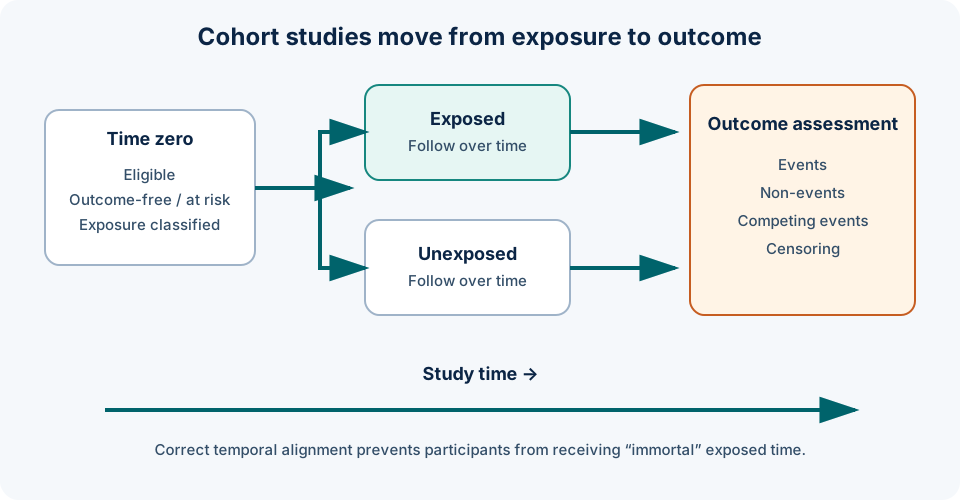
Time zero is the point at which eligibility, exposure assignment and follow-up begin. These elements should refer to the same clinical moment. Misalignment can create immortal-time or selection bias because a participant may need to survive or remain outcome free long enough to be classified as exposed.[2,3]
At-risk population
For an incidence outcome, participants should be capable of experiencing the event at cohort entry. A person with existing type 2 diabetes is not at risk of a first diagnosis. Baseline outcome assessment and a look-back period may be needed to distinguish prevalent from incident disease.
Exposure groups
Exposures can be fixed at baseline, updated over time or cumulative. A baseline exposure is simplest but may misrepresent changing behaviours, medicines or environmental conditions. Time-varying exposure requires dates and analysis that respects when status changes.
Outcomes and follow-up
Outcomes should have prespecified definitions, ascertainment sources and follow-up windows. Passive registry linkage, active visits and participant reports have different completeness and measurement properties. Competing events may prevent the primary event from occurring.
When to use this approach
Questions that support a cohort design
- Is incidence, prognosis, disease progression or time to event central?
- Can exposure or prognostic status be established before the outcome?
- Is a defined at-risk population available?
- Can outcomes be ascertained consistently during follow-up?
- Are the expected event frequency and follow-up duration feasible?
- Can important confounders be measured before or at exposure assignment?
A cohort may be inefficient for extremely rare outcomes or very long latency when no existing data source is available. A case-control study can then sample outcome information more efficiently. A trial may be preferable when the question concerns an intervention that can be assigned ethically and feasibly.
Research question and methodological fit
The illustrative question is:
Among women with gestational diabetes and no diabetes at six months postpartum, is completion of recommended postpartum testing associated with subsequent diagnosis of type 2 diabetes over five years?
The exposure is testing completion by six months. To avoid using future information, the comparison cohort can begin at the six-month landmark among women alive, observable and without type 2 diabetes at that time. This design estimates prognosis after that landmark, not risk from delivery.
The association may reflect earlier detection rather than a biological effect of testing. Therefore, the objective and interpretation should distinguish diagnosis incidence, true disease development and surveillance intensity.
Design, setting and study population
Cohort study
Core structure: A defined at-risk population is classified by exposure or prognostic characteristics and followed from a common time origin for subsequent outcomes.
Best suited for: Incidence, prognosis, natural history, multiple outcomes and temporally ordered exposure–outcome associations.
Important limitations: Confounding, changing exposures, loss to follow-up, surveillance differences and long duration can threaten validity.
Closed cohorts
A closed cohort has a defined membership at baseline and no new entrants. Participants contribute follow-up until event, censoring or study end. Risk over a fixed period can be estimated when follow-up is sufficiently complete.
Dynamic cohorts
A dynamic or open cohort allows entry and exit over calendar time, such as residents registered in a health system. Incidence rates based on person-time are often natural summaries. Eligibility, exposure and calendar-period rules must be evaluated at entry.
Sampling and recruitment
Cohort entry and sampling decisions
- Define the target and source populations.
- Specify baseline eligibility and at-risk status.
- State the time origin and permitted entry window.
- Define exposure groups without using post-baseline outcome information.
- Describe sampling from the cohort frame and recruitment procedures.
- Justify event numbers, precision or sample size for the primary objective.
- Plan retention, record linkage and outcome surveillance.
A cohort can include all eligible records, a probability sample or a clinically defined consecutive population. Inclusion of everyone in one database does not guarantee representativeness; database coverage and care pathways still determine the source population.
Variables, constructs and measurements
Illustrative cohort variable specification
illustrativeTable 1. Variables for the postpartum cohort
| Variable | Operational definition | Source | Timing |
|---|---|---|---|
| Testing completion | Glucose test documented by six months postpartum | Laboratory and linked records | Exposure window: delivery to 6 months |
| Cohort entry | Six months after delivery, if alive and free of diagnosed type 2 diabetes | Cohort rules | Time zero |
| Incident diabetes | First diagnosis meeting prespecified laboratory or clinical criteria | Linked records and adjudication | After cohort entry |
| Age and pregnancy factors | Prespecified potential confounders | Maternity records | Before exposure classification |
| Healthcare contact | Number of visits before cohort entry | Administrative records | Before time zero |
Note: Definitions and values are illustrative.
Outcome definitions should distinguish date of biological onset, first abnormal test and recorded diagnosis where possible. If the exposure affects testing frequency, diagnosis may occur earlier even without a difference in underlying disease incidence.
Procedures and data collection
Baseline procedures should establish identity, eligibility, exposure, confounders and outcome-free status. Follow-up procedures should specify scheduled visits, passive linkage, contact methods, event verification, censoring and data-quality checks.
A cohort operations manual can define permissible visit windows, adjudication, source hierarchy, duplicate records and departures from protocol. Outcome assessors should be blinded to exposure when feasible. Retention indicators should be monitored by exposure group and important prognostic strata.
Bias, validity and quality assurance
Other threats include confounding by healthcare access, differential outcome detection, exposure misclassification, informative censoring and competing events. A directed acyclic graph can guide the baseline adjustment set; variables affected by exposure should not be adjusted for automatically.
Appraising a cohort study
- Is the cohort population and time origin clear?
- Were participants at risk of the outcome at entry?
- Was exposure defined using information available at or before time zero?
- Were important confounders measured before exposure?
- Was outcome surveillance comparable across groups?
- Are loss to follow-up and competing events described?
- Does the analysis use the correct time scale and denominators?
Ethical and governance considerations
Interface with statistical analysis
Cohort analysis may estimate cumulative incidence, incidence rates, risk ratios, rate ratios, survival probabilities or hazard ratios. The choice depends on a fixed or varying follow-up period, censoring, competing events and the intended estimand. Time-to-event methods require a defined origin, event date and censoring date.
The planned lectures Introduction to Time-to-Event Data and Cox Proportional-Hazards Regression will provide the statistical details. Hazard ratios should not be described as risk ratios.
New-user and active-comparator designsMMed extension
For medicine-effect studies, restricting to new users and comparing clinically plausible alternatives can align treatment history and reduce confounding by indication and prevalent-user bias. The design should emulate a target trial by specifying eligibility, treatment strategies, time zero, follow-up, outcome and causal contrast before analysis.[4]
Worked example
Aligning the six-month landmark cohort
Women with gestational diabetes are classified at six months as having completed or not completed postpartum testing. Cohort entry is set at six months, and women with diabetes diagnosed before that landmark are excluded from the incident-diabetes analysis. Baseline confounders include age, pregnancy glucose severity, body mass index, socioeconomic indicators and pre-landmark healthcare contact.
Participants are followed through linked laboratory, outpatient, hospital and mortality data for five years. Because testing completion may increase later surveillance, the team reports healthcare-contact patterns and performs sensitivity analyses using a laboratory-based outcome definition.
The main analysis estimates five-year cumulative incidence and a time-to-event association. Interpretation is limited to prognosis after the six-month landmark and does not claim that testing itself biologically prevents or causes diabetes.
Suggested protocol or reporting wording
Common mistakes
Knowledge check
What four elements should align at cohort time zero?
Answer and reasoning
Eligibility, exposure assignment, at-risk status and the beginning of outcome follow-up should refer to the same point. Misalignment can create selection or immortal-time bias.
Why are women with existing diabetes excluded from a first-diagnosis incidence analysis?
Answer and reasoning
They are no longer at risk of the first event being studied. Including them would mix prevalence with incidence and make the denominator inappropriate.
Does a retrospective database cohort lack temporal ordering?
Answer and reasoning
Not necessarily. If historical dates show that exposure preceded outcome and the cohort was defined without future information, temporal ordering can be clear even though data were collected previously.
Why might testing completion be associated with recorded diabetes diagnosis even without causing disease?
Answer and reasoning
Women who engage with testing and care may undergo more surveillance, leading to earlier or more complete detection. Healthcare access can confound the association and affect outcome ascertainment.
Key take-home messages
Key take-home messages
- Cohort studies organise an at-risk population from a defined time origin to subsequent outcomes.
- Prospective data collection is not the defining feature; longitudinal structure is.
- Eligibility, exposure, time zero and outcome follow-up must be aligned.
- Cohorts can estimate incidence, prognosis, rates and time-to-event outcomes.
- Confounding, surveillance differences, changing exposure and loss to follow-up require explicit planning.
- The analysis measure should match the follow-up structure and intended estimand.
Cohort reporting should follow STROBE and explain participant selection, follow-up, missing data and analytical methods.[5,6]
References
- Rothman KJ, Greenland S, Lash TL. Modern epidemiology. 3rd ed. Philadelphia: Lippincott Williams & Wilkins; 2008.
- Hernán MA, Sauer BC, Hernández-Díaz S, Platt R, Shrier I. Specifying a target trial prevents immortal time bias and other self-inflicted injuries in observational analyses. J Clin Epidemiol. 2016;79:70–75. https://doi.org/10.1016/j.jclinepi.2016.04.014
- Lévesque LE, Hanley JA, Kezouh A, Suissa S. Problem of immortal time bias in cohort studies: example using statins for preventing progression of diabetes. BMJ. 2010;340:b5087. https://doi.org/10.1136/bmj.b5087
- Hernán MA, Robins JM. Using big data to emulate a target trial when a randomised trial is not available. Am J Epidemiol. 2016;183(8):758–764. https://doi.org/10.1093/aje/kwv254
- von Elm E, Altman DG, Egger M, Pocock SJ, Gøtzsche PC, Vandenbroucke JP; STROBE Initiative. The Strengthening the Reporting of Observational Studies in Epidemiology statement. PLoS Med. 2007;4(10):e296. https://doi.org/10.1371/journal.pmed.0040296
- Vandenbroucke JP, von Elm E, Altman DG, Gøtzsche PC, Mulrow CD, Pocock SJ, et al. STROBE: explanation and elaboration. PLoS Med. 2007;4(10):e297. https://doi.org/10.1371/journal.pmed.0040297
These materials support learning and research planning. They require adaptation to the study context and do not replace methodological, statistical, ethical, or regulatory consultation.