
Part 13 · Module 3
Standard Operating Procedures and Research Manuals
Develop practical standard operating procedures and research manuals that convert protocol requirements into consistent, auditable study operations.
Learning outcomes
After completing this lecture, you should be able to:
- Distinguish protocols, standard operating procedures, work instructions and manuals.
- Identify research activities that require prospective procedural standardisation.
- Write actionable procedures with roles, decision rules, documentation and escalation pathways.
- Plan document control, versioning, training and deviation handling.
- Appraise whether a research manual is usable in real field conditions.
Overview
A protocol states what the study intends to do and why. Standard operating procedures (SOPs), work instructions and research manuals explain how recurring activities will be performed consistently in practice. They are especially important when several staff members or sites must make the same decisions over time. ICH E6(R3) emphasises that trial processes and implementation plans should be clear, concise, operationally feasible and proportionate to risk.[1,2]
Research manuals are not limited to clinical trials. A surveillance survey may need a blood-pressure measurement SOP; a cohort may need a record-abstraction manual; a qualitative study may need an interview and transcription workflow; a multicentre observational study may need rules for screening, follow-up, query resolution and database access.
Why this matters
A protocol rarely specifies every operational detail. “Measure blood pressure using a validated device” does not tell staff how long the participant rests, which arm is used, what happens when two readings differ greatly, or where a device failure is documented. When these decisions are left to individual judgement, the study may acquire site or interviewer effects that reflect procedure rather than biology.
Standardisation does not mean removing all judgement. It means defining which decisions are routine, which require judgement, and when uncertainty must be escalated.
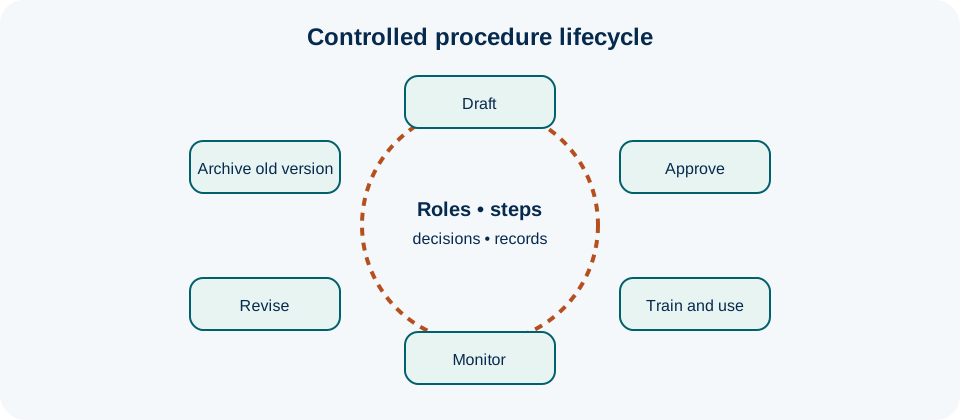
Documents have different jobs
A useful hierarchy is:
- Protocol: scientific and ethical design, objectives, population, procedures and analysis framework.
- SOP: controlled description of a recurring process that should be performed consistently.
- Work instruction: detailed task-level instruction, sometimes site- or equipment-specific.
- Research operations manual: study-specific collection of workflows, definitions, contact details, decision rules and references to relevant SOPs.
- Job aid: concise checklist, flow diagram or quick-reference card used during a task.
These labels vary across organisations. The important principle is not the name but that the authoritative source for each procedure is identifiable and current.
Decide what requires standardisation
Prioritise procedures where inconsistency could affect participant safety, eligibility, measurement, primary outcomes or data integrity. Examples include:
- screening and eligibility confirmation;
- informed-consent workflow;
- specimen collection and processing;
- physical measurements;
- questionnaire administration;
- outcome ascertainment;
- source-data abstraction;
- contact and retention procedures;
- handling protocol deviations;
- data entry and query resolution; and
- escalation of safety or confidentiality incidents.
A low-risk administrative task may require only a short instruction. A high-impact measurement may require detailed equipment, timing, calibration, troubleshooting and competency requirements.
Anatomy of an actionable SOP
A usable procedure normally answers:
- Purpose — what process is being standardised?
- Scope — where and to whom does it apply?
- Roles — who performs, verifies and approves the activity?
- Prerequisites — what training, equipment or source documents are required?
- Procedure — what steps are followed, in what order?
- Decision rules — what happens when expected conditions are not met?
- Documentation — what record demonstrates that the process occurred?
- Escalation — who decides when ambiguity or deviation occurs?
- References — which protocol, guideline or technical source governs the process?
- Document control — version, effective date, approval and superseded status.
Avoid vague verbs such as “check appropriately” or “follow up as necessary” unless the criteria for appropriate action are defined.
Write procedures that can be audited
- Use numbered actions for sequential tasks.
- Name the responsible role, not an individual who may later leave.
- Define required inputs, equipment and forms.
- State thresholds and decision rules explicitly.
- Include foreseeable exceptions and escalation routes.
- Specify what must be documented and where.
- Link to the protocol and related controlled documents.
- Record version, approval, effective date and change history.
Source hierarchy and exception rules
Operational manuals are particularly valuable when sources conflict. Suppose the delivery date differs between a discharge summary and the obstetric record. The study should not let each collector choose. Specify a source hierarchy or adjudication process.
Likewise, define exceptions. If a blood-pressure cuff of the correct size is unavailable, does the visit proceed? If a participant cannot attend the scheduled window, is home collection allowed? If an external laboratory report is a photograph rather than an original PDF, is it acceptable evidence? These decisions may have ethical, validity and governance implications.
Document control
A document is not controlled merely because it has a version number. The study should know:
- which version is current;
- who approved it;
- when it became effective;
- which earlier version it replaced;
- what changed and why;
- who needs retraining; and
- how obsolete copies are prevented from being used.
Do not overwrite an approved document in place. Retain the superseded version according to the study’s document-retention process. If a change affects the protocol, consent or ethics-approved procedure, follow the relevant governance pathway rather than treating it as an internal formatting update.[1]
Manuals as training and reference tools
The research manual should match the way staff work. A 200-page PDF can be comprehensive but unusable during a clinic. Consider a layered system: a controlled core manual plus concise job aids for frequent tasks. Training should teach staff how to find authoritative instructions, not require memorisation of every page.
WHO field-survey guidance similarly emphasises uniform methods and preparation of data collectors as part of data quality.[3]
Deviations and nonconformities
No manual can anticipate every event. Define how staff document deviations from required procedures, immediate corrective actions, and whether the event must be escalated. A deviation log can reveal repeated system problems such as unrealistic visit windows or confusing instructions.
Do not automatically equate every deviation with protocol failure. Classify its significance based on potential effects on participant rights, safety, study validity and data integrity. Recurrent deviations may indicate that the procedure, training or workflow needs redesign.
Worked example
Writing the external laboratory-result verification procedure
Purpose: Standardise verification of postpartum glucose tests performed outside participating hospitals.
Responsible role: Trained research assistant; uncertain cases escalated to the site investigator.
Procedure:
- Ask whether testing occurred outside the hospital system.
- With the participant’s authorised permission, obtain an acceptable documentary source according to the approved workflow.
- Confirm participant identity, specimen date, test type, result and unit.
- Enter the source category and transcribed result into the study form.
- Do not infer a numerical value from phrases such as “normal test”. Record the appropriate verification status instead.
- If identity, date or test type cannot be established, flag the record for investigator review.
- Document the query outcome without retaining unnecessary identifying copies in the analysis dataset.
The SOP makes explicit what counts as evidence and prevents each staff member from creating a personal standard.
Change management
Procedures should change when evidence, equipment or operations require it, but change should be deliberate. Before implementation, assess whether the revision affects participants already enrolled, outcome definitions, comparability over time or data already collected. If a measurement device is replaced, for example, assess whether calibration or bridging is required rather than assuming equivalence.
ICH guidance on quality by design encourages prospectively identifying factors critical to quality and managing risks throughout the study rather than treating documentation as an end in itself.[1,2]
When does a process need an SOP?
Prioritise a controlled procedure when at least one of these is true:
- different staff could reasonably perform the task differently;
- the task affects eligibility, safety, key measurements or outcomes;
- the task is repeated often enough that inconsistency will accumulate;
- the study needs evidence that the task was performed correctly;
- the process crosses sites, departments or information systems; or
- failure requires a defined escalation response.
Interface with electronic systems and records
Procedures should describe not only paper actions but also the use of electronic systems where errors could affect data. This can include account management, electronic signatures, data correction, audit trails, exports and system downtime. Current FDA guidance addresses trustworthy and reliable electronic systems and records in clinical investigations, reinforcing the need for procedures that reflect how systems are actually used.[4]
Data-management plans complement SOPs by describing naming, documentation, sharing, preservation and responsibilities over the data lifecycle.[5]
Risk-based procedural detailMMed extension
More detail is not always better. A procedure becomes difficult to follow when every trivial action is controlled. Use risk-based judgement: expand steps where variation could materially affect participant protection or study conclusions; keep low-risk administrative tasks concise.
A useful review question is: If two competent staff members followed this document independently, would they make the same important decisions? If not, the missing decision rule should be clarified. If yes, but the document takes 30 minutes to navigate for a 2-minute task, usability may be the next quality problem.
From process map to controlled procedure
Before writing an SOP, map the process visually or as a sequence of decisions. Identify the trigger, inputs, actions, decision points, outputs and records. This prevents a common writing problem in which the SOP describes isolated tasks but not how the workflow begins, ends or moves between roles.
For example, a follow-up process may begin when a participant reaches the target window, proceed through several approved contact methods, branch according to whether identity is verified, and end with completed assessment, documented refusal, loss to follow-up or escalation. Writing the process map first makes hidden assumptions visible.
Distinguish policy from procedure
A policy states an organisational requirement or principle; a procedure explains how that requirement is implemented. Research teams should not create local SOP wording that appears to override institutional policy, ethics approval or sponsor requirements. When an institutional SOP already governs an activity, the study manual can reference it and add only the study-specific details.
This avoids duplicate documents that later diverge. It also makes responsibility clearer: institutional controls remain authoritative, while the research manual explains how the study fits within them.
Build usable decision aids
Complex definitions are often best supported by decision tables or flow diagrams. A source hierarchy can be displayed as ordered steps. Eligibility criteria with exceptions can be represented as a decision tree. A specimen-processing SOP can include a concise timing table. These aids should remain controlled components of the procedure rather than unofficial notes created by individual staff.
Job aids need enough context to prevent misuse. A laminated card saying “three contact attempts” is unsafe if it omits the permitted interval, approved channels or definition of an unsuccessful attempt. The quick reference should point back to the authoritative procedure and share its version.
Review procedures against real work
Desk approval is not sufficient. Ask an intended user to perform a simulated task using only the document. Observe where they hesitate, search for missing information or interpret wording differently. This is operational usability testing for the SOP itself.
After implementation, review deviations and helpdesk questions. Repeated questions are evidence that the document may not be answering what users need. Revision should improve clarity without changing the scientific design unintentionally.
Appraise an SOP or research manual
- Is its authority and relationship to the protocol clear?
- Can a trained user identify the start and end of the process?
- Are roles, decision points and required records explicit?
- Are exceptions and escalation pathways described?
- Does the procedure avoid conflicting with institutional or ethics requirements?
- Are job aids linked to the same controlled version?
- Can the procedure be followed under realistic field conditions?
- Is there evidence that revisions and obsolete versions are controlled?
Keep the manual aligned with linked systems
Operational documents should be reviewed whenever forms, equipment, laboratory pathways or electronic systems change. A procedure that refers to an old field name or obsolete screen can cause staff to improvise even though the scientific rule is unchanged. Periodic cross-document review is therefore useful: verify that the protocol, SOP, job aid, data dictionary and electronic form still describe the same operational definition.
Assign ownership for this review rather than assuming inconsistencies will be noticed spontaneously. In long studies, document drift can become a major source of avoidable variation.
Common mistakes
Knowledge check
What is the main difference between a protocol and an SOP?
Answer and reasoning
The protocol defines the scientific and ethical study design—what will be done and why. An SOP or operational manual gives reproducible instructions for how recurring procedures are carried out in practice.
A site repeatedly records follow-up outside the allowed window. Is retraining always the correct response?
Answer and reasoning
Not necessarily. Repeated deviations may reflect unclear instructions, unrealistic scheduling or a system constraint. Investigate the cause before deciding whether retraining, workflow redesign or a protocol-level change is needed.
Why should obsolete SOP versions be retained but removed from active use?
Answer and reasoning
Retention preserves the audit trail for procedures that governed earlier participants, while removing obsolete copies prevents staff from applying superseded instructions to current work.
What makes a procedure auditable?
Answer and reasoning
It identifies responsible roles, concrete actions, decision rules, required records and escalation pathways, allowing a reviewer to determine what should have happened and what was documented.
Key take-home messages
Key take-home messages
- Use the protocol for scientific design and controlled procedures for reproducible implementation.
- Standardise processes where variation could affect safety, eligibility, measurement or data integrity.
- Write explicit roles, steps, decision rules, documentation and escalation pathways.
- Control versions and assess the implications of substantive procedural changes.
- Use deviation patterns to improve systems, not only to assign individual blame.
- Design manuals for real field use, with detail proportionate to methodological and participant risk.
References
- International Council for Harmonisation of Technical Requirements for Pharmaceuticals for Human Use. ICH harmonised guideline: Good Clinical Practice E6(R3). Step 4. 6 January 2025. https://database.ich.org/sites/default/files/ICH_E6%28R3%29_Step4_FinalGuideline_2025_0106.pdf
- International Council for Harmonisation of Technical Requirements for Pharmaceuticals for Human Use. ICH harmonised guideline: General considerations for clinical studies E8(R1). 6 October 2021. https://database.ich.org/sites/default/files/ICH_E8-R1_Guideline_Step4_2022_0204%20%281%29.pdf
- World Health Organization. WHO STEPS surveillance manual: the WHO STEPwise approach to noncommunicable disease risk factor surveillance. Geneva: World Health Organization. https://www.who.int/teams/noncommunicable-diseases/surveillance/systems-tools/steps
- US Food and Drug Administration. Electronic systems, electronic records, and electronic signatures in clinical investigations: questions and answers. Guidance for industry. Silver Spring (MD): FDA; 2024. https://www.fda.gov/regulatory-information/search-fda-guidance-documents/electronic-systems-electronic-records-and-electronic-signatures-clinical-investigations-questions
- Michener WK. Ten simple rules for creating a good data management plan. PLoS Comput Biol. 2015;11(10):e1004525. https://doi.org/10.1371/journal.pcbi.1004525
These materials support learning and research planning. They require adaptation to the study context and do not replace methodological, statistical, ethical, or regulatory consultation.