
Part 16 · Module 1
Structure of a Research Protocol
Learn how to structure a coherent health-research protocol that aligns the question, design, analysis, ethics, operations and reporting plan.
Learning outcomes
After completing this lecture, you should be able to:
- Explain the purposes of a research protocol before study conduct begins.
- Organise a protocol into logically connected scientific, operational and governance sections.
- Assess whether objectives, design, outcomes, analysis and sample-size planning are aligned.
- Distinguish protocol content from ethics forms, statistical analysis plans and operational manuals.
- Use protocol checklists as completeness aids without treating them as substitutes for methodological reasoning.
Overview
A research protocol is the prospective specification of what a study intends to answer, why the question matters, how participants or data will be selected, what will be measured, how the information will be analysed, and how ethical and operational responsibilities will be managed. For randomised trials, SPIRIT 2025 provides an updated minimum set of protocol-reporting items, while current good clinical practice emphasises proportionate, quality-by-design planning and reliable records.[1–3] The same underlying logic applies beyond trials: a protocol should make the intended inference and the procedures required to support it visible before results are known.
A protocol is therefore more than an administrative document submitted to an ethics committee. It is the study’s decision record. It should be detailed enough that another competent research team could understand the design, identify ambiguities, and reproduce the intended procedures. Ethical principles and publication guidance reinforce this prospective transparency because scientifically weak, selectively specified or poorly governed research wastes participant contributions and can produce misleading evidence.[4–6]
Why this matters
Many research problems that later appear to be “statistical” actually originate in an under-specified protocol. The primary outcome may not be defined at a single time point, the comparator may be vague, eligibility may be applied differently between sites, or the planned analysis may target a different quantity from the stated objective. Once recruitment has started, repairing these problems can introduce bias or require amendments that are difficult to distinguish from result-driven changes.
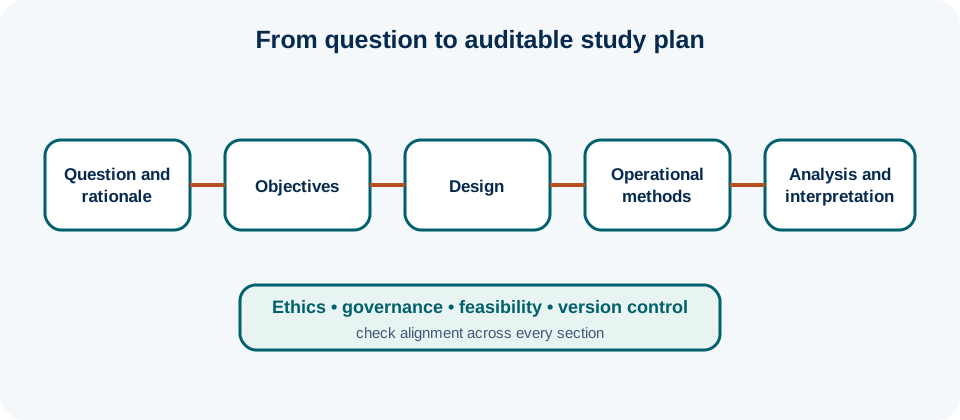
A well-structured protocol prevents this by forcing alignment. The background justifies the question; the objectives define what is to be learned; the design establishes the comparison and time order; the measurement plan operationalises the variables; the sampling and sample-size sections explain how much information will be obtained; the analysis plan specifies how the target effect or descriptive quantity will be estimated; and the governance sections establish who is responsible for consent, safety, data quality and deviations. The protocol should also distinguish stable design decisions from operational details that belong in SOPs, data dictionaries or the statistical analysis plan.
Key concepts
A useful protocol can be understood as a chain of linked claims. The scientific claim states the problem and knowledge gap. The design claim explains why the chosen design can answer the question. The measurement claim specifies how abstract constructs become observable variables. The analysis claim defines the quantity to be estimated and the procedures used to estimate it. The operational claim explains how the intended design will actually be implemented. The ethical claim explains why the study is acceptable to conduct.
These claims should not be written independently. If the objective is to estimate the effect of an intervention at 12 weeks, then the intervention, comparator, outcome definition, follow-up window, intercurrent events and analysis population must all support that effect. If the study is descriptive rather than causal, the protocol should not import trial language that implies an intervention effect. Likewise, a qualitative protocol should specify the phenomenon, sampling logic and analytic orientation rather than forcing variables into a quantitative template.
A protocol also has boundaries. It should define important decisions prospectively, but it does not need to contain every operational instruction. A separate statistical analysis plan can elaborate model coding, derived variables, multiplicity and sensitivity analyses. A data-management plan can specify access, version control, query management and archiving. SOPs can describe detailed workflows. These documents should be consistent with the protocol and version-controlled rather than used to quietly alter it.
Before writing the protocol, resolve these questions
- What exact research question or questions must the study answer?
- What design provides the required comparison, time order or depth of understanding?
- Who or what constitutes the target, source and study population?
- What is the primary outcome, phenomenon or target quantity, and when is it assessed?
- What information is required to justify the sample size or qualitative information power?
- Which risks, biases, operational failures and governance obligations must be controlled prospectively?
A step-by-step methodological workflow
1. Start with the problem, gap and intended contribution
Write the background so that it narrows from the health problem to the specific unresolved question. Separate the importance of the condition from the evidence gap: a common disease does not automatically justify another study. End the rationale by stating what decision, inference or knowledge gap the proposed study is designed to address. References should support both the clinical context and the methodological claim rather than merely showing that the topic has been published before.
2. Translate the question into objectives and a design
State one general objective and a manageable set of specific objectives that can each be linked to a planned result. Decide whether the study is descriptive, analytical, causal, diagnostic, prognostic, qualitative, mixed methods or another design family. The design label should follow from the question; it should not be selected because it is familiar or because a particular software procedure is available.
3. Specify population, setting, exposure or intervention and outcomes
Define the setting, recruitment period, target population, source population and study population. Eligibility criteria should operationalise the population without excluding people merely to make recruitment easier. For intervention research, describe both intervention and comparator sufficiently to permit implementation and interpretation. For observational research, define the exposure or predictor, outcome and time origin. For qualitative research, specify the phenomenon and sampling logic.
4. Plan sampling, sample size and information flow
Explain where eligible participants or records come from, how they will be selected or approached, and what will happen after enrolment. The sample-size rationale should be tied to the primary objective and planned analysis, including clustering, attrition or event requirements where relevant. A protocol should show how information moves from source data to analysis-ready variables, including measurement time points and procedures for missing or invalid observations.
5. Prespecify analysis at the level needed to protect the question
The protocol should state the primary analysis strategy, analysis population, effect measure or summary, covariate strategy, missing-data principles and key sensitivity analyses. Highly detailed implementation rules may sit in a separate SAP, but the protocol must still make the intended estimand and primary comparison understandable. If the study is qualitative or mixed methods, specify the analytic approach and integration plan rather than inserting a conventional hypothesis-testing section.
6. Integrate ethics, quality, dissemination and change control
Describe consent, privacy, safety, compensation, data access, quality assurance, monitoring and oversight in proportion to the study’s risks. State registration and dissemination plans where applicable. Version-control the protocol and establish how amendments will be approved, dated and communicated. A change is not inherently problematic; the problem is an undocumented or result-driven change whose timing cannot be reconstructed.
Minimum content to make prospectively explicit
- background, evidence gap, research question and objectives;
- design, setting, study period, population and eligibility criteria;
- sampling or recruitment route and sample-size or information-power rationale;
- intervention, exposure, comparator, outcome or central phenomenon with operational definitions;
- data-collection schedule, quality assurance and participant flow;
- primary analysis, important sensitivity analyses and handling of missing or incomplete information;
- ethics, consent, safety, privacy, data governance and oversight;
- registration, dissemination, protocol amendments and document version control.
An auditable planning document
Protocol alignment matrix
illustrativeTable 1. Illustrative protocol alignment matrix
| Protocol element | Example for the postpartum follow-up trial | Audit question |
|---|---|---|
| Research question | Does structured follow-up increase completed glucose testing by 12 weeks? | Is the time point explicit? |
| Primary outcome | Documented completion of the prespecified postpartum glucose test by day 84 | Is the definition reproducible? |
| Design | Two-group parallel randomised trial | Does the design support causal comparison? |
| Primary contrast | Intervention versus usual follow-up | Is usual care described? |
| Sample-size basis | Difference in the primary binary outcome | Does the calculation match the primary analysis? |
| Analysis | Prespecified effect estimate with 95% CI under the trial estimand | Is the estimand understandable? |
| Governance | Consent, access control, protocol versioning and safety escalation | Are responsibilities assigned? |
Note: This matrix is illustrative. It is a consistency check, not a substitute for the full protocol.
Quality, validity and governance
Protocol quality should be assessed on two levels. Completeness asks whether required information is present. Coherence asks whether the information fits together. A checklist such as SPIRIT can improve completeness for trial protocols, but it cannot rescue a poorly framed question or an inappropriate design.[1,2] Similarly, ethics approval does not certify methodological validity; committees depend on investigators to present a scientifically defensible plan.
A practical quality strategy is to conduct a “horizontal review” after the document is drafted. Instead of rereading section by section, trace each specific objective across the protocol: which population contributes, which variable answers it, when is that variable measured, what analysis addresses it, what sample-size assumption supports it, and what table or figure would eventually present it? Then trace each major risk: where could selection, measurement, contamination, missingness, protocol deviations or data-quality failures arise, and which protocol procedure mitigates each risk? This audit often detects contradictions that ordinary proofreading misses.
Governance also requires document integrity. Protocol versions should have dates, identifiers and change histories. Related documents should cite the correct protocol version. In regulated trials, ICH E6(R3) emphasises fit-for-purpose systems, critical-to-quality factors and reliable trial records.[3] Even in non-regulated academic work, the same principles improve reproducibility.
Appraise a protocol before approval or recruitment
- Does the research question identify a meaningful and answerable uncertainty?
- Do the objectives, design, variables and analysis target the same inferential quantity?
- Can another investigator determine exactly who is eligible and what happens after enrolment?
- Are primary and secondary outcomes or phenomena clearly distinguished?
- Are foreseeable biases, missingness and operational failures addressed prospectively?
- Are ethics, data governance, registration and amendment procedures proportionate and auditable?
Practical decision audit
Audit the objective-to-result pathway
For every specific objective, sketch the eventual result before data collection. If the team cannot say what estimate, theme, comparison or figure would answer the objective, the objective is probably too vague. This exercise also identifies duplicated objectives and objectives that require data not currently collected.
Audit terminology across sections
Terms such as “primary outcome”, “baseline”, “usual care”, “completion”, “index date” and “analysis population” should mean the same thing everywhere. Small wording differences can conceal substantive inconsistencies. Establish a protocol glossary when a project uses many specialised definitions or multiple sites.
Audit feasibility without weakening validity
Feasibility decisions should be explicit trade-offs. Restricting recruitment to one clinic may be necessary, but the protocol should acknowledge the resulting applicability limits. Reducing follow-up may make the study manageable but could change the clinical question. A defensible protocol records the trade-off rather than quietly rewriting the objective around available resources.
Audit the change pathway
Specify who can propose an amendment, who reviews scientific and ethical implications, when registration records are updated, and how sites receive the new version. Distinguish corrections of typographical errors from changes that affect eligibility, outcomes, intervention delivery, analysis or participant information. The chronology should remain recoverable after publication.
Integrating the protocol across the research lifecycle
A protocol should also be read as a coordination document. Different members of a research team often work from different representations of the same study: the clinician thinks in terms of eligibility and treatment, the statistician thinks in terms of estimands and variables, the research coordinator thinks in terms of visits and source documents, and the data manager thinks in terms of forms, identifiers and audit trails. The protocol must be sufficiently explicit that these representations remain compatible. A protocol review meeting is therefore more useful when each discipline is asked to explain how its work maps to the same objective rather than simply approving its own section.
One practical technique is the protocol walk-through. Select one hypothetical participant and follow that person from first contact to final analysis. Who identifies eligibility? Which version of the consent form is used? What defines baseline? Which source documents generate the primary outcome? What happens after an unscheduled visit or treatment interruption? How is a missing outcome classified? Which data fields ultimately enter the primary model? This participant-level walk-through detects operational gaps. A parallel data walk-through traces one important variable from source to CRF, database, derivation code, SAP and final table.
Protocol maturity should be staged
Early concept protocols can legitimately contain unresolved options. Before ethics approval and recruitment, however, decisions that affect participant rights, primary outcomes, eligibility, allocation, sample size or primary analysis should no longer be placeholders. Teams can use a staged maturity model: concept, scientific review, operational review, ethics-ready, site-ready and analysis-ready. Each stage has different expectations. This prevents a common failure in which a document labelled “final protocol” still contains language such as “the exact questionnaire will be decided later”.
Protocols should anticipate failure modes
Good planning asks not only what should happen but what is likely to go wrong. Recruitment may be slower than expected, devices may fail calibration, external laboratory results may be incomplete, staff may misunderstand eligibility, or follow-up may be disrupted. The protocol need not prescribe every response, but it should identify critical failure modes and establish escalation or contingency principles. For example, it can specify that any proposed change to the primary outcome window requires scientific and ethical review rather than allowing site staff to broaden the window informally.
Protocol transparency continues after the study
At publication, the protocol becomes part of the evidence trail. Readers should be able to compare the final report with the prospectively specified objectives and outcomes. When the protocol is publicly available, selective reporting and unexplained changes are easier to detect. Even when full public release is not possible, investigators should retain the approved versions and amendment history in a durable archive. The protocol therefore has value long after recruitment has ended.
Worked example
Reconstructing an under-specified protocol
The postpartum research team initially writes: “Women with gestational diabetes will be randomised to digital follow-up or standard care. The main outcome is postpartum testing. Approximately 150 women will be recruited.” A horizontal review identifies several unresolved decisions. “Postpartum testing” could refer to any glucose measurement, the recommended oral glucose tolerance test, or any documented diabetes screening. The timing is unclear. Standard care varies between clinics. No analysis population is defined, and 150 participants is not linked to an expected control proportion or detectable effect.
The team revises the protocol so that the primary outcome is documented completion of the prespecified glucose test within 84 days of delivery; intervention and usual-care processes are described; eligibility is tied to the participating hospitals’ gestational-diabetes population; the sample size is justified from the primary binary comparison with an allowance for missing outcome ascertainment; and the primary analysis and effect measure are stated. They add a visit and contact schedule, define permissible protocol deviations, specify REDCap access roles and source verification, and establish a protocol-amendment log.
The important improvement is not that the protocol becomes longer. It becomes decidable: reviewers can identify what the investigators intend to estimate, how participants contribute to that estimate, and what procedures protect validity and participant rights.
Suggested protocol and manuscript wording
Common mistakes
Knowledge check
What is the most important function of a research protocol?
Answer and reasoning
To prospectively align and document the scientific, methodological, operational and ethical decisions required to answer the research question. It is not merely an ethics-submission form.
Does compliance with SPIRIT prove that a randomised trial is well designed?
Answer and reasoning
No. SPIRIT improves completeness and transparency of protocol reporting. A protocol can report an inappropriate design completely. Methodological fit must still be appraised.
Why should the sample-size section be reviewed together with the primary analysis?
Answer and reasoning
Because the information assumptions used to determine sample size must correspond to the primary outcome, effect or precision target and the planned analysis. Otherwise the study may be powered for a different question.
When is a protocol amendment acceptable?
Answer and reasoning
When a scientifically or ethically justified change is reviewed through the appropriate governance process, dated, version-controlled and transparently reported. The timing and reason must remain reconstructable.
Key take-home messages
Key take-home messages
- A protocol is a prospective decision record and alignment tool.
- Completeness and methodological coherence are separate quality dimensions.
- Every specific objective should map to population, measurement, analysis and eventual reporting.
- Related documents such as SAPs, DMPs and SOPs should elaborate the protocol, not silently contradict it.
- Protocol amendments are legitimate when justified, governed and transparent.
References
- Chan AW, Boutron I, Hopewell S, et al. SPIRIT 2025 statement: updated guideline for protocols of randomised trials. BMJ. 2025;389:e081477. https://doi.org/10.1136/bmj-2024-081477
- Hróbjartsson A, Chan AW, Collins GS, et al. SPIRIT 2025 explanation and elaboration: updated guidance and exemplars for protocols of randomised trials. BMJ. 2025;389:e081660. https://doi.org/10.1136/bmj-2024-081660
- International Council for Harmonisation. ICH E6(R3) guideline for good clinical practice: principles and Annex 1. Step 4. 2025. https://database.ich.org/sites/default/files/ICH_E6%28R3%29_Step4_FinalGuideline_2025_0106.pdf
- World Medical Association. Declaration of Helsinki: ethical principles for medical research involving human participants. Ferney-Voltaire: WMA; 2024. https://www.wma.net/what-we-do/medical-ethics/declaration-of-helsinki/
- International Committee of Medical Journal Editors. Recommendations for the conduct, reporting, editing, and publication of scholarly work in medical journals. Updated January 2026. https://www.icmje.org/recommendations/
- EQUATOR Network. Search for reporting guidelines. Oxford: EQUATOR Network. https://www.equator-network.org/reporting-guidelines/
These materials support learning and research planning. They require adaptation to the study context and do not replace methodological, statistical, ethical, or regulatory consultation.