
Part 12 · Module 4
Exploratory Sequential Design
Begin with qualitative exploration, then build a quantitative phase that measures, tests or evaluates concepts developed from the first phase.
Learning outcomes
After completing this lecture, you should be able to:
- Explain the logic and sequence of an exploratory sequential mixed-methods design.
- Identify research problems for which qualitative exploration should precede quantitative measurement or evaluation.
- Translate qualitative findings into quantitative constructs, items, hypotheses or intervention components transparently.
- Distinguish qualitative-to-quantitative building from superficial theme counting.
- Appraise validity, sampling and integration challenges in exploratory sequential studies.
Overview
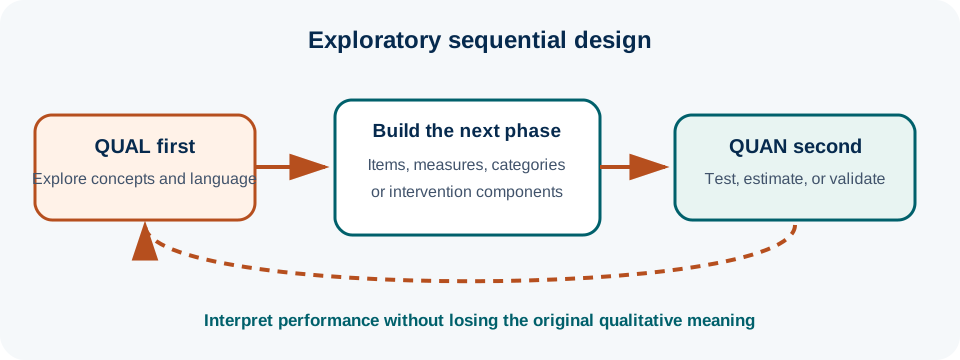
An exploratory sequential mixed-methods design begins with qualitative inquiry and then uses what was learned to design a subsequent quantitative phase.[1] It is commonly represented as QUAL → quan when the exploratory qualitative phase has priority, although the relative weighting can vary.
The design is appropriate when important concepts are insufficiently understood, poorly measured, culturally mismatched or inadequately represented in existing quantitative instruments. Qualitative work can first identify how participants describe the phenomenon, which dimensions matter, how language is used and which assumptions in existing frameworks fail. These findings then build the quantitative phase: they may generate questionnaire items, define variables, shape an intervention, identify hypotheses, determine response options or inform a sampling frame.[1,2]
The crucial methodological step is translation. Researchers must show how qualitative findings became quantitative content. Simply conducting interviews and then administering an unrelated survey is not an exploratory sequential design.
Why this matters
Health research often begins with constructs that are familiar in professional language but incompletely understood from the perspective of patients, families or frontline staff. Terms such as access, burden, acceptability, continuity, readiness and self-management may hide multiple dimensions. Starting with a fixed questionnaire can force participants’ experiences into categories chosen before the phenomenon is adequately understood.
Exploratory sequential design allows the researcher to discover relevant dimensions first and then examine their distribution, relationships or measurement properties quantitatively. It is particularly useful for instrument development, culturally adapting a measure, developing an intervention, generating a taxonomy, and studying an emerging health-service problem.[2,3]
The design is not automatically more valid than using an existing instrument. If a good validated measure already fits the intended construct, population and use, unnecessary development may waste resources. The rationale for qualitative-first design must therefore be explicit.
Key concepts
Exploration precedes specification
The qualitative phase should be open enough to discover dimensions not anticipated by the research team. If interview questions merely ask participants to endorse a pre-existing list of barriers, the first phase becomes a qualitative confirmation exercise rather than genuine exploration.
Typical products of the qualitative phase
The first phase can produce:
- a conceptual model or taxonomy;
- candidate questionnaire domains and items;
- wording that reflects participants’ language;
- quantitative variables that were not initially recognised;
- hypotheses to be tested in a larger sample;
- an intervention prototype or programme theory;
- categories for a structured observation tool; or
- contextual factors that should be measured during implementation.
The product must be appropriate to the later quantitative objective. If the goal is instrument development, item generation and content coverage are central. If the goal is intervention development, qualitative findings may specify components, delivery channels or contextual adaptations.
Translation should not erase meaning
Converting qualitative findings into numeric variables is a reduction. That is often necessary, but it should be deliberate. A rich theme such as “care coordination burden” might not be represented adequately by one yes/no item. The team may need several items, a formative index, a multi-item latent construct or a different measurement strategy.
Published examples show how qualitative findings can be used to adapt or generate questionnaire content and then examined quantitatively.[3] The value lies in the documented integration process rather than the label “mixed methods”.
When to use this approach
Choose exploratory sequential design when concepts must be understood before they can be measured or tested
Consider this design when:
- the phenomenon is insufficiently defined for a defensible quantitative instrument;
- existing measures may not fit the population, culture or care context;
- a new intervention or programme requires stakeholder-informed development before formal evaluation;
- qualitative findings are expected to determine quantitative variables, categories or hypotheses; or
- the research question asks both what matters to participants and how widely those dimensions occur.
Do not choose it merely because qualitative research “comes first”. The first phase must materially shape the second.
Research question and methodological fit
An exploratory sequential study can be structured around three linked questions.
Qualitative question: How do women describe the practical, informational and social burdens involved in completing postpartum glucose testing?
Development question: Which domains and candidate items can be constructed from those accounts while preserving conceptual coverage?
Quantitative question: What is the structure and distribution of the resulting measure, and how are its scores related to testing completion and other relevant variables?
Mixed-methods integration question: How well does the quantitative representation preserve the dimensions identified qualitatively, and what is learned when the new measure is applied to a larger sample?
This sequence makes clear that the quantitative phase is not an independent survey. It is the empirical continuation of the qualitative exploration.
NIH mixed-methods guidance emphasises that the rationale, design, component methods and integration strategy should be coherent from the planning stage.[4] More generally, mixed-methods design should make clear how the component questions relate and why the sequence is necessary rather than incidental.[5] For exploratory sequential work, this means stating prospectively what kind of product phase one is intended to build and how the adequacy of that product will be evaluated in phase two.
Design, setting and study population
Exploratory sequential mixed-methods design
Core structure: Qualitative data collection and analysis are completed first. Findings are used to build a quantitative instrument, intervention, taxonomy, variables or hypotheses. The developed product is then examined quantitatively.
Best suited for: New or poorly measured constructs, culturally grounded instrument development, intervention development, emerging phenomena and research areas where meaningful quantitative categories are not yet established.
Important limitations: Time-consuming translation between phases, risk of losing qualitative nuance, dependence of phase two on the quality and diversity of phase one, and the possibility of overfitting quantitative content to a narrow qualitative sample.
Phase-one population
The qualitative sample should maximise information relevant to construct development. Diversity may be more important than numerical size. For postpartum access burden, the team might include women who completed and did not complete testing, different travel distances, employment situations, parity and care sites.
Phase-two population
The quantitative sample must be appropriate for the later quantitative purpose. Instrument evaluation often needs a larger and more heterogeneous sample than the qualitative phase. The quantitative population should resemble the population in which the instrument is intended to be used.
A common mistake is to assume that because items were generated from a small qualitative sample, the same participants can provide adequate quantitative validation. Different objectives usually require different sample reasoning.
Sampling and recruitment
The relationship between samples should be stated clearly. The phase-two sample may be entirely new, partially overlapping or drawn from the same source population. Direct overlap is not required, but conceptual continuity is.
For qualitative sampling, the goal is to obtain sufficiently rich variation to support development. For quantitative sampling, the goal may involve precision, factor analysis, reliability assessment, association estimation or another statistical objective.
Plan both sampling stages separately
- Define the phase-one qualitative population and purposive sampling rationale.
- Include participants likely to reveal contrasting dimensions of the phenomenon.
- Pre-specify how qualitative adequacy will be judged.
- Define the intended phase-two use of the developed product.
- Plan phase-two sample size according to that quantitative objective rather than copying the qualitative sample size.
- State whether participants may contribute to both phases and how linkage will be handled.
- Document which qualitative findings are eligible to become quantitative content.
Variables, constructs and measurements
Instrument development provides a clear example of exploratory sequential integration. The researcher can create an item-development matrix:
| Qualitative domain | Illustrative evidence | Candidate quantitative representation | Rationale |
|---|---|---|---|
| childcare coordination | testing competes with infant-care needs | 2–3 items on arranging childcare and attending with infant | separate practical constraints from travel distance |
| referral clarity | uncertainty about where and when to test | items on location, timing and responsibility clarity | actionable information is multidimensional |
| transport dependence | reliance on partner or family member | item on ability to travel independently | captures dependence beyond kilometres travelled |
| work constraints | return to work and limited leave | items on schedule flexibility and paid/unpaid leave | distinguishes employment from actual flexibility |
The table is illustrative. Its purpose is traceability.
Item generation should then follow established principles of instrument development rather than relying solely on thematic frequency. Good items need clear wording, adequate construct coverage, appropriate response options and evidence of content validity before psychometric evaluation.[6]
Procedures and data collection
A defensible workflow is:
- conduct qualitative data collection with a clearly stated analytic approach;
- develop themes, categories or a conceptual model;
- identify which findings are relevant to the planned quantitative product;
- create a transformation or development matrix;
- draft items, variables or intervention components;
- obtain content review and cognitive feedback where appropriate;
- pilot the quantitative product;
- conduct the planned quantitative evaluation; and
- integrate findings to judge whether the developed representation adequately captures the original qualitative construct.
For questionnaires, exploratory sequential mixed methods should interface with the broader instrument-development process rather than substitute for it. Qualitative item generation does not remove the need for content validity, cognitive interviewing, reliability or structural-validity assessment where relevant.
Bias, validity and quality assurance
Other threats include:
- premature closure, when the research team stops exploration after confirming expected domains;
- frequency fallacy, when the most frequently mentioned theme is assumed to be the most important quantitative variable;
- translation opacity, when items appear in phase two without showing their qualitative origin;
- construct drift, when item wording changes the meaning of the original qualitative concept;
- overdevelopment, when every qualitative code becomes an item, producing an unwieldy questionnaire; and
- circular validation, when the new instrument is judged only against variables derived from the same conceptual assumptions.
Quality assurance should include qualitative reflexivity, explicit item-development records, expert or stakeholder review, pretesting, and appropriate quantitative measurement evaluation.
Ethical and governance considerations
If the study involves cultural adaptation, researchers should avoid presenting one subgroup’s language as representing an entire community. Engagement with diverse stakeholders can reduce this risk.
Interface with statistical analysis
The quantitative analysis depends on what phase one builds. If the product is a questionnaire, the analysis may involve item distributions, missingness, reliability, dimensionality and validity evidence. If the product is an intervention, the later quantitative study may estimate feasibility, uptake or effectiveness. If phase one generates hypotheses, statistical analysis should distinguish exploratory testing from confirmatory inference.
The same rule applies to sample size. There is no single “mixed-methods sample-size formula”. The qualitative and quantitative components require separate justification, and the relationship between the samples must support integration.
Detailed psychometric analysis belongs with the measurement lectures and Biostatistics series; the methodological focus here is the defensible transition from qualitative evidence to quantitative representation.
Worked example
From interviews to an access-burden instrument
Qualitative phase: Thirty women with varied postpartum testing experiences are interviewed. Thematic analysis identifies six domains: referral clarity, childcare coordination, transport dependence, employment flexibility, competing health appointments and perceived effort of arranging the test.
Building phase: The team maps each domain to candidate items, drafts 32 items, conducts expert content review and cognitive interviews, and removes redundant or confusing items. Twenty candidate items proceed to the quantitative phase.
Quantitative phase: The 20-item pool is administered to a larger sample of eligible postpartum women. The team examines response distributions, dimensional structure, reliability where appropriate, and associations with actual testing completion.
Integration: Quantitative analysis suggests that some domains combine statistically, whereas referral clarity behaves differently from practical burden. The team returns to the qualitative findings and concludes that informational continuity and practical access are related but distinct dimensions. The final conceptual model is therefore revised rather than forcing all items into one total score.
The numbers and findings are illustrative.
This example shows why integration continues after the quantitative phase. The qualitative findings are not discarded once items are created; they help interpret the structure and meaning of the quantitative results.[2]
Suggested protocol or reporting wording
Common mistakes
Knowledge check
What is the defining integration mechanism in an exploratory sequential design?
Answer and reasoning
The qualitative findings must build the quantitative phase. They may determine constructs, questionnaire items, variables, hypotheses, intervention components or sampling decisions. The link should be documented explicitly.
Why is counting how often a qualitative theme appears an inadequate way to create survey items?
Answer and reasoning
Qualitative importance is not equivalent to frequency. Rare experiences can be conceptually important, and frequent themes may contain multiple dimensions. Item development should consider meaning, coverage, relevance and intended use rather than simple counts.
Does qualitative item generation establish that a new scale is valid?
Answer and reasoning
No. It can strengthen content relevance and conceptual grounding, but later evidence is still required for the intended interpretation and use, including appropriate pretesting and psychometric evaluation.
Why might quantitative factor structure differ from the original qualitative themes?
Answer and reasoning
Qualitative themes and statistical dimensions answer different questions. Integration should examine whether differences reveal construct refinement, item problems or legitimate distinctions rather than assuming one structure must reproduce the other exactly.
Key take-home messages
Key take-home messages
- Exploratory sequential studies begin with qualitative exploration and use findings to build a later quantitative phase.
- The qualitative-to-quantitative translation must be explicit, traceable and conceptually justified.
- Qualitative diversity affects downstream content validity because later analysis cannot measure concepts that were never generated.
- Instrument development still requires the usual measurement-development and validation steps.
- Each strand requires its own sampling and analysis justification.
- Integration continues after quantitative analysis by comparing the resulting quantitative representation with the original qualitative conceptualisation.
References
- Fetters MD, Curry LA, Creswell JW. Achieving integration in mixed methods designs—principles and practices. Health Serv Res. 2013;48(6 Pt 2):2134–2156. https://doi.org/10.1111/1475-6773.12117
- Guetterman TC, Fetters MD, Creswell JW. Integrating quantitative and qualitative results in health science mixed methods research through joint displays. Ann Fam Med. 2015;13(6):554–561. https://doi.org/10.1370/afm.1865
- Cabassa LJ, Gomes AP, Meyreles Q, Capitelli L, Younge R, Dragatsi D, et al. Using an exploratory sequential mixed methods design to adapt an Illness Perception Questionnaire for African Americans with diabetes: the mixed data integration process. Health Psychol Behav Med. 2021;9(1):796–817. https://doi.org/10.1080/21642850.2021.1976650
- Creswell JW, Klassen AC, Plano Clark VL, Smith KC. Best practices for mixed methods research in the health sciences. Bethesda (MD): National Institutes of Health, Office of Behavioral and Social Sciences Research; 2011, revised 2018. https://obssr.od.nih.gov/sites/g/files/mnhszr296/files/Best_Practices_for_Mixed_Methods_Research.pdf
- Schoonenboom J, Johnson RB. How to construct a mixed methods research design. Köln Z Soziol. 2017;69(Suppl 2):107–131. https://doi.org/10.1007/s11577-017-0454-1
- Boateng GO, Neilands TB, Frongillo EA, Melgar-Quiñonez HR, Young SL. Best practices for developing and validating scales for health, social, and behavioral research: a primer. Front Public Health. 2018;6:149. https://doi.org/10.3389/fpubh.2018.00149
These materials support learning and research planning. They require adaptation to the study context and do not replace methodological, statistical, ethical, or regulatory consultation.