
Part 15 · Module 10
Research Misconduct and Questionable Practices
Recognise fabrication, falsification, plagiarism and questionable research practices, and respond responsibly to errors, concerns and correction of the scientific record.
Learning outcomes
After completing this lecture, you should be able to:
- Define fabrication, falsification and plagiarism and distinguish them from honest error.
- Recognise selective reporting, p-hacking, HARKing and inappropriate manipulation as integrity threats.
- Design research workflows that reduce opportunities for questionable practices.
- Explain appropriate responses to suspected misconduct or major error.
- Describe correction, retraction and transparent amendment as mechanisms for protecting the scientific record.
Overview
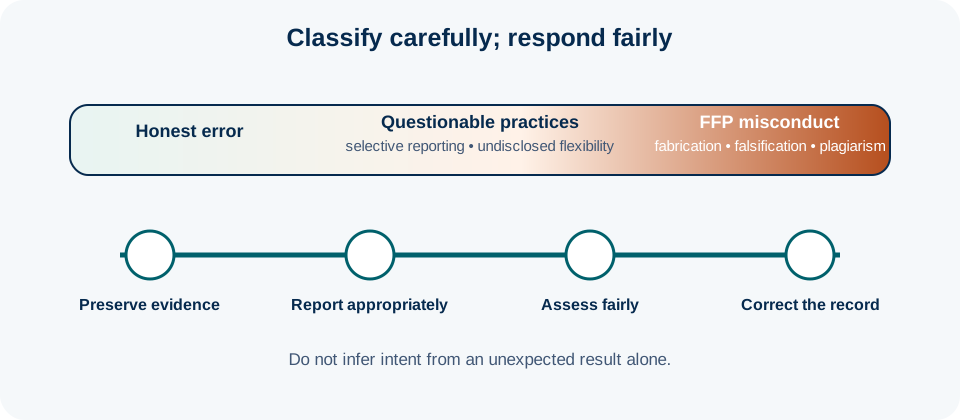
Research integrity concerns the trustworthiness of the entire scientific process. A widely used formal definition of research misconduct identifies fabrication, falsification and plagiarism (FFP), while recognising that many other questionable practices can damage reliability even when they do not meet a particular jurisdiction’s legal definition of misconduct.[1–3]
Examples include selective outcome reporting, inappropriate exclusion of observations, undisclosed analytic flexibility, misleading image manipulation, duplicate publication, p-hacking and presenting post hoc hypotheses as if they were prespecified. Researchers should distinguish honest error, poor practice and misconduct while responding seriously to all threats to the record.
Why this matters
Health decisions can be affected by a single distorted dataset, selectively reported outcome or irreproducible analysis. Integrity safeguards therefore belong in study design: prospective protocols, registration, reproducible code, audit trails, appropriate supervision and transparent reporting reduce ambiguity about what was planned and what changed. Broader research-integrity frameworks similarly emphasise institutional systems, culture and accountability in addition to individual conduct.[4]
A culture that punishes every honest mistake can encourage concealment; a culture that dismisses questionable practices as harmless can normalise bias. Responsible research needs both accountability and safe mechanisms for correction.
Core principles
Fabrication is making up data or results. Falsification involves manipulating research materials, processes or data so that the research record is not accurately represented. Plagiarism appropriates another person’s ideas, processes, results or words without appropriate credit.[1] Formal legal definitions and investigation thresholds vary by jurisdiction.
Questionable research practices occupy a broader space. Selective analysis and reporting may exploit researcher degrees of freedom; HARKing presents hypotheses developed after results as if they were known before,[5] while p-hacking searches analysis choices for favourable significance;[6] inappropriate image adjustment can remove or create apparent evidence. The remedy is not to ban exploratory analysis—it is to label exploration honestly and preserve the chronology of decisions.
Fabrication, falsification and plagiarism
FFP concerns deceptive distortion or appropriation, not every methodological disagreement or mistake. Honest error can still require correction, but misconduct findings generally require standards specified by the responsible institution or jurisdiction. Researchers should avoid making public accusations before appropriate fact-finding.
Selective reporting and outcome switching
A study may collect many outcomes and time points yet publish only favourable results. Prospective registration and protocols make selective reporting easier to detect. Changes can be legitimate, but the final paper should identify which outcomes were prespecified and explain important changes.[2,4]
P-hacking, multiple analysis paths and HARKing
Analytic flexibility is unavoidable in complex research, but undisclosed searching can exaggerate evidence. Prespecified analysis plans, version-controlled code, sensitivity analyses and transparent distinction between confirmatory and exploratory work reduce this risk. Robustness should not mean trying models until one yields the desired answer.
Data and image manipulation
Cleaning errors, transcription mistakes and image processing can be legitimate when documented and scientifically justified. Integrity problems arise when researchers alter or omit information to misrepresent evidence. Original files, audit trails and documented processing steps make verification possible.
Supervision, team culture and prevention
Many integrity failures occur in systems with poor oversight, unclear roles, unrealistic publication pressure or inaccessible data. Teams can reduce risk by defining responsibilities, protecting raw data, reviewing analysis decisions, using code review, documenting exclusions and encouraging questions without retaliation.
Responding to suspected problems
If a researcher encounters a possible error or misconduct concern, the first step is usually to preserve relevant records and follow institutional procedures rather than conducting an uncontrolled personal investigation. Serious concerns may require research-integrity officers, ethics committees, sponsors, journals or regulators depending on the issue. Confidentiality and procedural fairness matter for complainants and respondents.
Correction, retraction and the self-correcting record
Corrections are appropriate when the core findings remain valid but material errors need repair. Retraction may be appropriate when findings are unreliable because of misconduct or major error, or when other serious publication problems invalidate the record. Retraction is not synonymous with a misconduct finding. Transparent correction is a strength of science when errors are discovered and addressed responsibly.[2,3]
Questionable practices are not all legally “misconduct”
The US ORI definition is useful educationally but jurisdiction-specific.[1] Different institutions may define broader breaches of responsible research practice. This is why lectures should distinguish the conceptual harm of a practice from the formal process used to investigate it locally.
The research record should make the study reconstructable
Integrity is easier to protect when the study leaves a clear record of decisions. The protocol documents intentions; source data document observations; scripts document transformations; analysis plans document confirmatory choices; meeting notes and issue logs document important deviations. No single artefact is perfect, but together they make it possible to distinguish planned science, legitimate adaptation, honest error and deliberate distortion.
Reconstructability is especially important when an unexpected result becomes controversial. If the team can reproduce the dataset from source files and rerun the analysis from code, disagreements can focus on scientific interpretation rather than suspicion about hidden manipulation.
Selective reporting can occur without changing raw data
A researcher does not need to fabricate numbers to create a misleading paper. Selecting one of many outcomes, changing the time point, redefining the subgroup or choosing a favourable model can materially alter the story. If these decisions are made after seeing results and only the successful path is reported, readers receive an exaggerated impression of confirmatory evidence.
The remedy is transparent analytic history: prespecify what truly needs confirmatory status, document changes, report important deviations and label exploratory analyses as exploratory. Sensitivity analyses should test robustness, not function as a search engine for significance.
Questionable practices often arise from ordinary workflow pressures
Publication deadlines, grant renewal, promotion expectations and fear of disappointing supervisors can create incentives to cut corners. Small practices may become normalised: excluding inconvenient participants, stopping data collection when significance appears, reusing text without attribution, or reporting only the best-performing model. Training should therefore address systems and incentives, not only individual morality.
Leaders can reduce risk by rewarding careful negative results, requiring reproducible workflows, reviewing raw data periodically and making it safe for junior staff to ask difficult questions.
Statistical practices require methodological context
P-hacking is not simply “using many statistical tests”. Exploratory analysis legitimately examines data broadly. The problem is undisclosed flexibility combined with confirmatory claims. Similarly, changing a model is not falsification if the original model was inappropriate and the change is transparently justified. Research-integrity teaching should avoid turning methodological judgement into criminal language.
This distinction protects both scientific freedom and accountability. Investigators should be able to improve an analysis when evidence of model failure emerges, while preserving the original plan and explaining the reason for change.
Plagiarism is broader than verbatim copying
Appropriating another person’s ideas, analyses, text or results without appropriate credit can constitute plagiarism under relevant definitions. Reusing one’s own previously published text without transparent attribution may create redundant-publication or copyright concerns even when it is not plagiarism in the same sense. Authors should follow journal rules and cite original sources rather than disguising recycled work.
Methods language sometimes needs standard wording, but large-scale copied text should not be normalised merely because a method is routine.
Image integrity needs domain-specific judgement
Adjustment of brightness, contrast, cropping or image assembly may be scientifically legitimate when applied consistently and disclosed as required. Manipulation becomes problematic when it removes, adds, duplicates or selectively enhances features so that the image no longer represents the underlying observation. Journals and disciplines often have detailed image policies that should be consulted.
Original unprocessed images should be retained where applicable so concerns can be investigated.
Handling allegations requires procedural fairness
A suspicion is not a finding. Institutions generally distinguish preliminary assessment from formal investigation. Researchers should preserve evidence, avoid tipping off in ways that enable destruction of records, and avoid public accusations that can irreparably harm individuals before facts are established. Whistleblowers also require protection from retaliation under applicable policy.
The person raising a concern does not need to prove the entire case before reporting through an appropriate channel, but should distinguish observed facts from inference.
Honest error and responsible correction
Complex research inevitably produces mistakes. The integrity test is how researchers respond when a material error is discovered. If a coding mistake changes a table but not the conclusion, a correction may be enough. If the central result is unreliable, retraction or replacement may be required even without misconduct. If uncertainty remains while an investigation proceeds, journals may use expressions of concern according to their procedures.
Researchers should therefore view correction mechanisms as part of scholarship rather than humiliation. Protecting a false result because of reputation compounds the original problem.
Prevention is more effective than detection alone
Training, mentoring, open code review, clear authorship rules, realistic workload, secure data systems and transparent protocols reduce opportunities for wrongdoing. Audits and image screening can detect some problems but cannot create a healthy research culture by themselves.
A mature integrity system combines prevention, safe reporting, fair investigation and proportionate correction of the record.
Building an integrity-oriented analysis workflow
Before analysis begins, create a read-only or preserved copy of the raw data and perform cleaning through scripted, reproducible transformations where feasible. Every exclusion should be linked to a rule or documented decision. Manual spreadsheet edits should be minimised or logged because they are difficult to audit and easy to misapply.
Analysis code should generate the main tables and figures from controlled inputs. Peer review within the team can check whether denominators, model choices and outcome definitions match the protocol. For high-stakes analyses, an independent reproduction or statistical review may detect errors before publication.
A decision log is useful when unexpected issues arise. If a variable is unusable, a model fails to converge or a protocol assumption is violated, record the problem, alternatives considered, decision date and whether outcome results were already known. This preserves the distinction between principled adaptation and result-driven choice.
Integrity in qualitative and mixed-methods research
Research integrity is not limited to numerical data. Fabricating interview quotations, selectively presenting only themes that support the investigators’ preferred theory, failing to represent negative cases or claiming analytic procedures that were not performed can distort qualitative research. Reflexive interpretation is legitimate; invented evidence is not.
Mixed-methods studies should preserve how qualitative and quantitative strands were integrated rather than constructing a coherent story after the fact while hiding discordant findings.
Integrity in AI-assisted research
Generative AI and automated coding tools can introduce fabricated citations, undocumented transformations and confidentiality risks. Researchers should verify outputs against source material, preserve human oversight and disclose use when required. AI-generated text should never be assumed accurate because it sounds authoritative.
If AI is used to classify records or extract variables, validation and error monitoring become part of data integrity. A model can systematically misclassify data without any human intending deception, creating an honest methodological error that still requires correction.
Protecting people who raise concerns
Research organisations need channels that allow staff and students to raise concerns without routing every complaint through the person whose conduct is questioned. Fear of retaliation can suppress early warnings. At the same time, allegations should be handled confidentially and fairly to avoid punishment based on rumour.
Training should explain whom to contact, what records to preserve and what the institution’s process will do next. People are more likely to report responsibly when the route is clear.
Learning after an integrity event
After an error or confirmed misconduct case, institutions should ask what system changes are needed. Was supervision inadequate? Were raw data inaccessible? Did incentives reward speed over quality? Could code review, authorship policies or clearer data governance have prevented the problem? Focusing only on one individual may miss conditions that allow recurrence.
The aim is a research culture in which reliable work is easier to produce, concerns can be raised early and correcting the record is treated as a core scientific responsibility.
When you discover a serious concern
- Preserve original data, files, messages and audit trails.
- Separate what you know from what you suspect.
- Do not alter records or conduct covert evidence manipulation.
- Consult the applicable institutional research-integrity procedure.
- Protect confidentiality and avoid retaliatory or public accusations while the matter is assessed.
Integrity-by-design safeguards
- Register and prespecify confirmatory outcomes where appropriate.
- Use version-controlled protocols, datasets and analysis code.
- Document exclusions, transformations and deviations with reasons.
- Preserve raw/source records and audit trails.
- Separate exploratory from confirmatory analyses in reporting.
- Define supervision, data access and escalation responsibilities.
- Plan how errors discovered after publication will be handled.
Appraise integrity risks
- Can major analysis decisions be reconstructed from records?
- Were outcomes or hypotheses changed after seeing data without disclosure?
- Are exclusions and image/data processing scientifically justified and documented?
- Do team incentives or hierarchy discourage raising concerns?
- Does the final report distinguish error, uncertainty, exploration and prespecified inference honestly?
Worked example
Investigating unexplained exclusions without rewriting history
The team freezes the current dataset and analysis repository, restores the six records from the source-controlled copy and verifies each against source documents. Two values are confirmed transcription errors and corrected with an audit trail; four are valid extreme observations. The investigators rerun the prespecified analysis including the valid records and perform a clearly labelled sensitivity analysis using an independently justified robust method.
They disclose the original cleaning error internally and, if the affected result had already been disseminated, follow the appropriate correction process. The key integrity safeguard is the preserved chronology, not pretending the mistake never occurred.
Suggested protocol or governance wording
Common mistakes
Knowledge check
What are the three practices in the common FFP definition of research misconduct?
Answer and reasoning
Fabrication, falsification and plagiarism.
Is an exploratory hypothesis unethical because it was developed after seeing the data?
Answer and reasoning
No. Exploration is legitimate. The integrity problem is presenting a post hoc hypothesis as if it had been prespecified.
Does every retraction prove misconduct?
Answer and reasoning
No. Articles may be retracted because of major honest error, unreliable findings or other serious problems. A retraction and a formal misconduct finding are different determinations.
Why preserve raw data and version-controlled code?
Answer and reasoning
They allow the research chronology to be reconstructed, support error correction and make undocumented manipulation more difficult.
Key take-home messages
Key take-home messages
- Research integrity includes both formal misconduct and broader questionable practices that can distort evidence.
- FFP should be distinguished from honest error and from locally defined broader breaches.
- Prespecification and version control reduce undisclosed analytic flexibility.
- Exploratory work is valuable when labelled honestly.
- Responsible correction of material errors protects rather than weakens the scientific record.
References
- US Office of Research Integrity. Definition of research misconduct. https://ori.hhs.gov/definition-research-misconduct
- International Committee of Medical Journal Editors. Recommendations for the conduct, reporting, editing, and publication of scholarly work in medical journals. Updated January 2026. https://www.icmje.org/recommendations/
- Committee on Publication Ethics. COPE Core Practices and guidance. https://publicationethics.org/
- National Academies of Sciences, Engineering, and Medicine. Fostering integrity in research. Washington, DC: National Academies Press; 2017. https://doi.org/10.17226/21896
- Kerr NL. HARKing: hypothesizing after the results are known. Pers Soc Psychol Rev. 1998;2(3):196–217. https://doi.org/10.1207/s15327957pspr0203_4
- Simmons JP, Nelson LD, Simonsohn U. False-positive psychology: undisclosed flexibility in data collection and analysis allows presenting anything as significant. Psychol Sci. 2011;22(11):1359–1366. https://doi.org/10.1177/0956797611417632
These materials support learning and research planning. They require adaptation to the study context and do not replace methodological, statistical, ethical, or regulatory consultation.