
Part 16 · Module 2
Writing the Methodology Section of a Protocol
Learn to write a protocol methodology section that turns research objectives into reproducible design, sampling, measurement, procedure and analysis decisions.
Learning outcomes
After completing this lecture, you should be able to:
- Translate specific objectives into explicit methodological procedures.
- Write reproducible descriptions of design, setting, population, sampling and measurements.
- Distinguish methodological justification from procedural detail.
- Align data collection, quality assurance and analysis with the intended inference.
- Identify ambiguous wording that allows post hoc methodological decisions.
Overview
The methodology section is the executable core of a research protocol. It should tell a competent reader how the study population will be constructed, how exposure or intervention and outcomes will be defined, when measurements occur, how bias and data-quality threats will be controlled, and how the resulting data will answer the objectives. Contemporary protocol and reporting standards reinforce this requirement for transparent specification rather than generic statements such as “standard methods will be used”.[1–6]
Good methodology writing is therefore not primarily about prose style. It is about converting methodological decisions into language that is specific enough to be audited. A phrase such as “patients will be randomly selected” is inadequate unless the sampling frame, randomisation mechanism and recruitment process are specified. “Validated questionnaire” is inadequate unless the instrument, version, language, scoring and administration procedure are identified. “Appropriate statistical tests” is not a plan because appropriateness cannot be judged until the outcomes, estimands and models are defined.
Why this matters
Ambiguity in a methodology section creates analytic and operational degrees of freedom. Two sites may interpret the same eligibility criterion differently. Research assistants may record the same outcome using different windows. Analysts may choose among several defensible models after seeing the data. These problems reduce reproducibility and can introduce bias even when the investigators act in good faith.
The methodology section also connects scientific validity to ethics. Participants are asked to contribute time, information or risk on the expectation that the study can produce useful knowledge. If the procedures are too vague to implement consistently, that expectation is weakened. Clear methods allow ethics committees, supervisors, funders, statisticians and operational staff to review the same planned study rather than different interpretations of it.
Key concepts
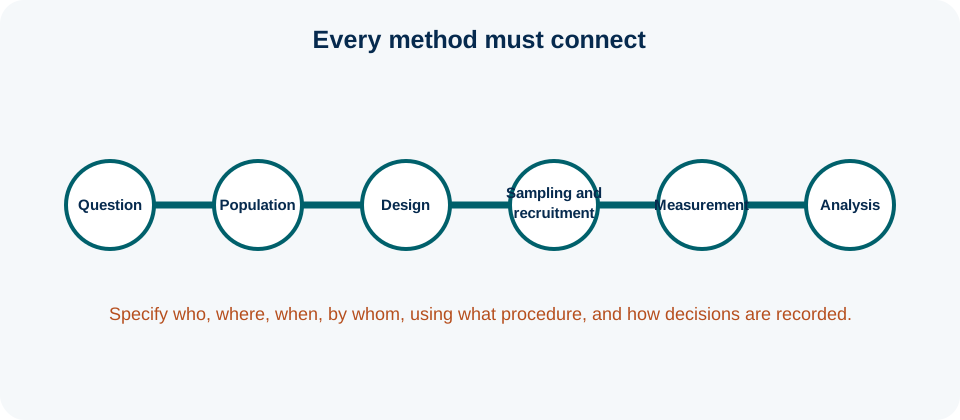
Methodology writing should distinguish design parameters, operational definitions, procedures, and analytic interfaces. Design parameters include the design family, time origin, comparison structure and follow-up. Operational definitions convert constructs such as “controlled hypertension” or “adherence” into reproducible criteria. Procedures explain who measures what, when and how. Analytic interfaces identify which variables and repeated observations will contribute to each objective.
The appropriate level of detail depends on consequence. Decisions that can change who enters the study, how the primary outcome is classified, what comparison is made or which observations are excluded should be explicit in the protocol. Very granular instructions—such as the screen-by-screen sequence for entering data—can be placed in an SOP or manual if the protocol references the controlled document. The protocol should remain readable while preserving all decisions necessary to understand validity.
Methodology writing also benefits from temporal ordering. Describe what happens before enrolment, at enrolment or baseline, during exposure or intervention, during follow-up, at outcome ascertainment, and before analysis. This reveals impossible sequences, such as defining an exclusion criterion using information available only after the outcome has occurred.
For each methodological paragraph, ask what decision it must make explicit
- Who or what can enter the study and from which source population?
- What event or date defines baseline and the start of follow-up?
- How are intervention, exposure, comparator and outcomes operationalised?
- Who measures each variable, with what instrument, under what timing window?
- What procedures prevent or detect important selection, measurement and data-quality errors?
- How will the collected information map to the planned analysis?
A step-by-step methodological workflow
1. Name the design precisely and justify it
State whether the design is cross-sectional, cohort, case-control, randomised, quasi-experimental, diagnostic, qualitative, mixed methods or another recognised approach. Add the key structural features that affect inference, such as prospective versus retrospective ascertainment, clustering, repeated measurements or matching. One sentence should explain why this design fits the primary question better than the main feasible alternatives.
2. Define setting, calendar time and study base
Specify institutions, clinics or communities, recruitment dates, follow-up period and any relevant service context. Define the target and source populations before listing eligibility criteria. This prevents the common error of describing inclusion criteria without making clear the population from which eligible people arise.
3. Write eligibility as observable rules
Each inclusion or exclusion criterion should be assessable at the point it is applied. Avoid labels such as “severe disease”, “poor compliance” or “unfit” unless an operational criterion is provided. Distinguish scientific exclusions from logistical exclusions, and consider whether criteria unnecessarily narrow external validity or exclude groups whose participation could be made safe with reasonable adaptations.
4. Describe sampling and recruitment separately
Sampling determines which eligible units have an opportunity for selection; recruitment is the process of approaching and enrolling them. A consecutive sample, a simple random sample and an open invitation create different selection mechanisms. State the sampling frame, selection procedure, approach pathway, consent process, refusal tracking and any caps or stratification.
5. Operationalise variables and measurement schedules
For each primary and important secondary variable, specify definition, instrument or source, unit, timing, assessor and scoring or derivation rules. For repeated measures, show the permitted visit windows and how unscheduled measurements are treated. For record-based variables, specify the relevant data fields, coding systems and look-back period.
6. Connect procedures to analysis and quality control
State how the primary objective will be analysed, what observations enter that analysis and how common complications such as missingness, clustering or confounding will be addressed. Then identify critical-to-quality procedures: training, calibration, source verification, central review, inter-rater checks, query rules or monitoring. Quality procedures should target the variables and processes most capable of changing the study conclusion.
Methods details that should be reproducible from the protocol
- design and inferential purpose;
- setting, study period and time origin;
- target, source and study populations;
- eligibility, sampling and recruitment;
- sample-size or information-power rationale;
- operational definitions and measurement schedule;
- participant or record flow and follow-up;
- data-quality, monitoring and deviation procedures;
- analysis population, primary analysis and missing-data principles.
An auditable planning document
Objective-to-method mapping table
illustrativeTable 1. Illustrative objective-to-method mapping
| Objective | Required data | Methodological specification | Analysis interface |
|---|---|---|---|
| Estimate 6-month BP control | Standardised BP at 6 months | Device, rest period, repeat readings, visit window | Proportion controlled with CI |
| Evaluate adherence as predictor | Valid adherence measure before outcome | Instrument version, scoring rule, timing | Regression coefficient or adjusted association |
| Describe treatment changes | Medication records across follow-up | Source, coding and date rules | Frequency and timing summaries |
| Assess loss to follow-up | Contact status and last observed date | Contact attempts and closure rule | Attrition description and sensitivity analysis |
Note: The table is illustrative and should be adapted to the actual objectives.
Quality, validity and governance
Quality begins by identifying which procedures are critical to the credibility of the primary conclusion. If the primary outcome is clinic blood pressure, device calibration, participant preparation, repeat-reading rules and outcome-window adherence deserve more attention than low-impact variables. If the study uses medical records, data provenance, coding definitions, duplicate records and changes in the electronic system may be more important than traditional bedside standardisation.
A methods section should also expose likely biases rather than hiding them under a generic “limitations” paragraph. Consecutive clinic recruitment may miss people who do not attend care. Self-reported adherence may be influenced by social desirability. A retrospective cohort may have incomplete confounder measurement. Stating the mechanism enables prevention or sensitivity analysis. Current reporting guidance is useful during protocol development because it reveals information that readers will later need to judge selection, measurement, follow-up and analysis.[1–6]
Finally, methods and operational documents must be synchronised. If an SOP changes the blood-pressure procedure, the team should assess whether the protocol, CRF, training materials and analysis derivations are affected. Version control is a methodological safeguard, not merely an administrative one.
Appraise the methodology section for executability
- Could a new site identify eligible participants without asking the author for clarification?
- Are the time origin, follow-up windows and outcome definitions unambiguous?
- Are sampling and recruitment mechanisms separately described?
- Can each specific objective be mapped to collected variables and a planned analysis?
- Are critical measurements standardised sufficiently to control avoidable information bias?
- Are deviations, missingness and data-quality problems handled prospectively rather than left to analyst discretion?
Practical decision audit
Replace adjectives with criteria
Words such as “adequate”, “recent”, “severe”, “regular”, “poor” and “stable” often hide decisions. Replace them with thresholds, validated categories, time windows or documented clinical criteria. Where clinical judgement is necessary, specify who makes the judgement and what evidence is reviewed.
Test the chronology
Draw a timeline from eligibility assessment to the final observation. Confirm that baseline covariates are measured before the exposure or outcome they are supposed to precede, that follow-up starts at a defined time zero, and that eligibility does not depend on surviving or remaining event-free during a period that occurs after cohort entry.
Test inter-site consistency
For multicentre work, imagine two research assistants at different sites applying every important procedure. If their interpretations could diverge, add definitions, training criteria or central adjudication. Site-specific operational differences should be documented because they may affect both bias and analysis.
Test the methods against the planned tables
Draft the main shell tables or figures. Missing denominators, undefined categories or impossible contrasts often become obvious immediately. This is especially useful when a protocol has many secondary objectives that may otherwise accumulate without a clear data-to-result pathway.
Writing methods at the level of the research decision
A useful way to improve methodology writing is to ask whether each paragraph answers a decision question. “The study will be conducted at Hospital A” gives a location, but the methodological decision may be broader: why this setting, what population does it serve, and what features of the setting affect applicability? “Participants will complete a questionnaire” states an action, but the important decision concerns which instrument, why it measures the intended construct, in which language, at what time, and how scores are derived. This shift from activity description to decision description makes methods more informative without necessarily making them much longer.
Separate what is fixed from what is responsive
Not every study procedure can be completely rigid. Qualitative interviews adapt to participant responses; pragmatic trials allow ordinary clinical variation; implementation research may permit contextual adaptation. The methodology section should therefore distinguish fixed elements, which define the scientific comparison, from responsive elements, which can vary within prespecified boundaries. For example, an interview guide can contain core domains that must be covered while allowing flexible probing. An implementation strategy can preserve its core function while adapting delivery format. The protocol should specify how adaptations are documented so that flexibility does not become invisible methodological drift.
Define denominators prospectively
Many reporting problems begin because the protocol never defined the denominator. The denominator for adverse events may be all treated participants, while the denominator for questionnaire completion may be all participants expected to complete that time point. In diagnostic studies, denominators can differ because some participants do not receive the reference standard. In surveys, item-level missingness can change percentage denominators. The methods should specify who is expected to contribute to each major outcome and how missing or not-applicable observations will be represented.
Write methods for the difficult participant, not only the ideal participant
A protocol often reads smoothly because it imagines a participant who attends every visit and has complete data. Test the methods against difficult but plausible cases: an eligible person becomes pregnant during follow-up; a participant transfers care; a laboratory sample is haemolysed; a questionnaire is completed outside the visit window; a record has conflicting dates; a cluster closes early. The methodology section should either provide a rule or identify the governance process that will make the rule. This reduces ad hoc decisions during conduct.
Include enough detail to appraise applicability
Methods should allow readers to judge whether findings apply to their own setting. Report recruitment context, referral pathways, service intensity and eligibility restrictions that shape the study population. A tertiary-centre cohort may differ from community patients even when diagnoses are identical. Applicability information is not decorative background; it is part of understanding what population the study estimates describe.
Worked example
Rewriting the hypertension cohort methods
The team revises its vague “prospective study” into a prospective clinic-based cohort of adults with diagnosed hypertension who attend two participating primary-care clinics during a defined six-month recruitment window. Consecutive eligible patients are approached after clinic registration. Baseline is the enrolment visit. Blood pressure is measured using a named validated automated device after a standard rest period, using the mean of prespecified readings. Medication adherence is assessed with a specified questionnaire version before the outcome visit.
The primary outcome is blood-pressure control at six months within a defined visit window. Treatment changes, admissions and adverse events are abstracted from the electronic record using dated rules. Participants who miss the six-month visit receive a prespecified sequence of contact attempts. The protocol explains which observations enter the primary analysis, the effect measure for the adherence association, the confounders selected from the conceptual framework, and the sensitivity analysis for missing outcome data.
The rewritten section is longer, but its real improvement is that key scientific decisions are no longer hidden behind phrases such as “followed up”, “measured” and “analysed appropriately”.
Suggested protocol and manuscript wording
Common mistakes
Knowledge check
Why should sampling and recruitment be written as separate concepts?
Answer and reasoning
Sampling determines how eligible units are selected from a source population; recruitment describes how selected or encountered people are approached, consented and enrolled. They create different sources of selection bias.
What is wrong with writing “blood pressure will be measured using standard technique”?
Answer and reasoning
The wording does not specify the device, preparation, number of readings, averaging rule, assessor or timing. Different teams could implement materially different measurements.
Why draft table shells while writing a methodology section?
Answer and reasoning
They reveal whether each objective has the variables, denominators, categories and comparisons required to produce an interpretable result.
Should every operational instruction be placed in the protocol?
Answer and reasoning
No. Detailed procedures can reside in controlled SOPs or manuals, but decisions that affect eligibility, primary measurements, participant flow or inference must remain visible and consistent with the protocol.
Key take-home messages
Key take-home messages
- The methodology section should be executable, not merely descriptive.
- Write observable rules for population, timing, variables and procedures.
- Sampling, recruitment, measurement and analysis must be linked to specific objectives.
- Quality assurance should focus on critical-to-quality processes and variables.
- A good methods section reduces the number of scientifically important decisions left until after data are seen.
References
- Chan AW, Boutron I, Hopewell S, et al. SPIRIT 2025 statement: updated guideline for protocols of randomised trials. BMJ. 2025;389:e081477. https://doi.org/10.1136/bmj-2024-081477
- Hróbjartsson A, Chan AW, Collins GS, et al. SPIRIT 2025 explanation and elaboration: updated guidance and exemplars for protocols of randomised trials. BMJ. 2025;389:e081660. https://doi.org/10.1136/bmj-2024-081660
- Hopewell S, Chan AW, Collins GS, et al. CONSORT 2025 statement: updated guideline for reporting randomised trials. BMJ. 2025;388:e081123. https://doi.org/10.1136/bmj-2024-081123
- von Elm E, Altman DG, Egger M, Pocock SJ, Gøtzsche PC, Vandenbroucke JP. The STROBE statement: guidelines for reporting observational studies. PLoS Med. 2007;4(10):e296. https://doi.org/10.1371/journal.pmed.0040296
- International Council for Harmonisation. ICH E6(R3) guideline for good clinical practice: principles and Annex 1. Step 4. 2025. https://database.ich.org/sites/default/files/ICH_E6%28R3%29_Step4_FinalGuideline_2025_0106.pdf
- EQUATOR Network. Search for reporting guidelines. Oxford: EQUATOR Network. https://www.equator-network.org/reporting-guidelines/
These materials support learning and research planning. They require adaptation to the study context and do not replace methodological, statistical, ethical, or regulatory consultation.