
Part 11 · Module 9
Trustworthiness and Reflexivity
Apply trustworthiness and reflexivity as coherent, methodology-sensitive quality practices throughout qualitative research rather than as a checklist added after analysis.
Learning outcomes
After completing this lecture, you should be able to:
- Explain credibility, dependability, confirmability and transferability and recognise that they arise from a particular qualitative tradition.
- Use reflexivity to examine how researcher position, relationships and assumptions shape the research process.
- Appraise triangulation, member reflection, negative-case analysis and audit trails without treating any single technique as proof of quality.
- Match quality strategies to the epistemology, methodology and analytic approach used.
- Develop a prospective trustworthiness and reflexivity plan for an advanced qualitative health study.
Overview
Qualitative quality is sometimes reduced to a list of techniques: triangulation, member checking, two coders and an audit trail. That approach is misleading. A study can perform all four activities and still be conceptually incoherent, poorly sampled or analytically superficial. Conversely, some high-quality qualitative approaches deliberately do not use coder agreement or respondent validation as truth tests.
A stronger approach asks whether the study’s claims are credible, transparent, reflexive, sufficiently evidenced and coherent with its epistemological and methodological commitments.[1]
One influential naturalistic tradition describes trustworthiness through credibility, dependability, confirmability and transferability.[2] These concepts are valuable, but they should not be treated as the only possible vocabulary for qualitative quality. Tracy proposes broader quality criteria such as worthy topic, rich rigour, sincerity, credibility, resonance, significant contribution, ethics and meaningful coherence.[3] The important principle is methodological fit rather than checklist compliance.
Why this matters
Qualitative researchers are themselves part of the knowledge-production process. They decide whom to approach, what to ask, when to probe, which passages to code, what counts as a pattern, which contradictions deserve attention and how findings are written. Pretending that these decisions disappear when procedures are standardised can make the study less rather than more transparent.
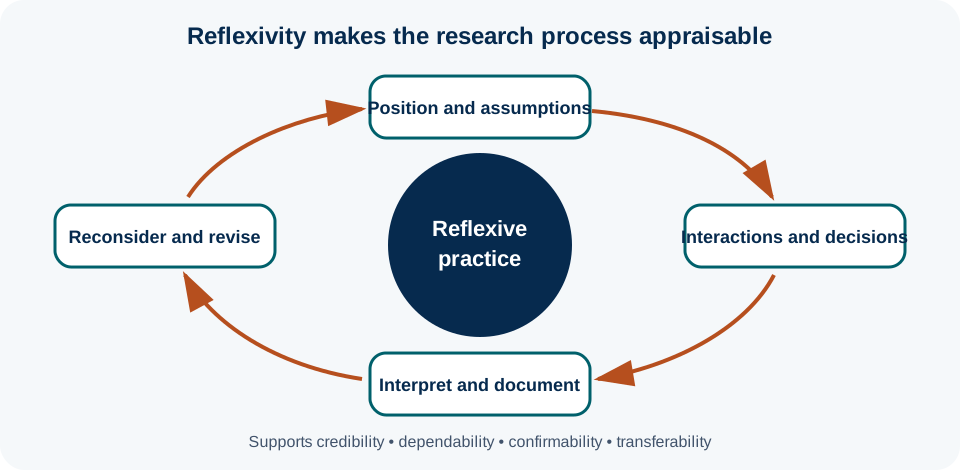
Reflexivity provides a disciplined way to examine those influences. Berger describes reflexivity as an ongoing process in which researchers consider how their position and relationship to the field may shape the inquiry.[4]
Trustworthiness as a quality framework
Credibility
Credibility concerns whether interpretations are plausible and well supported in relation to the participants, data and context. It is not equivalent to internal validity in a simple one-to-one sense.
Strategies that may support credibility include prolonged or sufficiently deep engagement, appropriate sampling, attention to contradictory cases, triangulation, participant reflection and clear evidential links between data and interpretation.[2]
No technique guarantees credibility. A participant agreeing with a researcher’s interpretation does not transform it into objective truth, and a participant disagreeing does not automatically falsify the analysis.
Dependability
Dependability concerns the transparency and reasoned consistency of the research process. Because qualitative designs may evolve, dependability does not mean that nothing changes. It means that changes are documented and justified.
Examples include versioned interview guides, sampling decision logs, analytic memos, records of category or theme development, and documentation of why recruitment or analysis changed.
Confirmability
Confirmability addresses whether findings are grounded in the study material rather than presented as unsupported researcher preference. The researcher’s subjectivity is not expected to disappear; instead, reflexive and evidential practices make its role visible.
An audit trail, reflexive memos, quotations, negative-case analysis and transparent analytic explanation may support confirmability.[2]
Transferability
Transferability concerns the extent to which readers can judge whether findings may be informative in another setting or population. The researcher supports that judgement by providing contextually rich description, not by claiming statistical representativeness.
Information about setting, participants, service organisation, recruitment and relevant social conditions helps readers compare contexts.
Reflexivity
Reflexivity is systematic attention to how the researcher and research process participate in knowledge production.[4]
Personal reflexivity
Researchers examine assumptions, experiences, identities, values and emotional responses that may shape the study. A clinician interviewing patients about adherence may bring expectations about responsibility, risk and appropriate behaviour.
Relational reflexivity
Data are co-produced within relationships. Hierarchy, familiarity, language, age, gender, professional role and institutional affiliation can affect what participants say and what interviewers feel able to ask.
Methodological reflexivity
Researchers question how design decisions shape the findings: who was not recruited, which questions were prioritised, what the interview guide made easier or harder to discuss, how coding fragments context, and what an analytic framework foregrounds or obscures.
Contextual and institutional reflexivity
Funding, service priorities, policy commitments and research-team interests can affect the problem definition and interpretation. A study evaluating a programme developed by the researcher’s own institution warrants explicit attention to that relationship.
Build reflexivity into the study prospectively
- Describe relevant researcher backgrounds and relationships to the topic.
- Identify assumptions that may shape question framing or interpretation.
- Consider how participants may perceive the interviewer or observer.
- Maintain reflexive memos during recruitment, data generation and analysis.
- Discuss divergent interpretations within the team rather than seeking superficial unanimity.
- Record major analytic decisions and why they changed.
- Examine how funding, organisational roles or prior programme involvement may create commitments.
- Report reflexivity relevant to understanding the findings rather than an autobiographical catalogue.
Triangulation
Triangulation is often described as using several methods, researchers, sources or theoretical perspectives. It can reveal convergence, complementarity or divergence.
The weak version asks, “Do all sources say the same thing?” The stronger version asks, “What does each source allow us to see, and what can we learn when their accounts differ?”
Data-source triangulation
Compare experiences across participants, sites, roles, times or forms of data. For example, patient interviews, staff focus groups and observations may illuminate different aspects of the same follow-up pathway.
Investigator triangulation
Several researchers contribute interpretations. This can broaden analytic perspective. It should not automatically be translated into inter-rater reliability unless the analytic method is explicitly designed around reproducible coding.
Method triangulation
Different methods address complementary aspects of a phenomenon—for example, interviews for meaning and observation for enacted workflow.
Theory triangulation
Alternative theoretical lenses can expose different assumptions or mechanisms. It is useful when done intentionally, not as a competition to identify the one “correct” theory.
Member checking, participant validation and member reflection
Returning transcripts or interpretations to participants is frequently recommended, but several different activities are often collapsed under “member checking”:
- confirming factual details;
- asking participants to comment on transcripts;
- discussing preliminary categories or themes;
- presenting findings to a participant group; or
- inviting reflections on how interpretations resonate or differ.
Each has a different purpose.
A participant’s later account may differ because circumstances changed, because the researcher’s synthesis goes beyond one individual’s perspective, or because the participant disagrees with the interpretation. Researchers should not treat participants as infallible adjudicators of the entire dataset.
A more useful formulation may be member reflection: participants’ responses become additional material for thinking about the analysis rather than a binary validity certificate.
Negative cases and disconfirming evidence
Analyses become more credible when researchers deliberately seek evidence that complicates the emerging story.
Suppose the developing theme is “postpartum testing becomes invisible after maternity discharge”. Several women, however, describe persistent concern and highly organised testing despite fragmented services. These cases may show that strong prior diabetes knowledge or family experience changes how women respond to weak service signals.
The analysis should be refined to accommodate this variation rather than quietly excluding it.
When an interpretation seems persuasive, challenge it
Ask:
- Which participants or data items do not fit?
- Is the apparent pattern produced by the sampling strategy?
- Am I privileging vivid or professionally familiar accounts?
- Would another theoretical lens explain the same material differently?
- Does the wording of the claim exceed what the evidence supports?
- What contextual conditions appear necessary for the pattern?
Use contradictions to improve the claim rather than to protect it.
Audit trails and decision trails
An audit trail is a structured record of how the study developed. Possible elements include:
- protocol and amendment versions;
- sampling and recruitment logs;
- interview-guide versions;
- field notes;
- reflexive journals;
- coding-framework versions where relevant;
- analytic memos;
- theme or category maps;
- records of team discussions; and
- decisions linking data to final claims.
The purpose is not to create bureaucracy. The record should make consequential decisions traceable.
Audit trail versus reproducibility
A second researcher may not reproduce the identical interpretation because qualitative analysis involves situated judgement. The audit trail instead allows readers and team members to understand how the interpretation was reached and assess whether the reasoning is coherent and grounded.
Research-team reflexivity
Team diversity can strengthen analysis when differences are used productively. A clinician may notice workflow details, a sociologist may challenge individualised explanations, and a patient partner may recognise institutional assumptions that professionals overlook.
However, merely listing a multidisciplinary team does not demonstrate reflexivity. The study should explain how perspectives influenced decisions.
Using analytic disagreement reflexively
Two analysts review a passage in which a woman says she “forgot” the glucose test because she had many newborn-care appointments.
The clinician initially codes poor recall. The social-science analyst codes preventive care displaced by intensive infant-care demands. They return to the transcript and several related cases. The team notices that women repeatedly describe highly organised attendance for infant appointments while maternal follow-up lacks a clear appointment and named service.
The final category becomes asymmetric organisation of mother and infant care. The team records that the clinicians’ initial assumption individualised a problem that the broader dataset linked to service structure.
The value of multiple analysts here is not agreement. It is the capacity to identify and interrogate assumptions.
Method-specific quality criteria
Qualitative traditions do not share one universal quality checklist. Tracy’s criteria emphasise broad qualities such as rich rigour, sincerity and meaningful coherence.[3] Reporting standards such as SRQR ask authors to disclose design, context, researcher characteristics, data collection and analytic processes.[5] JARS-Qual similarly supports transparent reporting across qualitative traditions.[6]
These frameworks overlap, but none should be used to erase methodological differences.
Reflexive thematic analysis
Quality may involve rich engagement with data, theoretically coherent interpretation, reflexivity and themes that capture meaningful patterns. Mandatory coder agreement can be inconsistent with the method’s assumptions.
Grounded theory
Quality should consider whether iterative data collection and analysis, constant comparison, memoing, category development and—where claimed—theoretical sampling actually occurred.
Phenomenology
Appraisal should examine coherence between the phenomenological orientation, focus on lived experience, analytic procedures and interpretive claims.
Ethnography
Depth of contextual engagement, observation, field relationships and interpretation of cultural or organisational practice are particularly important.
Qualitative content analysis
The clarity of analytic units, coding process, category development, interpretive level and evidential linkages should match the chosen content-analysis tradition.
Why importing quantitative validity language can distort qualitative appraisalMMed extension
Terms such as bias, reliability and validity can sometimes be used thoughtfully in qualitative research, but direct transfer of quantitative criteria can produce category errors. Statistical representativeness, power calculations and measurement reliability answer questions that are not automatically relevant to interpretive sampling or theme development.
Advanced appraisal begins with the study’s knowledge claim: What is the study trying to know? Under what assumptions? Through what relationship between researcher, participants and evidence? Quality criteria should then test the coherence and credibility of that claim.
This does not exempt qualitative research from rigour. It requires a form of rigour appropriate to the inquiry rather than a weaker imitation of another paradigm.
Ethics and reflexivity
Reflexivity also has an ethical dimension. Interviews can evoke distress; researchers may occupy positions of authority; interpretations can stigmatise groups even when individuals are anonymised. Researchers should ask not only “Is this interpretation supported?” but also “How am I representing people, and what consequences might this representation have?”
Writing a trustworthiness plan
Appraising claims of trustworthiness
Do the quality claims match the actual study?
- Is the quality framework compatible with the methodology and epistemology?
- Are strategies described concretely rather than merely named?
- Is reflexivity present throughout the study or only in a final paragraph?
- Are researcher roles, relationships and prior commitments relevant to interpretation reported?
- Does triangulation explore convergence and divergence?
- Is participant feedback given a defined purpose?
- Are negative or contradictory cases visible in the analysis?
- Is the decision trail proportionate and meaningful?
- Do quotations and contextual evidence support the claims?
- Are transfer claims bounded by sufficient contextual description?
- Are quality techniques incorrectly presented as guarantees?
Reflexivity across the full research lifecycle
Reflexivity should begin before the first interview. During problem formulation, ask why this topic has been defined as a problem and whose priorities shaped the question. During sampling, ask which perspectives are easiest for the team to access and which require additional effort. During data generation, examine how status, language and setting affect what can be said. During analysis, document which explanations feel intuitively persuasive and why. During writing, consider whose voices become representative and which quotations are selected to carry the argument.[1,4]
This lifecycle perspective prevents reflexivity from becoming a ceremonial paragraph under “researcher characteristics”. It also supports ethical awareness: the same professional authority that facilitates access may inhibit criticism, and the same insider knowledge that improves probing may cause the interviewer to assume shared meanings without asking participants to explain them.
Insider and outsider positions
Researchers are rarely entirely insiders or outsiders. A clinician may be an insider to medical practice but an outsider to a patient’s family experience; a researcher from the same community may share language but differ in class, profession or age. Positions can also shift across encounters.[4]
Rather than claiming neutrality, researchers can ask what their position enables and constrains. Insider status may provide contextual understanding and trust but can normalise practices that deserve questioning. Outsider status may make taken-for-granted assumptions more visible but can produce misunderstanding or limited access.
Proportionate quality strategies
Not every qualitative study requires every trustworthiness technique. A small interview study may benefit more from deep reflexive analysis and negative-case examination than from adding several superficial “triangulation” activities. An ethnography may derive credibility from prolonged engagement and contextual depth, whereas a directed content analysis may need a transparent coding framework and explicit handling of material outside the framework.[2,3]
A useful protocol therefore links each quality strategy to a specific threat or need:
| Quality concern | Possible strategy | What the strategy contributes |
|---|---|---|
| Researcher assumptions dominate early interpretation | reflexive memoing and team dialogue | makes assumptions visible and contestable |
| Sample misses contrasting experiences | purposive variation or iterative sampling | broadens the evidential range |
| Emerging explanation ignores exceptions | negative-case analysis | tests boundaries of the claim |
| Readers cannot judge contextual relevance | thick contextual description | supports transferability judgement |
| Analysis changes without trace | versioned memos and decision trail | makes evolution transparent |
The justification is more important than the number of techniques listed.
Reflexivity in collaborative and patient-involved research
Patient or public contributors can add perspectives unavailable to professional researchers, but involvement does not automatically eliminate bias or confer authenticity on every interpretation. Contributors also occupy particular positions and may not represent all patients. Their role, influence and disagreements should be documented with the same reflexive care applied to academic team members.[5,6]
When a patient partner challenges terminology such as “non-compliant women”, for example, the contribution may expose a hidden moral assumption in the analysis. The team should record how the language and interpretation changed, rather than merely stating that “patient involvement enhanced validity”.
Common mistakes
Knowledge check
Does using two independent coders automatically make a qualitative analysis more trustworthy?
Answer and reasoning
No. The value of multiple analysts depends on the analytic approach. A structured coding design may value consistency, whereas reflexive thematic analysis may use different interpretations to expose assumptions and deepen analysis. Methodological fit matters more than the number of coders.
A participant disagrees with one of the final themes. Does that invalidate the theme?
Answer and reasoning
Not automatically. The theme is an interpretation across a dataset and may not reproduce every individual’s self-interpretation. The disagreement should be considered seriously and may refine the analysis, but participant feedback is not a simple true-or-false test of the whole analytic account.
Why can a negative case strengthen rather than weaken qualitative analysis?
Answer and reasoning
A negative case tests the boundaries of an emerging claim. Examining why it differs can reveal contextual conditions, subgroups or mechanisms that make the final interpretation more precise and credible.
What is the main purpose of an audit or decision trail?
Answer and reasoning
It makes consequential methodological and analytic decisions traceable. It helps others understand how the study evolved and how interpretations were developed; it does not guarantee that another researcher would reproduce an identical interpretation.
What should reflexivity contribute beyond a researcher biography?
Answer and reasoning
It should examine how researcher position, relationships, assumptions, methodological choices and institutional context may have shaped recruitment, data generation, analysis and representation, and show how the team responded to those influences.
Key take-home messages
Key take-home messages
- Qualitative trustworthiness is a reasoned argument supported by coherent practices, not a checklist score.
- Credibility, dependability, confirmability and transferability are useful concepts but are not the only valid quality vocabulary.
- Reflexivity examines how researchers and research relationships shape knowledge throughout the study.
- Triangulation, member reflection, negative cases and audit trails have defined purposes and do not guarantee truth individually.
- Quality strategies must fit the paradigm, methodology and analytic approach.
- Advanced qualitative rigour makes interpretation more transparent without pretending that researcher judgement can be removed.
References
- Malterud K. Qualitative research: standards, challenges, and guidelines. Lancet. 2001;358(9280):483-488. https://doi.org/10.1016/S0140-6736(01)05627-6
- Shenton AK. Strategies for ensuring trustworthiness in qualitative research projects. Educ Inf. 2004;22(2):63-75. https://doi.org/10.3233/EFI-2004-22201
- Tracy SJ. Qualitative quality: eight “big-tent” criteria for excellent qualitative research. Qual Inq. 2010;16(10):837-851. https://doi.org/10.1177/1077800410383121
- Berger R. Now I see it, now I don’t: researcher’s position and reflexivity in qualitative research. Qual Res. 2015;15(2):219-234. https://doi.org/10.1177/1468794112468475
- O’Brien BC, Harris IB, Beckman TJ, Reed DA, Cook DA. Standards for reporting qualitative research: a synthesis of recommendations. Acad Med. 2014;89(9):1245-1251. https://doi.org/10.1097/ACM.0000000000000388
- Levitt HM, Bamberg M, Creswell JW, Frost DM, Josselson R, Suárez-Orozco C. Journal article reporting standards for qualitative primary, qualitative meta-analytic, and mixed methods research in psychology: the APA Publications and Communications Board task force report. Am Psychol. 2018;73(1):26-46. https://doi.org/10.1037/amp0000151
These materials support learning and research planning. They require adaptation to the study context and do not replace methodological, statistical, ethical, or regulatory consultation.