
Part 15 · Module 1
Ethical Principles in Health Research
Learn the ethical foundations of health research and apply respect, welfare, justice, scientific validity and independent review to study design.
Learning outcomes
After completing this lecture, you should be able to:
- Explain the ethical purpose of health-research governance.
- Apply respect for persons, beneficence, non-maleficence and justice to a protocol.
- Explain why scientific validity and social value are ethical requirements.
- Distinguish investigator responsibility from independent ethics review.
- Identify ethical tensions that require proportionate rather than formulaic judgement.
Overview
Health research ethics is not an administrative layer added after a protocol has been designed. It is a way of deciding whether a proposed study is worth doing, whether its methods can answer the question, whether participants are respected, and whether risks and burdens are justified by the expected value of the knowledge. Contemporary guidance combines respect for autonomy and dignity with duties of welfare, fairness, scientific integrity, transparency and independent review.[1–4]
This lecture provides a practical ethical framework for studies involving human participants, their identifiable data or biospecimens. It does not replace local law or committee requirements; those must be checked for the institution and jurisdiction in which the work will occur.
Why this matters
A poorly designed study can be unethical even if every participant signs a consent form. Participants may accept inconvenience, risk or privacy loss yet the study may still be incapable of producing reliable knowledge. Conversely, a socially valuable study can remain unethical if people are recruited unfairly, exposed to avoidable harm, misled about participation or denied adequate protections.
Ethical review therefore connects directly to methodology. Sample selection affects justice, measurement affects scientific validity, missing-data planning affects whether burdens are wasted, and dissemination affects whether society receives the value promised when people agreed to participate.[1,2]
Core principles
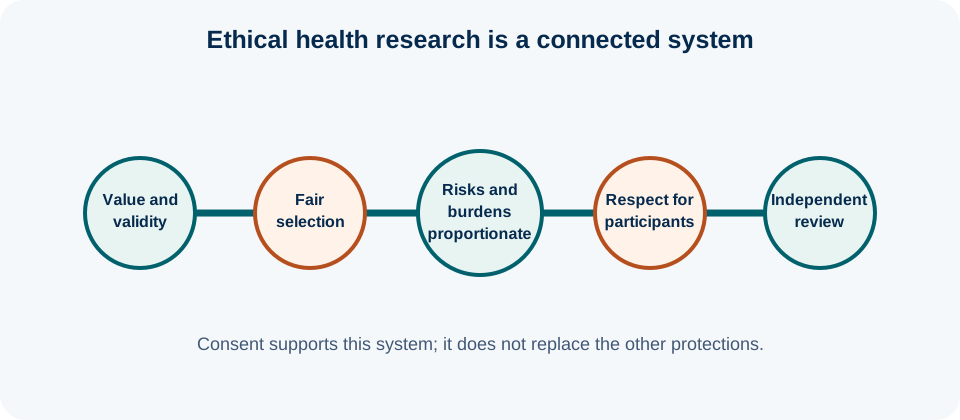
Five ideas are especially useful. Respect for persons requires attention to autonomy, dignity, voluntariness and the circumstances that make decision-making difficult. Beneficence and non-maleficence require researchers to maximise reasonable benefit and reduce avoidable harm and burden. Justice asks who bears research burdens and who may benefit from the knowledge. Scientific validity and social value require a question and design capable of producing worthwhile knowledge. Independent review reduces the risk that investigators become the sole judges of the acceptability of their own project.[2,3,5]
These principles are not a checklist in which one item automatically overrides all others. They structure reasoning. A minor privacy risk may be acceptable when safeguards are strong and the research question is important; a similar privacy risk may be unjustified when the project duplicates existing evidence without a credible knowledge gap.
Respect, welfare and justice in practice
Respect is visible in how people are approached, what they are told, how much time they have to decide, whether refusal affects care, and whether withdrawal is feasible. Welfare is visible in risk minimisation, monitoring, referral pathways and burden reduction. Justice is visible in eligibility criteria, recruitment locations, language access, inclusion of groups historically excluded from research, and distribution of benefits.
A common mistake is to equate justice with identical treatment. Fair research may require additional support for people who face transport, communication or accessibility barriers. The aim is equitable opportunity and protection, not mechanical uniformity.
Social value and scientific validity
Social value concerns the importance of the knowledge the study is expected to produce for health, policy, practice or future research. Scientific validity concerns whether the design can realistically generate that knowledge. A project with no plausible route to an interpretable answer asks participants to carry burden without sufficient prospect of knowledge benefit.[1,2]
This is why protocol review should examine the alignment of objectives, population, variables, sample size, procedures and analysis. Ethical and statistical review are not separate worlds.
Independent review and continuing responsibility
Research ethics committees provide prospective, independent scrutiny, but approval does not transfer ethical responsibility away from investigators. Researchers remain responsible for implementing the approved protocol, protecting participants, reporting new information, documenting deviations and seeking review for material changes. Ethics is therefore continuous through design, recruitment, follow-up, analysis, dissemination and data stewardship.[1,3,4]
Applying ethical principles across the research lifecycle
Ethical reasoning changes as a study moves from idea to dissemination. At the question stage, investigators should ask whether the uncertainty is genuine and important enough to justify involving participants. At the design stage, they should examine whether the population, comparator, measurements and sample size can produce interpretable knowledge. At the recruitment stage, attention shifts to fairness, voluntariness and communication. During follow-up, safety, privacy, protocol fidelity and response to new information become prominent. During analysis and reporting, selective exclusion, outcome switching, suppression of unfavourable results and inappropriate data reuse can undermine the ethical commitments made earlier.
This lifecycle perspective helps explain why a single ethics-approval letter cannot be the whole ethical record. A project may be acceptable at approval yet become problematic if the risk profile changes, investigators add unapproved procedures, participants receive misleading information, or the final report hides material deviations. Conversely, a well-governed study can adapt responsibly when unexpected events occur because the team has a clear process for review, documentation and communication.
Scientific validity as participant protection
The relationship between scientific validity and ethics is especially important in student and investigator-initiated research. A vague primary outcome, unmeasurable exposure, infeasible recruitment target or analysis plan disconnected from the design can make the study incapable of answering its question. The ethical response is not merely to add a sentence on “benefit to society”; it is to repair the design. The duty to use participants’ contributions responsibly includes collecting only data that are necessary, avoiding duplicate procedures, preventing avoidable missingness and ensuring that the planned analysis corresponds to the intended inference.
At the same time, scientific validity should not be used to demand methodological perfection before any study can proceed. Research necessarily involves uncertainty. The relevant question is whether the design is sufficiently rigorous for the purpose and burden, whether limitations are understood, and whether the remaining uncertainty is honestly represented. A small feasibility study may be ethically justified when its purpose is operational learning, while the same sample would be inadequate if the investigators claim definitive effectiveness.
Justice is about pathways, not only percentages
Justice can be assessed through the entire recruitment pathway. Who hears about the study? Who can physically reach the research site? Which languages are supported? Are people with disability able to use the consent materials? Are clinic staff approaching only patients they expect will agree? Are people with fewer resources disproportionately exposed to inconvenience because the study is convenient to conduct in their setting? These questions reveal that fair selection is not achieved merely by reporting demographic percentages after recruitment.
Justice also applies to downstream use of knowledge. If an intervention is tested only in highly resourced hospitals but is promoted for national use, the evidence may not address populations expected to receive it. If a disadvantaged community contributes data but has no realistic path to benefit from the knowledge, investigators should consider whether the study design, partnerships and dissemination plan are equitable. International guidance does not require every study to solve structural inequality, but it does require researchers to take unfair distribution of burdens and benefits seriously.[1,2]
Ethical reasoning should be visible in the protocol
A strong protocol makes the logic explicit. Instead of writing “there are no ethical issues”, identify the relevant issues and explain why the safeguards are proportionate. Instead of saying “participants will benefit”, separate direct clinical benefit from knowledge value. Instead of saying “data will be confidential”, describe who can access identifiable data, how long the key is retained and what limits apply. This makes ethics review more efficient because the committee can evaluate concrete decisions rather than reassuring adjectives.
The same discipline improves teaching. Learners should be able to trace an ethical concern to a design decision and a safeguard. The aim is not memorisation of principle names; it is the ability to ask, for each research step, who may be affected, what could go wrong, why the activity is justified and what will be done if circumstances change.
Five questions for an ethical protocol
- Does the study address a worthwhile and sufficiently defined question?
- Can the proposed design answer that question without avoidable bias or waste?
- Are participant selection, consent and burdens fair and proportionate?
- Are privacy, safety and data-governance protections matched to foreseeable risks?
- Is there independent review and a plan for transparent completion and dissemination?
Prospective ethics map
- State the social and scientific value of the study.
- Identify foreseeable physical, psychological, social, economic and privacy risks.
- Explain risk-minimisation measures and safety/referral procedures.
- Justify population selection and important exclusions.
- Describe consent or justify any requested waiver or alteration.
- Specify privacy, data access, retention, sharing and dissemination plans.
Appraise the ethical architecture
- Is scientific validity adequate for the burdens imposed?
- Are participant groups selected for scientific reasons rather than convenience or vulnerability?
- Could the consent context create pressure or dependency?
- Are risks, burdens and compensation described transparently?
- Are negative or inconclusive findings expected to be reported as responsibly as positive findings?
Worked example
Auditing the postpartum follow-up protocol
The team revises the protocol in four ways. First, it validates a common laboratory-outcome hierarchy across sites so that participant burden produces interpretable data. Second, it translates recruitment and consent materials into the languages used at participating clinics and documents how comprehension will be supported. Third, it specifies that refusal will not affect clinical care and that staff who provide routine care will not pressure patients to enrol. Fourth, it commits to registration where applicable and dissemination of results irrespective of direction.
None of these changes is merely administrative. Each improves the ethical relationship between participants, researchers and the value of the study.
Suggested protocol or governance wording
Common mistakes
Knowledge check
Why is scientific validity an ethical issue?
Answer and reasoning
Because participants should not be exposed to burden or risk for a study that cannot credibly answer its question. Methodological validity is therefore part of the justification for involving people in research.
Does informed consent by itself make a study ethical?
Answer and reasoning
No. Consent is essential in many studies, but ethical acceptability also depends on social value, scientific validity, fair selection, proportionate risk, privacy, governance and independent review.
Why is independent review needed if the investigators are experienced?
Answer and reasoning
Investigators have intellectual, professional and sometimes financial interests in their project. Independent review provides a separate assessment of participant protection and ethical justification.
Is equal recruitment from every demographic group always required by justice?
Answer and reasoning
No. The appropriate distribution depends on the research question, target population and expected benefits and burdens. Justice requires fair and scientifically justified inclusion rather than arbitrary numerical equality.
Key take-home messages
Key take-home messages
- Research ethics is integrated with methodology, not added after design is complete.
- Respect, welfare, justice, scientific validity, social value and independent review are mutually connected.
- Consent is necessary in many studies but is not sufficient for ethical acceptability.
- Ethical responsibility continues after approval through conduct, reporting and data stewardship.
- Local legal and committee requirements must be verified for the actual study setting.
References
- World Medical Association. Declaration of Helsinki: ethical principles for medical research involving human participants. Ferney-Voltaire: WMA; 2024. https://www.wma.net/what-we-do/medical-ethics/declaration-of-helsinki/
- Council for International Organizations of Medical Sciences. International ethical guidelines for health-related research involving humans. 4th ed. Geneva: CIOMS; 2016. https://cioms.ch/publications/product/international-ethical-guidelines-for-health-related-research-involving-humans/
- World Health Organization. Standards and operational guidance for ethics review of health-related research with human participants. Geneva: WHO; 2011. https://www.who.int/publications/i/item/9789241502948
- International Council for Harmonisation. ICH E6(R3) guideline for good clinical practice: principles and Annex 1. Step 4. 2025. https://database.ich.org/sites/default/files/ICH_E6%28R3%29_Step4_FinalGuideline_2025_0106.pdf
- National Commission for the Protection of Human Subjects of Biomedical and Behavioral Research. The Belmont Report. Washington, DC: US Department of Health and Human Services; 1979. https://www.hhs.gov/ohrp/regulations-and-policy/belmont-report/
These materials support learning and research planning. They require adaptation to the study context and do not replace methodological, statistical, ethical, or regulatory consultation.