
Part 16 · Module 4
Reporting Guidelines and Research Checklists
Learn to select and use health-research reporting guidelines appropriately, distinguish them from appraisal tools, and integrate them into study planning.
Learning outcomes
After completing this lecture, you should be able to:
- Explain the purpose and limitations of research reporting guidelines.
- Select an appropriate reporting guideline according to study design and report type.
- Distinguish reporting guidelines from methodological standards, risk-of-bias tools and critical-appraisal checklists.
- Use reporting checklists during planning without allowing them to determine the research question or design.
- Identify when a guideline extension is more appropriate than the parent guideline alone.
Overview
Research reporting guidelines are structured recommendations that identify information readers need to understand what was planned, what was done, what was found and how the work should be interpreted. The EQUATOR Network maintains a searchable library covering major health-research designs and specialised extensions.[1] Important current examples include CONSORT 2025 for randomised trials, STROBE for observational studies, PRISMA 2020 for systematic reviews, STARD for diagnostic accuracy studies and TRIPOD-family guidance for prediction models.[2–6]
A reporting guideline is not a certificate of methodological quality. A badly designed study can be reported completely. Conversely, a methodologically strong study can be difficult to appraise if essential information is omitted. Reporting and validity are related because transparent reporting exposes the decisions needed for appraisal, but they remain different constructs.
Why this matters
Incomplete reporting wastes research. Readers cannot judge eligibility, attrition, missing data, intervention fidelity, analytic decisions or applicability when those details are absent. Systematic reviewers may be unable to extract outcomes, and clinicians may misinterpret effect estimates because the comparator or analysis population is unclear.
Using the right guideline early can also improve planning. CONSORT can prompt investigators to preserve participant-flow information; STROBE can prompt explicit handling of missing data and selection; PRISMA can prompt documentation of search and screening processes. However, the checklist should not dictate the study’s scientific design. Its role is to ensure that the design actually used is reported with enough detail for readers to understand and appraise it.
Key concepts
A reporting guideline addresses completeness and transparency of a report. A methodological guideline recommends how research should be designed or conducted. A risk-of-bias tool evaluates whether features of a study could systematically distort a particular result. A critical-appraisal checklist may combine several domains for educational or decision-making purposes. These tools can overlap in content, but using them interchangeably leads to false conclusions.
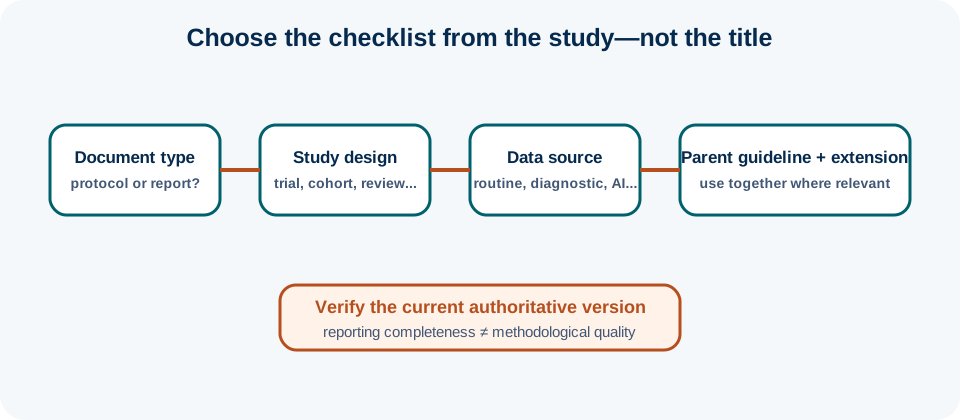
Guideline selection starts with the study design and report type. A randomised trial protocol uses SPIRIT, whereas the completed trial report uses CONSORT. A systematic review protocol uses PRISMA-P, whereas the completed review uses PRISMA 2020. Observational studies generally use STROBE, while studies using routinely collected health data may additionally require RECORD. Prediction-model studies may need TRIPOD-family guidance rather than STARD, because diagnostic accuracy and prediction modelling answer different questions.
Extensions matter when they address information absent from the parent guideline. Cluster trials, pragmatic trials, harms, abstracts, AI interventions or routinely collected data may each have specialised reporting needs. The researcher should verify the current version rather than relying on an old checklist saved on a departmental drive.
Select a reporting guideline in this order
- identify the actual study design, not the statistical test used;
- identify whether the document is a protocol, abstract, full report or another report type;
- find the current parent guideline in an authoritative source such as EQUATOR;
- check for design-specific, population-specific, intervention-specific or data-source extensions;
- use the explanation-and-elaboration document where available;
- follow the target journal’s requirements without replacing the methodological judgement of the research team.
A step-by-step methodological workflow
1. Classify the study before choosing the checklist
Start with how participants or data were selected, whether an intervention was assigned, the timing of exposure and outcome, and the primary inferential purpose. A study that uses logistic regression is not therefore “a logistic-regression study”. The design drives guideline choice.
2. Separate protocol guidance from report guidance
Protocol standards preserve prospective decisions; reporting standards describe completed conduct and results. For trials, SPIRIT and CONSORT now form a closely aligned pair. For reviews, PRISMA-P and PRISMA 2020 serve different stages. Using the final-report checklist while designing the protocol is helpful, but it should not replace protocol-specific items.
3. Check extensions and scope statements
Read what the guideline authors say it applies to. STARD applies to diagnostic accuracy reports; TRIPOD-type guidance applies to prediction-model studies. RECORD extends STROBE for observational research using routinely collected health data. A guideline extension should be used with its parent when instructed, not treated as a universally independent checklist.
4. Use the guideline as an information map during writing
Map checklist items to manuscript sections. Create a temporary author table showing where each item is addressed. This prevents late-stage insertion of disconnected sentences and helps co-authors identify missing information. Do not copy checklist wording mechanically; write coherent prose that gives the required information.
5. Reconcile the checklist with protocol and registry records
A transparent report should distinguish what was prespecified from what changed. Compare the manuscript with the protocol, registry entry and SAP. Outcome switching, changed eligibility, revised sample-size assumptions or added subgroup analyses should be disclosed rather than hidden by a perfectly completed checklist.
6. Submit the checklist honestly
When a journal requests a completed checklist, provide accurate page or section locations. Do not mark an item “not applicable” merely because the authors chose not to report it. If an item genuinely does not apply, the rationale should be defensible from the study design.
Questions to answer before declaring the reporting framework
- What is the study design and inferential purpose?
- Is the document a protocol or completed report?
- What is the current version of the parent guideline?
- Does an extension apply to this design, data source or intervention?
- Is an explanation-and-elaboration document available?
- Does the journal require a specific checklist or flow diagram?
An auditable planning document
Examples of design-to-guideline matching
illustrativeTable 1. Illustrative reporting-guideline map
| Research product | Core guideline | Important note |
|---|---|---|
| Randomised trial protocol | SPIRIT 2025 | Protocol reporting, not trial results |
| Randomised trial report | CONSORT 2025 | Supersedes CONSORT 2010 |
| Cohort/case-control/cross-sectional study | STROBE | Check relevant extensions |
| Routine health-data observational study | STROBE + RECORD | Report data-source and coding details |
| Diagnostic accuracy study | STARD | Distinguish from prediction modelling |
| Systematic review | PRISMA 2020 | Protocol uses PRISMA-P |
| Scoping review | PRISMA-ScR | Pair with appropriate conduct guidance |
Note: Always verify the current guideline and scope from an authoritative source.
Quality, validity and governance
A checklist is most useful when applied twice: once during planning and again during manuscript review. Early use identifies information that must be collected prospectively, such as reasons for exclusion or intervention fidelity. Late use verifies transparency. It is less useful when first opened immediately before journal submission, because omitted information may no longer be recoverable.
Researchers should also be alert to “checklist theatre”: adding the requested item without providing enough information to make it meaningful. For example, writing “missing data were handled appropriately” does not satisfy the underlying need to explain the amount, pattern, assumptions and method. Likewise, reporting “participants were randomised” without sequence generation and allocation-concealment details does not permit appraisal.
Reporting guidelines evolve. CONSORT 2025 superseded CONSORT 2010, and the updated statement includes a 30-item checklist with stronger open-science alignment.[2] A lecture, SOP or departmental template should therefore link to authoritative sources rather than embedding a static checklist indefinitely.
Appraise use of a reporting guideline
- Was the guideline selected according to the actual design and report type?
- Was the current version used?
- Were relevant extensions considered?
- Do reported items contain enough detail for independent appraisal?
- Are protocol deviations and post hoc analyses transparent despite checklist completion?
- Is the guideline being misused as evidence that the methods themselves are valid?
Practical decision audit
Audit the guideline source
Prefer EQUATOR, the guideline group or the original publication. Search-engine images and old supplementary files may contain superseded versions. Record the version in authoring templates and update departmental teaching materials when major revisions occur.
Audit the study-design label
If authors call a study “prospective” or “case-control”, verify that participant selection and time order actually fit the label. Reporting checklists should follow the real design, not the label chosen in the title.
Audit reporting against source documents
Compare outcomes, sample size, analysis populations and subgroup plans against the protocol, registry and SAP. Complete reporting includes explaining changes, not merely reporting the final version as if it had always been planned.
Audit applicability of extensions
Extensions should solve a real reporting problem. For routinely collected data, RECORD asks for details about data sources and algorithms. For cluster trials, cluster-specific information matters. Do not accumulate multiple checklists simply because their topics sound related.
Reporting guidelines as part of research infrastructure
Reporting guidelines are most powerful when embedded into the research workflow rather than treated as submission paperwork. A research unit can map guideline items to its protocol template, CRFs, screening logs, SAP and manuscript template. For example, if the final report must describe reasons for exclusion, the screening system should capture those reasons prospectively. If CONSORT requires participant flow through allocation and follow-up, the trial-management system should preserve the necessary counts. Reporting requirements can therefore reveal data that must be collected during conduct.
One study may require more than one reporting framework
Complex research products often cross design boundaries. A randomised implementation trial may require CONSORT for the trial design and StaRI for the implementation strategy. A cohort study using routinely collected data may use STROBE plus RECORD. A mixed-methods study may need design-specific quantitative and qualitative guidance alongside mixed-methods reporting principles. The aim is not to maximise the number of checklists; it is to cover genuinely distinct reporting dimensions without duplication.
Reporting guidelines evolve independently of older departmental templates
Departments commonly retain templates for years. When a major guideline changes, an old template can silently perpetuate obsolete requirements. CONSORT 2025 is a clear example: it supersedes CONSORT 2010. Protocol and manuscript templates should therefore reference guideline versions explicitly and be reviewed periodically. A central control file or curriculum manifest can help prevent individual lecture notes and SOPs from drifting apart.
Checklists should be used with explanation documents
Many checklist items are deceptively short. Explanation-and-elaboration papers clarify rationale, examples and edge cases. Authors who use only the one-page checklist may provide superficial answers. For instance, simply naming a randomisation method does not necessarily explain allocation concealment, and simply reporting “no missing data” may not describe how that conclusion was established. When a reporting item is unclear, consult the full guidance rather than guessing from the item label.
Transparent non-applicability is better than forced compliance
Not every item applies to every study. The appropriate response is to explain why an item is not applicable, not to invent a corresponding procedure. A qualitative study should not add a sample-size power calculation simply because another checklist asks for one. A diagnostic study without a prespecified threshold should report how the threshold was determined rather than pretending it was fixed. Reporting standards support transparency about the research that actually occurred.
Final reporting-guideline stress test
Before submission, reconstruct the manuscript from the study’s source documents rather than checking the reporting guideline only against the finished prose. Compare the final report with the approved protocol, registry entry, statistical analysis plan, data-management records and any documented amendments. This helps distinguish a genuine reporting omission from a legitimate design change that should be explained transparently.
A useful final question is: could an informed reader understand what was planned, what changed, what was actually done and why? A completed checklist cannot compensate for an unexplained change in outcomes, eligibility criteria, analysis populations or timing. Conversely, a well-reported deviation is not automatically a methodological flaw. Reporting guidelines work best as structured transparency tools, not as retrospective certificates of study quality.
Using checklists without writing to the checklist
A reporting checklist should improve completeness without turning a manuscript into a sequence of disconnected answers. After mapping every item to a manuscript location, edit the paper again for scientific narrative: the Introduction should establish the question, the Methods should permit appraisal and replication, the Results should answer the prespecified objectives, and the Discussion should interpret those findings in context. Checklist completeness and readable scientific argument are complementary goals.
For multidisciplinary studies, assign responsibility for specialist extensions early. For example, a prediction-model, diagnostic, implementation or routinely collected-data extension may require information that only the statistician, informatician or implementation scientist can supply. Waiting until journal submission to discover these requirements often reveals undocumented decisions that can no longer be reconstructed reliably.
Worked example
Selecting the framework for an electronic-record cohort study
The student’s study estimates the association between early renal-function decline and later hospitalisation using a hospital data warehouse. Participants are not assigned an intervention, and exposure status is determined from prior laboratory records. The base design is therefore a cohort study, making STROBE the appropriate core guideline rather than CONSORT. Because the study uses routinely collected electronic health data, RECORD adds relevant reporting items on codes, algorithms, data linkage and the process by which the study population was derived.
The student creates a guideline map before drafting. The Methods section describes the database and study period, code lists, eligibility algorithm, index date, exposure definition, outcome linkage, missing data and analysis. The Results section reports how many records were available at each derivation step and explains exclusions. The Discussion addresses limitations arising from coding completeness and care outside the network.
The checklist improves transparency, but it does not prove that the chosen exposure definition is valid or that confounding has been controlled. Those remain methodological appraisal questions.
Suggested protocol and manuscript wording
Common mistakes
Knowledge check
What is the main purpose of a reporting guideline?
Answer and reasoning
To improve completeness and transparency so readers can understand and appraise what was planned, done and found.
Which should guide a randomised trial protocol: SPIRIT or CONSORT?
Answer and reasoning
SPIRIT is the protocol-reporting guideline; CONSORT is for the completed randomised-trial report. They are complementary.
Why is RECORD relevant to some cohort studies?
Answer and reasoning
It extends STROBE for observational studies using routinely collected health data and prompts reporting of data-source, coding, linkage and population-derivation details.
Does full checklist adherence mean a study has low risk of bias?
Answer and reasoning
No. Complete reporting may reveal serious bias. Reporting quality and methodological validity are related but distinct.
Key take-home messages
Key take-home messages
- Select reporting guidance by design, report type and relevant extension.
- Use current authoritative versions rather than archived checklists.
- Reporting guidelines improve transparency; they are not risk-of-bias tools.
- Use checklists during planning so required information is actually collected.
- Reconcile the report with protocol, registry and SAP to expose rather than conceal changes.
References
- EQUATOR Network. Search for reporting guidelines. Oxford: EQUATOR Network. https://www.equator-network.org/reporting-guidelines/
- Hopewell S, Chan AW, Collins GS, et al. CONSORT 2025 statement: updated guideline for reporting randomised trials. BMJ. 2025;388:e081123. https://doi.org/10.1136/bmj-2024-081123
- von Elm E, Altman DG, Egger M, Pocock SJ, Gøtzsche PC, Vandenbroucke JP. The STROBE statement: guidelines for reporting observational studies. PLoS Med. 2007;4(10):e296. https://doi.org/10.1371/journal.pmed.0040296
- Page MJ, McKenzie JE, Bossuyt PM, et al. The PRISMA 2020 statement: an updated guideline for reporting systematic reviews. BMJ. 2021;372:n71. https://doi.org/10.1136/bmj.n71
- Bossuyt PM, Reitsma JB, Bruns DE, et al. STARD 2015: an updated list of essential items for reporting diagnostic accuracy studies. BMJ. 2015;351:h5527. https://doi.org/10.1136/bmj.h5527
- Collins GS, Moons KGM, Dhiman P, et al. TRIPOD+AI statement: updated guidance for reporting clinical prediction models that use regression or machine learning methods. BMJ. 2024;385:e078378. https://doi.org/10.1136/bmj-2023-078378
These materials support learning and research planning. They require adaptation to the study context and do not replace methodological, statistical, ethical, or regulatory consultation.