
Part 11 · Module 4
Sampling and Recruitment in Qualitative Studies
Plan qualitative sampling and recruitment that deliberately seeks relevant, diverse and information-rich perspectives while protecting voluntariness and access.
Learning outcomes
After completing this lecture, you should be able to:
- Distinguish qualitative sampling logic from probability-based representativeness.
- Choose purposive sampling strategies that fit the qualitative methodology and research question.
- Use information power and explicit saturation concepts to justify sample adequacy.
- Plan recruitment routes that minimise gatekeeper, accessibility and participation bias.
- Write a transparent sampling, recruitment and stopping rationale for a qualitative protocol.
Overview
Qualitative sampling is designed to obtain relevant, varied and sufficiently rich information for the research question. It usually does not aim to reproduce the population distribution through known selection probabilities. Instead, researchers select participants, cases, settings or events because they can illuminate the phenomenon under study.[1,2]
Part 6 introduced purposive sampling and information power. This lecture develops those ideas within a complete qualitative study: defining the sample universe, selecting a purposive strategy, planning recruitment, handling gatekeepers, monitoring sample adequacy and documenting when enough information has been generated.
Why this matters
A qualitative analysis can be sophisticated yet still narrow if recruitment reaches only the easiest participants. For example, a study of barriers to postpartum follow-up that recruits only women attending follow-up clinics cannot directly access those who never return. Likewise, clinician gatekeepers may unintentionally exclude people they consider “too busy”, “too distressed” or “unlikely to participate”, removing precisely the perspectives that matter.[1]
Sample quality therefore depends on both who researchers intend to include and who the recruitment pathway actually allows them to reach.
Key concepts
Define the sample universe first
The sample universe is the group or set of cases from which qualitative participants could reasonably be drawn for the stated question. It should be defined by experience and relevance, not merely convenience.[2]
For the scenario, the universe might be women who had gestational diabetes, delivered in participating facilities during a defined period and reached the postpartum interval relevant to the study. The team can then purposively select within that universe.
Purposive sampling is deliberate selection
Purposeful sampling selects information-rich cases for a reason. Palinkas and colleagues describe multiple purposeful strategies used in implementation research, including criterion, maximum variation, homogeneous, typical-case and extreme-case sampling.[1]
Choosing a purposive strategy
Criterion sampling
All participants meet a defining experience. For example, every participant had gestational diabetes and is at least 12 weeks postpartum. Criterion sampling ensures relevance but does not by itself produce diversity.
Maximum-variation sampling
Researchers deliberately seek contrast across dimensions expected to shape the phenomenon. In the example these may include completed versus missed testing, rural versus urban residence, first versus later pregnancy, or different follow-up pathways.
The purpose is to examine patterns across variation, not to mirror the population distribution.
Homogeneous sampling
A narrow subgroup is sampled for intensive exploration, such as women who did not complete testing despite receiving reminders. This can be appropriate when the question itself is highly specific.
Critical, extreme or deviant cases
Unusual success or failure may reveal mechanisms hidden in more typical accounts. A remote clinic with exceptionally high postpartum follow-up might be selected to understand how the service overcame common barriers.
Theoretical sampling
Theoretical sampling belongs especially to grounded theory. As categories develop, researchers deliberately seek participants or situations that can refine, contrast or challenge the emerging theory. It is not simply adding more participants after the original sample is exhausted.
Snowball or chain-referral sampling
Participants or community contacts identify others who may meet the criteria. This is useful for hidden or dispersed groups but can reproduce social-network similarity. Recruitment chains and confidentiality should be considered explicitly.
Match the sampling strategy to the analytic purpose
- Use criterion sampling to establish relevant experience.
- Add maximum variation to examine contrasting contexts.
- Use homogeneous sampling for focused depth within a subgroup.
- Use critical or deviant cases to understand revealing successes or failures.
- Use theoretical sampling when emerging grounded-theory categories drive further recruitment.
- Use snowball sampling when ordinary recruitment cannot readily locate the population.
- Combine strategies when each serves a different, documented purpose.
Recruitment is not the same as sampling
Sampling specifies who should be sought. Recruitment specifies how they are approached and invited. A strong sampling plan can fail if the recruitment route systematically filters access.
Sampling and recruitment matrix
illustrativeTable 1. Separating sampling intention from recruitment source
| Perspective sought | Sampling reason | Possible recruitment source | Main risk |
|---|---|---|---|
| Completed testing early | Contrast with non-completers | Postpartum clinic | Overrepresents engaged patients |
| Did not complete testing | Central experience of interest | Delivery register with approved contact pathway | Difficult contact, privacy concerns |
| Rural residence | Access context | District clinic lists | Gatekeeper filtering |
| Different language groups | Communication variation | Multilingual outreach | Exclusion if interviewers lack language support |
| Staff across roles | Organisational perspective | Service roster | Managers may influence participation |
Gatekeepers and access
Gatekeepers—clinicians, managers, community leaders or programme staff—may be necessary to establish legitimate access. However, they can shape the sample by deciding who is “suitable”. The researcher should define eligibility independently where possible and ask gatekeepers to distribute invitations rather than privately judging who should participate.
A dependent relationship creates additional concern. Junior staff recruited by their supervisor may fear consequences for declining or criticising the service. Patients recruited by their treating clinician may feel that participation affects care. Recruitment should therefore separate research choice from clinical or employment authority where practical.
Sample adequacy: information power
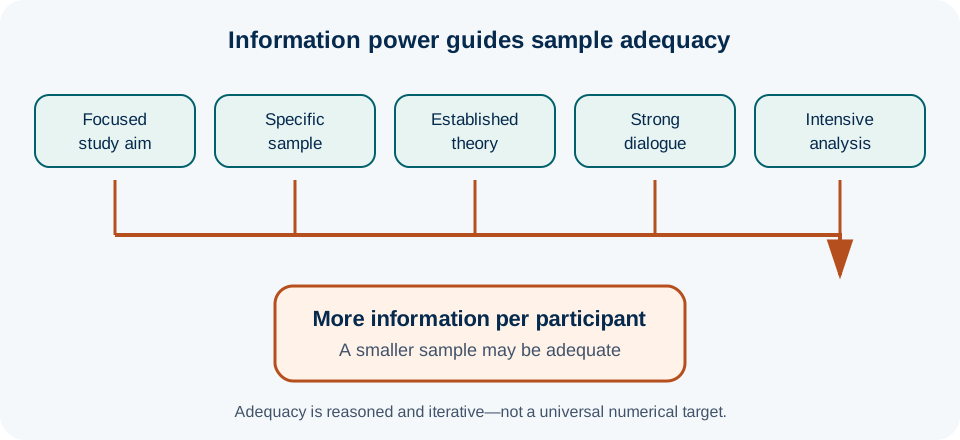
Malterud and colleagues proposed information power as a way to reason about sample adequacy. Fewer participants may be needed when the aim is narrow, participants are highly specific to the question, established theory supports the inquiry, dialogue is strong and analysis is intensive. More participants may be needed when the aim is broad, the sample is heterogeneous, dialogue is shallow or the analysis seeks cross-case variation.[3]
Information power is not a formula. It is a structured justification that should be revisited during the study.
Document the sample-adequacy rationale
- Scope and specificity of the study aim.
- Specificity and diversity of participants.
- Methodological approach and role of theory.
- Expected depth and quality of data generation.
- Analytic strategy and degree of within-case versus cross-case analysis.
- Planned initial sample or recruitment range for feasibility.
- Criteria for reviewing whether further sampling is needed.
- How changes to the sample will be documented.
Saturation: use the term precisely
“Saturation” has several meanings and should not be used as a universal ritual phrase. Hennink and colleagues distinguished code saturation, where few new issues are being identified, from meaning saturation, where the dimensions and nuances of those issues are sufficiently understood.[4] Grounded theory also uses theoretical saturation in relation to developing categories.
Empirical reviews show substantial variation in the number of interviews associated with different saturation definitions and study designs.[5] Therefore, a fixed claim such as “12 interviews are always enough” is not methodologically defensible.
Saturation should match the analytic traditionMMed extension
In reflexive thematic analysis, some scholars question whether saturation is always conceptually compatible because themes are actively developed through interpretation rather than passively discovered until nothing new exists. Researchers should use a stopping rationale consistent with their methodology rather than importing saturation terminology automatically.
Recruitment monitoring
A qualitative screening log can be useful even when statistical response rates are not the main outcome. It can record:
- number and type of potential participants identified;
- recruitment source;
- eligibility;
- invitation method;
- acceptance, refusal or no response where known;
- broad reasons for refusal if volunteered; and
- which sampling dimensions remain underrepresented.
The purpose is not to produce a survey response rate but to detect whether the realised sample is being shaped by access barriers.
Ethical and governance considerations
Contacting non-attenders requires special care because researchers may be using records for people who have not returned to the service. The protocol should define who may access contact details, what prior permission or governance basis applies, how many contact attempts are reasonable and how privacy is protected in messages.
Worked example
Building a purposive postpartum interview sample
The team defines the sample universe as women with gestational diabetes who delivered in the participating hospitals during the previous nine months and have reached at least 12 weeks postpartum.
They begin with criterion sampling, then use maximum variation across testing status, residence, parity and follow-up pathway. Because the central question includes non-completion, they do not rely only on clinic recruitment. An approved contact process is established through the study team using delivery records.
After an initial set of interviews, the team reviews a sampling matrix and analytic memos. Rural non-completers are underrepresented and the emerging analysis suggests that transfer between maternity and primary care may be important. Recruitment is therefore extended purposefully in that subgroup. The team stops when the dataset provides adequate depth and contrast for the stated analytic approach, documenting the decision using information power rather than claiming that a predetermined number guarantees saturation.
Suggested protocol or reporting wording
Sampling adequacy across qualitative methodologies
Sample adequacy should be justified in relation to the methodological task rather than a universal numeric target.[3-5] A focused phenomenological study of a highly specific experience may require fewer participants than a maximum-variation service study spanning several sites and professional groups. Grounded theory may continue sampling because emerging categories require comparison, while an ethnography may gain substantial information from prolonged engagement with a smaller number of key actors and settings.
Information power offers a useful framework: the more specific the sample, stronger the dialogue, clearer the theoretical grounding and narrower the aim, the fewer participants may be needed; broader and more heterogeneous aims generally demand more information.[3] This is a planning principle, not a calculator that returns a fixed sample size.
Saturation must be defined
“Saturation” has several meanings. Hennink and colleagues distinguish code saturation, when few new issues or codes arise, from meaning saturation, when the dimensions and nuances of issues are sufficiently understood.[4] The latter can require substantially more material. Researchers should therefore state what form of saturation they sought, how it was assessed and whether it was actually appropriate to their analytic approach.
In reflexive thematic analysis, for example, treating saturation as the point at which an objectively complete set of themes has been discovered may conflict with the interpretive assumptions of the method. In grounded theory, theoretical saturation has a more methodology-specific role connected to category development.
Recruitment accessibility and inclusion
Recruitment materials and procedures can exclude participants even when eligibility criteria are broad. Invitations available only in one language, phone calls during working hours, interviews requiring travel to hospital, digital-only consent or lack of childcare can shape who is able to participate. The recruitment plan should therefore address language, disability, digital access, transport and scheduling where these are relevant to the population.[1,2]
Researchers should also distinguish unable to contact, ineligible, declined, and gatekeeper did not approach. These categories have different implications for assessing recruitment bias. Reporting only the number interviewed hides the path by which some perspectives disappeared.
Iterative sampling decisions
Qualitative sampling may change as analysis develops. That flexibility should be documented, not disguised. If early interviews overrepresent women who completed testing, the team may deliberately recruit non-completers. If an emerging category concerns rural laboratory access, additional rural participants may be sought. In grounded theory, such iteration can become theoretical sampling.[1]
A sampling decision log can record the date, emerging analytic need, proposed new perspective, recruitment source and resulting contribution. This creates a transparent link between analysis and further data generation.
Recruitment monitoring as methodological data
Keep a recruitment log that records where invitations were distributed, which eligibility groups were approached, who declined where this can be recorded ethically, and which planned perspectives remain missing. Patterns of refusal or failed contact can reveal access problems relevant to the study itself. The purpose is not to pressure non-participants or calculate a quantitative response rate, but to understand how the realised sample was produced and where its boundaries lie.
Common mistakes
Knowledge check
Why is a probability sample usually unnecessary for an in-depth qualitative interview study?
Answer and reasoning
The primary aim is normally conceptual depth and variation rather than population estimation. Participants are therefore selected for relevance to the phenomenon. Probability sampling may occasionally be used, but it is not the default quality criterion for qualitative inquiry.
What is the difference between maximum-variation sampling and quota sampling for representativeness?
Answer and reasoning
Maximum variation deliberately seeks contrasting experiences to examine how findings differ or persist across contexts. It does not require subgroup proportions to reproduce the target population and should not be presented as statistically representative.
Why might one clinic-based recruitment source be inadequate for a study of non-attendance?
Answer and reasoning
People who never attend the clinic cannot be recruited there. The recruitment pathway would therefore systematically exclude a central group required to understand the phenomenon.
What is the practical value of information power?
Answer and reasoning
It provides a structured way to judge sample adequacy using the study aim, specificity of participants, theory, dialogue quality and analytic strategy rather than relying on a universal numerical rule.
Key take-home messages
Key take-home messages
- Qualitative sampling is purposeful and question-driven rather than automatically representative.
- Separate the sampling strategy from the practical recruitment route.
- Monitor whether gatekeepers and access pathways systematically exclude important perspectives.
- Justify sample adequacy using methodology-specific reasoning such as information power and clearly defined saturation concepts.
- Document iterative changes to sampling as part of the analysis rather than hiding them as protocol deviations.
References
- Palinkas LA, Horwitz SM, Green CA, Wisdom JP, Duan N, Hoagwood K. Purposeful sampling for qualitative data collection and analysis in mixed method implementation research. Adm Policy Ment Health. 2015;42(5):533-544. https://doi.org/10.1007/s10488-013-0528-y
- Robinson OC. Sampling in interview-based qualitative research: a theoretical and practical guide. Qual Res Psychol. 2014;11(1):25-41. https://doi.org/10.1080/14780887.2013.801543
- Malterud K, Siersma VD, Guassora AD. Sample size in qualitative interview studies: guided by information power. Qual Health Res. 2016;26(13):1753-1760. https://doi.org/10.1177/1049732315617444
- Hennink MM, Kaiser BN, Marconi VC. Code saturation versus meaning saturation: how many interviews are enough? Qual Health Res. 2017;27(4):591-608. https://doi.org/10.1177/1049732316665344
- Hennink M, Kaiser BN. Sample sizes for saturation in qualitative research: a systematic review of empirical tests. Soc Sci Med. 2022;292:114523. https://doi.org/10.1016/j.socscimed.2021.114523
These materials support learning and research planning. They require adaptation to the study context and do not replace methodological, statistical, ethical, or regulatory consultation.