
Part 15 · Module 7
Study Registration, Amendments and Continuing Review
Manage prospective study registration, amendments, continuing oversight, deviations and closure as part of transparent and accountable research governance.
Learning outcomes
After completing this lecture, you should be able to:
- Explain the ethical and scientific purposes of prospective trial registration.
- Distinguish registration from ethics approval and regulatory authorisation.
- Classify protocol amendments and deviations by their governance implications.
- Plan continuing reporting and study-closure responsibilities.
- Maintain consistency among protocol, registry and published report.
Overview
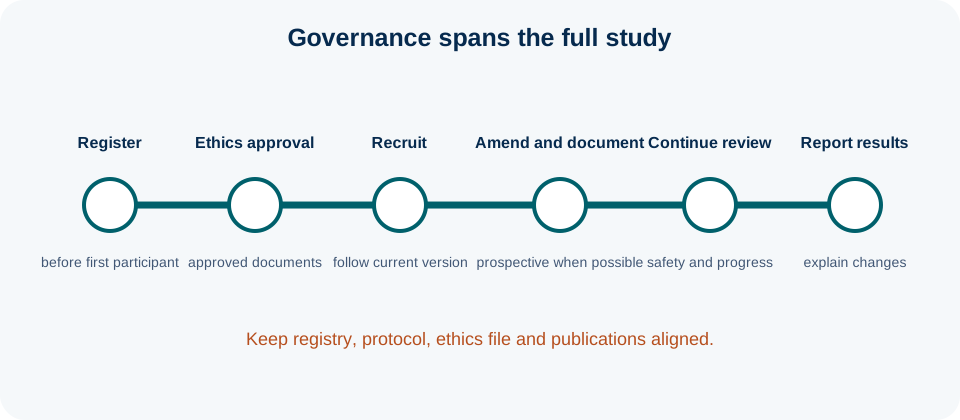
Research governance continues after initial ethics approval. Prospective registration makes key information about clinical trials publicly visible before results are known, helping reduce undisclosed outcome switching and non-publication.[1–3] During conduct, amendments, deviations, new safety information and changes in recruitment may require ethics, sponsor, regulatory or registry action depending on the study and jurisdiction.
Registration, ethics approval and regulatory authorisation serve different purposes and should never be treated as interchangeable.
Why this matters
A protocol can drift gradually from the plan that participants, committees and registries were shown. Endpoints change, sample sizes are revised, sites are added or procedures are altered. Some changes are justified; the integrity problem arises when they are undocumented, implemented without required review or reported later as if they had always been planned.
Good governance preserves the chronology of decisions so readers can distinguish prospective plans from later adaptations.
Core principles
Prospective registration records core trial information in a recognised public registry before outcome knowledge can shape reporting. The WHO ICTRP facilitates access to records from registry networks and defines a Trial Registration Data Set.[1,2] ICMJE requires prospective registration of clinical trials as a condition for consideration by member journals, using acceptable registries as described in its current recommendations.[3]
Amendments are planned changes to approved study documents. Deviations are departures from the protocol during conduct; their significance depends on effects on participant rights, safety, data reliability and interpretation. Continuing oversight may include progress reports, safety reports, review of new information and closure reporting according to the applicable framework.
Registration is not ethics approval
A registry makes protocol information public; it does not independently determine whether participant protections are adequate. An ethics committee reviews ethical acceptability; regulators may authorise particular products or trial activities. The same study may need all three processes.
What should be kept consistent
Key identifiers, study status, recruitment dates, primary and secondary outcomes, sample size, intervention groups and data-sharing information should be kept consistent across the protocol, registry and public report. If a change occurs, the record should show when and why rather than overwriting history without explanation.[1–3]
Amendments and urgent safety changes
Material amendments should ordinarily undergo the required review before implementation. An important exception may arise when immediate action is necessary to eliminate an urgent hazard to participants; in such circumstances, the protective action is taken and the required notifications follow according to the relevant rules.[4] Exact amendment categories and timelines are jurisdiction-specific.
Deviations, violations and serious breaches
Terminology differs among sponsors and regulators, so investigators should follow the applicable definitions. Operationally, every departure should be documented sufficiently to evaluate cause, participant impact, data impact and corrective/preventive action. Recurrent deviations may reveal a protocol that is impractical rather than careless staff.
Continuing review and closure
Ongoing obligations may include recruitment and safety updates, annual or periodic reports, reports of important new information, amendments, deviations and final closure. Study closure should address participant follow-up, data reconciliation, archiving, dissemination and registry status. A study is not ethically complete merely because recruitment has stopped.
Malaysia-specific note
For work within the Malaysian Ministry of Health, NMRR provides research registration and associated review workflows.[5] This local registration does not automatically substitute for prospective registration in a WHO-recognised or ICMJE-acceptable clinical-trial registry when such registration is required for the trial’s transparency or publication obligations.[1–3] Regulated trials should also follow current NPRA requirements.[6]
Registration is part of a transparency chain
Prospective trial registration works best when connected to a protocol, statistical analysis plan and final report. Each document has a different level of detail, but key features should agree. If the registry lists one primary outcome and the manuscript reports another, readers should be able to find the amendment date and rationale.
This transparency chain also helps the research team. When staff change, the registry and version-controlled protocol provide an external reference for what was intended. Public records make it harder for institutional memory to drift toward the most favourable interpretation of the final data.
Prospective means before the relevant outcome knowledge
For ICMJE purposes, clinical-trial registration should occur before enrolment of the first participant under the policy’s definition.[3] Researchers should not delay registration until recruitment is well under way or until they know whether the intervention appears promising. Retrospective registration may still improve transparency compared with no record, but it should not be presented as prospective.
Observational studies are not uniformly subject to the same journal registration policy, yet prospective registration or protocol publication can still be valuable for transparency. Researchers should distinguish ethical good practice from a formal mandatory requirement.
Amendments should be classified by impact
A wording correction is different from a new invasive procedure. A change in recruitment target is different from a change in primary estimand. Teams benefit from a change-control form recording what changes, why, which documents are affected, whether participant information changes, whether statistics are affected and which approvals or notifications are required.
This classification also prevents over-reporting trivial operational changes while under-reporting substantive ones. Sponsor and institutional SOPs may define categories such as substantial amendment, administrative change or urgent safety measure; use the definitions that actually govern the study.
Protocol deviations can reveal design failure
Repeated late visits, missed assessments or consent errors may indicate more than individual non-compliance. If many sites fail the same procedure, the protocol may be unrealistic. Root-cause analysis should therefore examine system design, workload, training, participant burden and technology as well as staff behaviour.
Corrective and preventive action should address the cause. Re-training staff every month will not solve a visit window that conflicts with routine clinical scheduling.
Continuing review should ask whether the ethical balance has changed
New external evidence, accumulating adverse events, slower recruitment, higher attrition or unexpected privacy incidents can alter the justification for continuing the study. Continuing oversight is not simply an annual administrative renewal. Investigators should ask whether participants would reasonably want to know new information and whether the original risk–benefit balance remains valid.
Some frameworks have reduced routine annual continuing review for specified low-risk research, whereas other committees still require periodic reports. This is precisely why current local requirements must be checked rather than assumed from generic teaching materials.
Study closure includes dissemination
Closure should reconcile participant status, unresolved safety issues, data queries, specimen disposition, database status and archive responsibilities. Registry records should be updated when appropriate, and results should be reported according to applicable ethical, journal and regulatory expectations.
A study that stops early because recruitment failed or the intervention was ineffective still creates knowledge about feasibility or effect. Suppressing such studies wastes participant contribution and contributes to publication bias.
Maintaining a governance log
A governance log can consolidate registration identifiers, ethics decisions, regulatory correspondence, protocol versions, amendments, deviations, safety notifications and closure dates. The purpose is not duplicate bureaucracy; it is to give the study team one chronological view of decisions that otherwise sit in separate systems.
For each amendment, the log can record whether the registry, participant information, statistical analysis plan, CRF, SOP or data-sharing agreement also changed. This prevents a common problem in which the protocol is updated but downstream documents continue using the old definition.
Registry maintenance should have a named owner and backup. Records become outdated when responsibility is assumed to belong to “the sponsor” or “someone in the study office”. Recruitment status, completion dates, outcome definitions and results information should be updated according to the registry and applicable policy. Ownership should be reassigned when staff leave.
Multicentre studies should define whether an amendment can be implemented simultaneously or only after each local site has obtained required approval. Central and local review structures differ. A version may therefore be approved centrally but not yet active at every site. The study management system should make the effective version clear for each location.
Closure should include a final comparison of protocol, registry and publication. Any unresolved discrepancy should be explained before manuscript submission. This “transparency reconciliation” is analogous to data reconciliation: it ensures the public account of the study reflects its actual chronology rather than an idealised retrospective version.
Reporting deviations without destroying interpretability
A final paper does not need to list every minor operational incident, but deviations that could affect participant rights, exposure classification, outcome measurement, missingness or the intended analysis should be considered for reporting. Trial flow diagrams, protocol appendices and supplementary materials can provide appropriate detail without overwhelming the main text.
Researchers should avoid two extremes: hiding all deviations to present a perfectly controlled study, or reporting a long undifferentiated list that prevents readers from identifying important issues. Classify deviations by mechanism and consequence. Explain whether they were balanced between groups, whether they led to missing data, and whether sensitivity analyses were undertaken.
This approach links governance to interpretation. Deviation documentation is not only for inspectors; it helps readers decide how closely the realised study matches the planned estimand and methods.
Linking governance changes to analysis provenance
When a protocol amendment changes eligibility, outcome timing, intervention delivery or follow-up, the analysis dataset should preserve enough information to identify which participants were affected and under which version. Otherwise, the statistical team may be unable to evaluate whether the amendment changed the estimand or created heterogeneity. Version-aware datasets and dated analysis plans therefore connect governance history directly to reproducible inference.
Keep participant-facing information aligned with amendments
A registry or protocol update is incomplete if participants continue receiving outdated information about procedures, risks or study duration. The amendment assessment should therefore ask whether current participants need notification or re-consent and whether recruitment materials require revision. The exact threshold depends on the nature of the change and committee decision, but the participant perspective should be considered explicitly whenever the study changes.
Registry records should remain interpretable after completion
A useful registry record is not merely marked “completed”. Final recruitment numbers, completion dates, outcomes and results information should be updated as required by the registry and governing policies. If a trial stops early, the reason should be represented accurately rather than leaving the record apparently active. Maintaining the public record through completion honours the transparency purpose that justified prospective registration in the first place.
Governance responsibility should have named owners
Registration updates, amendment submissions, safety notifications and closure reports should each have a named responsible role and a backup. Governance failures often arise not because a team rejects transparency, but because everyone assumes another person is maintaining the record. Responsibility matrices and calendar reminders convert ethical intentions into reliable study operations.
Final transparency reconciliation
Before database lock and again before publication, compare the current protocol, registry entry, ethics amendment history and analysis plan. Any differences in primary outcomes, sample size, eligibility, intervention definition or follow-up should be explained and dated. This reconciliation makes selective reporting easier to detect internally before it becomes a publication problem. It also provides the manuscript team with an accurate chronology, allowing deviations from the original plan to be reported transparently rather than reconstructed from memory months later.
The team should retain evidence of submitted registry updates and acknowledgements, not only screenshots of the public page, so the timing of governance actions remains auditable throughout the study lifecycle.
When the study changes
- Does the proposed change affect participant risk, consent, eligibility, intervention, outcome or data use?
- Which ethics, sponsor, institutional, regulatory and registry records are affected?
- Must review occur before implementation, or is immediate safety action necessary?
- How will participants be informed if the change affects their decision to continue?
- How will the chronology be preserved in the final report?
Governance calendar
- Record ethics and regulatory approval dates.
- Register applicable clinical trials prospectively in an acceptable registry.
- Schedule required progress or continuing reports.
- Define the pathway for amendments and protocol deviations.
- Assign responsibility for registry updates and safety notifications.
- Plan study closure, results reporting and archival completion.
Appraise governance history
- Was the trial registered prospectively and in an appropriate registry?
- Do registry outcomes match the protocol and publication?
- Are important amendments dated and justified?
- Were deviations evaluated for participant and data impact?
- Is the study record updated through completion rather than abandoned after recruitment?
Worked example
Handling a justified outcome amendment transparently
Suppose new external guidance changes the clinically preferred postpartum-testing window while recruitment is ongoing. The investigators document the scientific rationale, assess whether the primary estimand changes, submit the amendment through required ethics and sponsor processes, update the registry with the revised outcome and amendment date, and specify how participants enrolled before and after the change will be analysed.
The final report states that the change occurred after recruitment began and explains whether any outcome data had been reviewed. Transparency allows readers to judge the change rather than forcing them to infer it.
Suggested protocol or governance wording
Common mistakes
Knowledge check
Why register a clinical trial prospectively?
Answer and reasoning
To create a public record of key planned features before results are known, supporting transparency and reducing selective outcome reporting and non-publication.
Does NMRR registration automatically satisfy ICMJE trial-registration policy?
Answer and reasoning
Not necessarily. Investigators should confirm that the trial is registered in a registry acceptable under the relevant WHO/ICMJE framework; local institutional registration serves a different governance purpose.
Are all protocol changes unethical?
Answer and reasoning
No. Changes can be scientifically or ethically necessary. The key requirements are justification, appropriate review, transparent dating and consistent reporting.
What should happen after a deviation?
Answer and reasoning
Document what occurred, assess participant and data impact, identify root causes when relevant, take corrective/preventive action and report according to applicable requirements.
Key take-home messages
Key take-home messages
- Registration, ethics review and regulatory authorisation are distinct governance functions.
- Prospective registration protects transparency before results can influence reporting.
- Amendments should preserve a dated, reviewable decision history.
- Deviations should be evaluated for participant, safety and data consequences.
- Governance continues through study closure, results reporting and archival completion.
References
- World Health Organization. International Clinical Trials Registry Platform. https://www.who.int/tools/clinical-trials-registry-platform
- World Health Organization. WHO Trial Registration Data Set, version 1.3.1. https://www.who.int/tools/clinical-trials-registry-platform/network/who-data-set
- International Committee of Medical Journal Editors. Recommendations for the conduct, reporting, editing, and publication of scholarly work in medical journals. Updated January 2026. https://www.icmje.org/recommendations/
- International Council for Harmonisation. ICH E6(R3) guideline for good clinical practice: principles and Annex 1. Step 4. 2025. https://database.ich.org/sites/default/files/ICH_E6%28R3%29_Step4_FinalGuideline_2025_0106.pdf
- Ministry of Health Malaysia. National Medical Research Register. https://nmrr.gov.my/
- National Pharmaceutical Regulatory Agency Malaysia. Clinical trial guidelines and Malaysian Guidelines for Good Clinical Practice. Updated 2026. https://www.npra.gov.my/index.php/en/guideline-for-the-submission-of-product-samples-for-laboratory-testing/clinical-trial/clinical-trial-guidelines.html
These materials support learning and research planning. They require adaptation to the study context and do not replace methodological, statistical, ethical, or regulatory consultation.