
Part 11 · Module 8
Thematic and Qualitative Content Analysis
Conduct and appraise thematic analysis and qualitative content analysis using an explicit analytic approach that connects codes, categories or themes to the research question and dataset.
Learning outcomes
After completing this lecture, you should be able to:
- Distinguish codes, categories and themes and explain their different analytic roles.
- Compare reflexive thematic analysis with qualitative content-analysis approaches.
- Plan an iterative analytic workflow from familiarisation through coding, interpretation and refinement.
- Use deductive and inductive reasoning transparently without treating software or code frequencies as the analysis.
- Report qualitative analysis with enough evidence and reflexivity for readers to understand how interpretations were developed.
Overview
Qualitative analysis transforms a body of text, observation, documents or other qualitative material into a reasoned interpretation that answers the research question. Coding is one part of that process, not the final product.
Two widely used families are thematic analysis and qualitative content analysis. Braun and Clarke’s influential account presents thematic analysis as a method for identifying and interpreting patterned meaning across a dataset.[1] Qualitative content analysis has several traditions, including conventional, directed and summative approaches,[2] as well as approaches that distinguish manifest and latent content.[3]
Researchers should therefore avoid writing “the data were thematically analysed” as if that phrase described one standard procedure. The analytic orientation, role of theory, coding process, theme or category development, researcher role and evidential basis should be explicit.
Why this matters
Poor qualitative analysis can create an illusion of rigour. A researcher may import transcripts into software, generate hundreds of codes and present a colourful coding tree, yet never explain how those codes answer the question. Another researcher may count how often a phrase appears and label the most frequent topics “themes”, even though frequency alone does not establish conceptual importance.
Good analysis requires deliberate movement between data, question, analytic framework, interpretation and reflexivity.
Core analytic language
Data item and dataset
A data item may be one interview, one focus group, one document or another defined unit. The dataset is the collection selected for analysis. The researcher should specify what constitutes both.
Code
A code is a concise analytic label applied to a segment considered relevant to the question. Codes can remain close to participants’ words or express a more interpretive idea.
Example segment:
“I thought after delivery the diabetes was already finished, so I did not know the test was still important.”
Possible descriptive code: believes gestational diabetes ends after delivery.
Possible more interpretive code: risk framed as pregnancy-limited.
Neither code is inherently superior. The appropriate level depends on the analytic aim.
Category
A category commonly groups related content according to shared descriptive or conceptual features. Categories are especially common in content-analysis traditions.[2-4]
Theme
In reflexive thematic analysis, a theme is not merely a topic heading. It represents a pattern of shared meaning organised around a central concept.[1,5] “Transportation” is a topic. “Follow-up becomes optional when care requires a separate journey after maternity services end” is closer to a thematic proposition because it expresses patterned meaning.
Thematic analysis is a family of practices
Thematic analysis can be conducted from different epistemological and procedural positions. A reflexive thematic-analysis approach associated with Braun and Clarke treats researcher subjectivity as an analytic resource requiring reflexive awareness rather than as error to be removed.[1,5]
Other thematic approaches may use structured codebooks and larger coding teams. Those designs can be legitimate, but quality criteria should match the approach. For example, calculating inter-coder agreement may fit some coding-reliability designs, whereas treating it as a mandatory validity test would conflict with reflexive thematic analysis.[5]
A reflexive thematic-analysis workflow
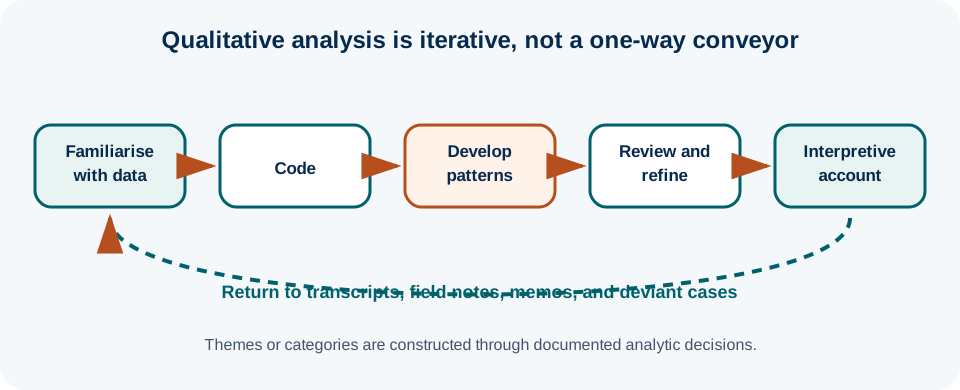
A commonly taught sequence includes:
- familiarisation with the dataset;
- generating codes;
- developing candidate themes;
- reviewing and refining themes;
- defining and naming themes; and
- producing the analytic account.[1]
These are not rigid one-way stages. Researchers move back and forth as interpretations develop.
Illustrative reflexive thematic-analysis plan
Question: How do women make sense of postpartum glucose testing after gestational diabetes?
Orientation: Interpretive, primarily inductive but informed by awareness of health-service context.
Coding: Researcher-generated, applied across the full dataset, with ongoing memoing.
Theme development: Construct patterns of shared meaning rather than aggregate code frequencies.
Reflexivity: Maintain analytic memos about assumptions arising from the researcher’s clinical background.
Evidence: Use selected extracts to demonstrate how each theme is supported and how variation or contradictions are handled.
Qualitative content analysis
Qualitative content analysis can be more descriptive or more interpretive depending on its tradition. Hsieh and Shannon describe conventional, directed and summative approaches.[2]
Conventional content analysis
Codes and categories are developed primarily from the data when existing theory or evidence is limited. Researchers still bring prior knowledge; “inductive” does not mean the researcher becomes conceptually empty.
Directed content analysis
An existing theory or framework guides initial coding categories. This can be efficient when the aim is to extend or examine an established framework, but it creates a risk of forcing unexpected data into predefined boxes. The plan should preserve a route for material that does not fit.
Summative content analysis
A summative approach may begin with words or content frequencies and then examine contextual meaning. Counting can support the analysis, but frequency is not sufficient by itself to establish significance.[2]
Manifest and latent content
Graneheim and Lundman distinguish attention to manifest content—what the text more directly says—from latent content, which concerns underlying meaning.[3] Researchers should make the interpretive level visible rather than sliding between description and inference without explanation.
Choose an analytic approach deliberately
Use reflexive thematic analysis when the aim is to develop and interpret patterned meaning across the dataset and researcher reflexivity is explicitly integrated.
Use conventional qualitative content analysis when the aim is to organise and describe content with categories substantially developed from the data.
Use directed content analysis when an existing framework deliberately structures initial analysis but new categories remain possible.
Use summative content analysis when selected content frequencies are analytically relevant and are followed by contextual qualitative interpretation.
Do not choose the method because a software menu uses the same label.
Inductive and deductive reasoning
Inductive analysis develops codes or patterns mainly from the dataset. Deductive analysis uses concepts, theory or a framework to guide attention. Real projects often combine them.
For example, a team may start with predefined domains from a care-access framework but create additional codes when women describe identity transitions after childbirth that the framework does not capture. The transparent description would be primarily deductive with inductive expansion, not simply “inductive analysis”.
Building an auditable analytic workflow
Step 1: Prepare and familiarise
Check transcript completeness, recording quality, translation status, field-note integration and dataset boundaries. Read and reread enough material to understand context before fragmenting it into codes.
Step 2: Code systematically
Coding should address the research question while remaining open to unexpected meaning. If multiple analysts code, clarify whether the purpose is collaborative interpretation, codebook consistency, training, division of workload or formal reliability assessment.
Step 3: Write analytic memos
Memos capture why codes were created, how categories relate, where interpretations changed, what contradictions emerged and what the researcher is uncertain about. They create a bridge between coding and higher-level analysis.
Step 4: Develop patterns
For thematic analysis, examine whether candidate themes express coherent shared meaning. For content analysis, examine how codes form categories and subcategories and whether their boundaries are conceptually defensible.[4]
Step 5: Test the analysis against the dataset
Actively seek variation, exceptions and negative or deviant cases. Ask whether a proposed theme fits only the most memorable participants. Return to original transcripts rather than relying entirely on coded extracts.
Step 6: Refine and name the analytic product
A theme name should communicate its central organising concept. Category labels should be clear enough that readers can understand what belongs inside and outside them.
Step 7: Construct the analytic narrative
The results section should not be a sequence of quotations. Each quotation or field-note extract should support an analytic point. The researcher’s explanation links evidence to the claim.
Pre-specify what can reasonably be specified
A qualitative analysis plan can state:
- analytic approach and methodological orientation;
- who will analyse the data and their relevant positioning;
- whether coding begins inductively, deductively or both;
- use of software, if any;
- how memos and code/category/theme changes will be documented;
- whether multiple analysts have collaborative, consensus or reliability roles;
- how contradictory cases will be explored;
- how translated data will be handled; and
- how evidence will be selected for reporting.
Do not fabricate a final codebook before collecting data merely to make the protocol appear precise.
What qualitative software does and does not do
Computer-assisted qualitative data-analysis software can store, retrieve, link and organise material. It can help teams manage coding and preserve an audit trail. It does not decide what a passage means, determine which interpretation is defensible or automatically produce themes.
The statement “NVivo generated five themes” would therefore misrepresent the analytic process. A more accurate description is that researchers used software to manage data and coding while themes were developed through iterative interpretation.
Coding teams and agreement
Team analysis can broaden perspectives and expose assumptions. However, the purpose of multiple coders should match the analytic tradition.
In a structured content-analysis project, a shared codebook may be developed and refined so analysts apply categories consistently. In reflexive thematic analysis, forcing independent coders to reach numerical agreement can imply that one objectively correct coding exists, which is inconsistent with the method’s interpretive foundations.[5]
A team using reflexive thematic analysis might instead compare different readings, discuss why interpretations differ and use those discussions to deepen the analysis.
Why inter-rater reliability is not a universal qualitative quality criterionMMed extension
Reliability coefficients answer a specific question about reproducibility of coding decisions under a defined coding system. That can be useful when the analytic design treats code application as standardised classification.
Interpretive approaches may instead treat different researcher perspectives as analytically productive. The quality question then concerns reflexivity, coherence, transparency and evidential support rather than whether two analysts independently produce identical codes. Methodological criteria should follow the epistemological and analytic design rather than being borrowed automatically from measurement research.
From codes to a defensible interpretation
Developing themes rather than reporting a barrier list
Early codes include believes diabetes ended, baby becomes priority, no clear handover, testing requires new appointment, family sees mother as recovered, fear of future diabetes, helpful reminder, and community clinic easier.
A superficial report might group these into “knowledge”, “family”, “health system” and “facilitators”. The team instead develops a candidate theme: “After childbirth, diabetes becomes administratively and socially invisible.”
They test this theme across transcripts. It captures women’s belief that pregnancy-related care has ended, family expectations that the mother is now well, and fragmented transfer from maternity to chronic-disease prevention. However, several women remain highly concerned about diabetes. Their accounts refine the interpretation: awareness alone is insufficient when the care pathway no longer signals that follow-up is part of routine postpartum care.
The final analysis retains contrasting accounts rather than presenting a uniform story. The theme is supported with selected extracts and linked to the research question.
Presenting qualitative findings
A strong results section usually combines:
- an analytic claim;
- explanation of the pattern or category;
- evidence from the dataset;
- variation or exceptions where relevant; and
- connection among themes or categories.
Reporting standards such as SRQR emphasise transparent description of data-processing and analysis procedures.[6] The reader should understand how researchers moved from data to the reported interpretation without expecting a mechanical recipe that eliminates judgement.
Appraising qualitative analysis
Questions for appraisal
- Is the analytic approach named and described rather than merely labelled?
- Does the approach fit the research question and methodology?
- Are codes, categories and themes used consistently?
- Is the role of theory or a priori frameworks explicit?
- Is the researcher’s interpretive role acknowledged?
- Are software and multiple-coder procedures represented accurately?
- Is there evidence of iterative engagement with the whole dataset?
- Are contradictory or minority cases considered?
- Do quotations or extracts support analytic claims rather than replace analysis?
- Are claims appropriately bounded to the data and study context?
Translation and analytic meaning
Multilingual datasets add another interpretive layer. Codes developed in English may not capture distinctions expressed in Malay or another source language. The team should decide whether coding occurs before or after translation, who checks translated extracts, and how culturally specific terms are retained in memos or reporting. Translation should be treated as an analytic act rather than a clerical step.[6]
When reporting a translated quotation, researchers can state that the extract was translated and, where a term carries important meaning, explain the translation choice. The aim is not literal word-for-word equivalence at the expense of meaning.
When analysis is complete enough to report
Analytic completion is not defined by having coded every line once. The team should be able to articulate what each theme or category contributes, how it relates to the research question, what evidence supports it, where it does not apply and how the overall analytic account hangs together.[1,5] If theme boundaries remain indistinct or findings simply mirror the interview guide, further analytic work is probably needed.
Common mistakes
Knowledge check
Is 'transportation' automatically a theme in thematic analysis?
Answer and reasoning
No. It is more likely a topic or code label. A theme should communicate patterned meaning organised around a central concept—for example, how requiring a separate journey after maternity discharge makes preventive follow-up negotiable or optional.
Can a directed content analysis include findings that were not in the original framework?
Answer and reasoning
Yes. A strong directed analysis should preserve a route for data that do not fit predefined categories. Otherwise the framework can become a device for suppressing rather than examining unexpected findings.
Two analysts using reflexive thematic analysis assign different codes to the same passage. Must this be treated as an error?
Answer and reasoning
No. Different interpretations can be used reflexively to deepen analysis. Numerical coder agreement is not a universal requirement; its relevance depends on the analytic approach and what coding is intended to represent.
What is wrong with the statement 'NVivo identified the study themes'?
Answer and reasoning
Qualitative software can manage and retrieve data, but interpretation is performed by researchers. The statement should describe the software as an organisational tool and explain how researchers developed and refined themes.
Key take-home messages
Key take-home messages
- Coding is an analytic tool, not the final qualitative finding.
- Themes, categories and codes have different roles and should not be used interchangeably.
- Thematic analysis and qualitative content analysis contain different methodological variants; name and describe the approach used.
- Inductive and deductive reasoning can be combined transparently.
- Researcher judgement, reflexivity and evidential support are central to defensible qualitative interpretation.
- Software and coder agreement should serve the analytic design rather than define it.
References
- Braun V, Clarke V. Using thematic analysis in psychology. Qual Res Psychol. 2006;3(2):77-101. https://doi.org/10.1191/1478088706qp063oa
- Hsieh HF, Shannon SE. Three approaches to qualitative content analysis. Qual Health Res. 2005;15(9):1277-1288. https://doi.org/10.1177/1049732305276687
- Graneheim UH, Lundman B. Qualitative content analysis in nursing research: concepts, procedures and measures to achieve trustworthiness. Nurse Educ Today. 2004;24(2):105-112. https://doi.org/10.1016/j.nedt.2003.10.001
- Elo S, Kyngäs H. The qualitative content analysis process. J Adv Nurs. 2008;62(1):107-115. https://doi.org/10.1111/j.1365-2648.2007.04569.x
- Braun V, Clarke V. One size fits all? What counts as quality practice in (reflexive) thematic analysis? Qual Res Psychol. 2021;18(3):328-352. https://doi.org/10.1080/14780887.2020.1769238
- O’Brien BC, Harris IB, Beckman TJ, Reed DA, Cook DA. Standards for reporting qualitative research: a synthesis of recommendations. Acad Med. 2014;89(9):1245-1251. https://doi.org/10.1097/ACM.0000000000000388
These materials support learning and research planning. They require adaptation to the study context and do not replace methodological, statistical, ethical, or regulatory consultation.