
Part 8 · Module 1
Case-Control Study Design
Understand how case-control studies sample people by outcome status to investigate prior exposures efficiently and without estimating exposure from convenience groups.
Learning outcomes
After completing this lecture, you should be able to:
- Define the study base, cases, controls and exposure-assessment period in a case-control study.
- Explain why controls should represent the exposure distribution in the population that produced the cases.
- Distinguish case-control sampling from a cohort design and from a simple comparison of people with and without disease.
- Identify major threats from selection, recall, measurement and temporal ambiguity.
- Specify the protocol and statistical-analysis interface for a basic case-control study.
Overview
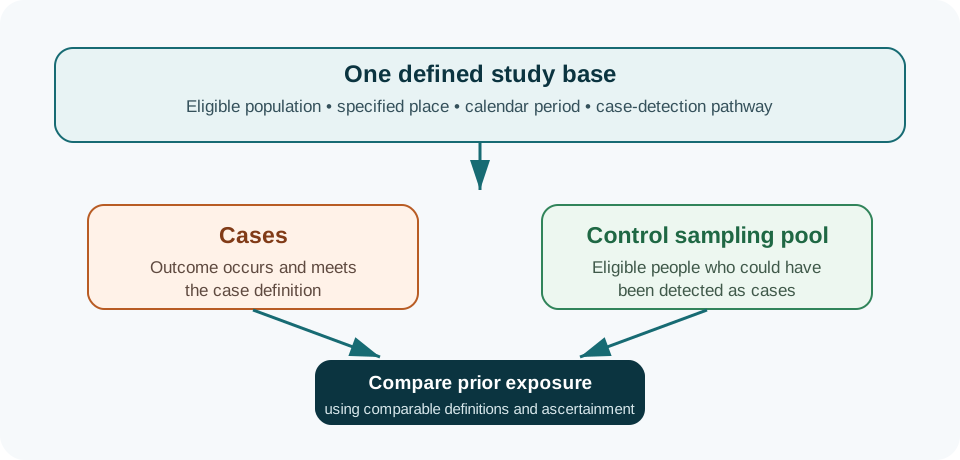
A case-control study begins with an outcome: people who have the outcome are selected as cases, and people who could have become cases but did not have the outcome at the relevant time are selected as controls. Investigators then compare prior exposure histories between the two groups. This outcome-based sampling can study uncommon diseases, outcomes with long latency, or multiple possible causes without following a very large population for years.[1,2]
The design is not defined merely by comparing a “disease group” with a “healthy group”. Its validity depends on a coherent study base: the population and time experience that generated the cases. Controls must represent the exposure distribution in that same base. When this principle is ignored, a technically polished analysis may answer no defensible population question.[2,3]
This lecture introduces the basic structure, appropriate uses, main design decisions, important biases and analysis interface of case-control research.
Why this matters
Case-control studies have helped identify causes of rare diseases and harmful exposures, but they are especially vulnerable to mistakes in participant selection and retrospective measurement. Investigators sometimes:
- define cases from one hospital but recruit controls from an unrelated convenience population;
- select controls because they are “healthy” rather than because they belong to the study base;
- measure exposure differently in cases and controls;
- include prevalent cases whose exposure may affect disease duration rather than occurrence;
- interpret the odds ratio as a risk ratio without considering outcome frequency; or
- assume that a retrospective study is automatically a case-control study.
The central design task is to reconstruct a fair comparison within the population that gave rise to the cases.
Key concepts
The study base
The study base is the population-time experience from which the cases arose. It may be geographically defined, such as all eligible residents of a district, or service defined, such as people whose acute event would normally be managed by a network of hospitals. The base must specify place, calendar time, eligibility and the pathway by which cases are detected.
Cases
Cases should satisfy a reproducible outcome definition and belong to the study base. The protocol should specify:
- incident or prevalent cases;
- diagnostic criteria and confirmation procedures;
- first or recurrent events;
- age, location and time restrictions;
- inclusion of fatal or rapidly resolving cases; and
- whether assessors are blinded to exposure history.
Incident cases are often preferred for causal questions because exposure is more clearly assessed before disease occurrence and survival after disease onset does not determine eligibility.
Controls
Controls are not included to estimate the number of people without disease. Their purpose is to estimate the exposure distribution in the study base that produced the cases. A useful counterfactual question is: Had a selected control developed the outcome during the study period, would that person have been eligible and detected as a case?[2,3]
Exposure assessment
Exposure must refer to a period before the outcome’s biologically relevant onset. The same definitions, sources and intensity of ascertainment should be used in both groups wherever possible. Records, registries, stored specimens and blinded structured interviews can reduce differential measurement.
When to use this approach
Conditions that support a case-control study
- The outcome is uncommon or would require a very large cohort.
- There is a plausible and measurable prior exposure.
- Cases can be identified using consistent criteria.
- A defensible study base and control source can be defined.
- Exposure assessment can be applied comparably to cases and controls.
- The main objective concerns one outcome and one or more potential causes.
A case-control study may be inefficient or misleading when the exposure is extremely rare, the study base cannot be defined, exposure records are unavailable and recall is likely to differ strongly, or investigators need direct estimates of incidence and absolute risk. A cohort design may then be preferable.
Research question and methodological fit
An appropriate question is:
Among women aged 30–54 years in the participating hospitals’ source population, is documented previous gestational diabetes associated with the occurrence of a first myocardial infarction during 2025–2027?
The intended inference is an exposure–outcome association within the defined source population. The unit of observation is the woman. The primary contrast is the odds of previous gestational diabetes among cases relative to controls. Under appropriate incidence-density sampling, the resulting odds ratio estimates an incidence rate ratio without requiring the outcome to be rare.[1,2]
The question should not be framed as “What proportion of women with myocardial infarction had gestational diabetes?” because that describes only cases and ignores the comparison needed to estimate association.
Design, setting and study population
Case-control study
Core structure: Participants are sampled according to outcome status, and exposure history before the relevant outcome time is compared between cases and controls.
Best suited for: Uncommon outcomes, outcomes with long latency, and efficient evaluation of several prior exposures.
Important limitations: Direct incidence and risk cannot usually be estimated from the sampled groups; selection and retrospective exposure measurement require particular care.
The source population can be population based or facility based. A hospital-based design is not automatically invalid, but admission pathways must be understood. If the exposure influences admission for the control conditions, the control exposure distribution may be distorted.
The index date anchors exposure assessment. For a case, it may be the date of diagnosis or symptom onset. Each control needs a comparable reference date so that exposure windows, age and opportunity for exposure are aligned.
Sampling and recruitment
Core sampling decisions
- Define the study base by population, place and calendar period.
- Specify incident or prevalent case ascertainment and diagnostic confirmation.
- Define the control source and demonstrate that controls could have become cases.
- State whether controls are sampled at the end of follow-up, from risk sets or from a baseline cohort.
- Specify the case-to-control ratio and any matching or stratification.
- Record eligibility, approach, refusal and analysis numbers separately for cases and controls.
Using more than one control per case can improve precision, but gains become modest after approximately four controls per case in many ordinary settings. The choice should be justified by availability, cost and expected exposure frequency rather than a fixed ritual.[1]
Variables, constructs and measurements
Illustrative variable specification
illustrativeTable 1. Variables for the myocardial-infarction case-control study
| Variable | Operational definition | Source | Timing |
|---|---|---|---|
| Case status | First myocardial infarction meeting prespecified clinical criteria | Hospital records and adjudication | Index admission |
| Previous gestational diabetes | Diagnosis recorded in a pregnancy before the index date | Maternity or linked records | Before index date |
| Smoking | Smoking status during the etiologically relevant period | Structured interview and records | Before index date |
| Age | Age in completed years at index date | Identity record | Index date |
| Hypertension | Documented diagnosis before index date | Medical records | Before index date |
Note: All values and procedures are illustrative.
The protocol must distinguish confounders from mediators and consequences of disease. Variables measured after diagnosis may have been altered by symptoms, treatment or behavioural change.
Procedures and data collection
Case ascertainment should be independent of exposure whenever possible. A common manual, data dictionary and training programme should be used for both groups. Interviewers can be blinded to the main hypothesis or use standardised prompts. Record abstractors should apply the same search period and source hierarchy.
Quality assurance can include duplicate abstraction, adjudication of uncertain diagnoses, checks for impossible dates, monitoring of missing exposure data and comparison of interview reports with records in a validation subsample.
Bias, validity and quality assurance
The structural mechanisms of selection bias and the broader epidemiological principles underlying these threats are discussed in established methodological sources.[4,5]
Important threats include:
- selection bias: case or control inclusion depends jointly on exposure and outcome;
- recall bias: cases search their memory differently after diagnosis;
- interviewer bias: probing differs by outcome status;
- survivor bias: rapidly fatal cases are unavailable;
- reverse causation: apparent exposure was changed by early disease; and
- confounding: a common cause influences exposure and outcome.
Questions for critical appraisal
- Is the study base clearly defined and capable of producing both cases and controls?
- Were cases identified using valid, consistent and exposure-independent criteria?
- Do controls estimate the exposure distribution in the study base?
- Were exposure sources and reference periods comparable between groups?
- Were confounders selected using subject-matter reasoning rather than only univariable p-values?
- Are the reported association and limitations consistent with the sampling scheme?
Ethical and governance considerations
Interface with statistical analysis
The conventional analysis estimates an odds ratio with a 95% confidence interval. Unmatched studies commonly use logistic regression; individually matched studies require methods that preserve matched sets, such as conditional logistic regression. Frequency matching is usually addressed through adjustment for matching factors. The direction of the contrast and reference categories must be explicit.
The planned lecture Measures of Epidemiological Association will provide additional detail on odds ratios and their interpretation. Statistical adjustment cannot correct controls sampled from the wrong study base.
Why the rare-disease rule is not universalMMed extension
An odds ratio from a case-control study does not have one universal interpretation. With cumulative-incidence sampling it approximates a risk ratio when the outcome is rare. With incidence-density sampling, controls are sampled from those at risk at each case time and the odds ratio estimates an incidence rate ratio even when the outcome is not rare. The sampling design determines the estimand.[1,2]
Worked example
Designing the myocardial-infarction study
The team defines the study base as women aged 30–54 years who reside in participating districts and whose acute myocardial infarction would normally be treated by the hospital network. Incident first events during 2025–2027 are adjudicated without knowledge of pregnancy history.
For each case, controls are sampled from women in the same source population who are alive and have not yet experienced a first myocardial infarction at the case’s index date. Previous gestational diabetes is extracted from linked maternity records using the same look-back rules. Age, calendar time, smoking and hypertension are prespecified using the conceptual framework.
This design is preferable to recruiting “healthy volunteers” from hospital staff because staff may differ from the source population in age, employment, access to records and prior pregnancy care. The proposed risk-set sampling also gives the odds ratio an incidence-rate-ratio interpretation.
Suggested protocol or reporting wording
Common mistakes
Knowledge check
What is the primary purpose of controls in a case-control study?
Answer and reasoning
Controls estimate the exposure distribution in the study base that generated the cases. They are not selected merely to provide a disease-free comparison group or to resemble cases on every characteristic.
Why are hospital staff usually poor controls for community cases?
Answer and reasoning
Staff may not belong to the population whose disease would be detected as a case, and their employment, healthcare access and exposure histories may differ systematically. Similarity in age alone does not establish membership in the study base.
Can a control later become a case?
Answer and reasoning
Yes. Under incidence-density sampling, a person can be selected as a control while at risk and later become a case. This is consistent with the control’s role as a sample of person-time at risk.
Why can the case-control odds ratio estimate a rate ratio without a rare outcome?
Answer and reasoning
When controls are sampled from the risk set at each case time, their exposure distribution represents person-time at risk. The odds ratio produced by that sampling scheme estimates the incidence rate ratio; the interpretation follows from the design, not a rare-disease approximation.
Key take-home messages
Key take-home messages
- A case-control study samples participants according to outcome status and then compares prior exposure histories.
- Cases and controls must arise from one coherent study base.
- Controls should represent the exposure distribution among people who could have become cases.
- Exposure ascertainment should use comparable sources, definitions and reference periods.
- The control-sampling scheme determines how the odds ratio should be interpreted.
- Statistical sophistication cannot repair a fundamentally inappropriate control group.
Transparent reporting should follow the STROBE recommendations for case-control studies.[6]
References
- Keogh RH, Cox DR. Case-control studies. Cambridge: Cambridge University Press; 2014. https://doi.org/10.1017/CBO9781139094757
- Wacholder S, McLaughlin JK, Silverman DT, Mandel JS. Selection of controls in case-control studies. I. Principles. Am J Epidemiol. 1992;135(9):1019–1028. https://doi.org/10.1093/oxfordjournals.aje.a116396
- Wacholder S, Silverman DT, McLaughlin JK, Mandel JS. Selection of controls in case-control studies. II. Types of controls. Am J Epidemiol. 1992;135(9):1029–1041. https://doi.org/10.1093/oxfordjournals.aje.a116397
- Rothman KJ, Greenland S, Lash TL. Modern epidemiology. 3rd ed. Philadelphia: Lippincott Williams & Wilkins; 2008.
- Hernán MA, Hernández-Díaz S, Robins JM. A structural approach to selection bias. Epidemiology. 2004;15(5):615–625. https://doi.org/10.1097/01.ede.0000135174.63482.43
- von Elm E, Altman DG, Egger M, Pocock SJ, Gøtzsche PC, Vandenbroucke JP; STROBE Initiative. The Strengthening the Reporting of Observational Studies in Epidemiology (STROBE) statement: guidelines for reporting observational studies. PLoS Med. 2007;4(10):e296. https://doi.org/10.1371/journal.pmed.0040296
These materials support learning and research planning. They require adaptation to the study context and do not replace methodological, statistical, ethical, or regulatory consultation.