
Part 14 · Module 7
Contamination, Co-Intervention and Behavioural Effects
Recognise contamination, co-intervention and research-participation effects, and design studies to preserve intervention contrast without creating new bias.
Learning outcomes
After completing this lecture, you should be able to:
- Define contamination, co-intervention, non-adherence and behavioural reactivity as distinct threats.
- Explain how these processes can dilute, exaggerate or otherwise alter estimated intervention effects.
- Plan design and monitoring strategies that reduce cross-group contamination and differential co-intervention.
- Distinguish assignment effects from adherence-based effects and avoid inappropriate post-randomisation exclusions.
- Interpret behavioural effects of study participation cautiously rather than assuming a universal Hawthorne effect.
Overview
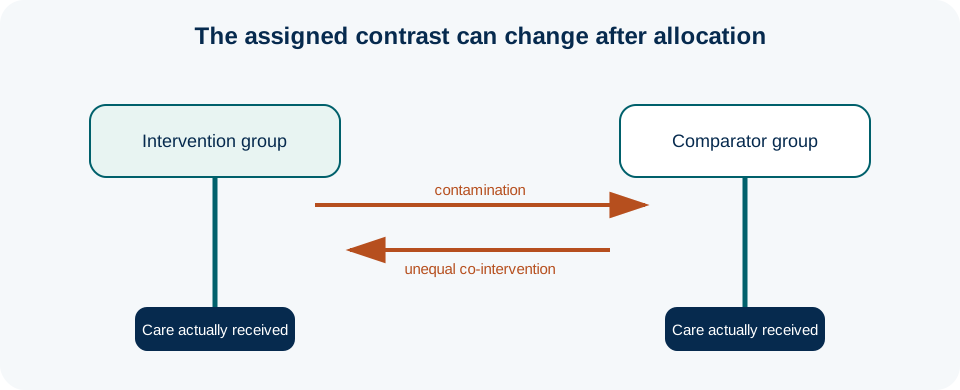
Intervention studies are affected by what participants and clinicians actually do after allocation. Contamination occurs when participants assigned to one group receive elements intended for another group. Co-intervention occurs when additional care differs between groups and can affect the outcome. Non-adherence means participants do not follow the assigned intervention as intended. Research participation itself can also change behaviour or measurement, sometimes described broadly as a Hawthorne effect.[1,2]
These mechanisms are related but not interchangeable. Each changes the meaning of the observed contrast differently. A trial can preserve unbiased random assignment yet estimate a smaller assignment effect because the groups received increasingly similar care.
Why this matters
When the intervention contrast is weakened, investigators may be tempted to exclude non-adherent participants or analyse only those who received treatment exactly as planned. Such analyses can destroy randomisation and create selection bias. The safer starting point is to define the estimand, monitor intervention delivery and prespecify how deviations will be interpreted.[2,3]
Cluster randomisation, staff separation or geographic separation can reduce contamination in some settings, but these design choices create other consequences for sample size, analysis and generalisability. Prevention should therefore be proportionate to the actual mechanism.
Key concepts
Contamination is best understood as cross-group exposure to intervention components. It may occur through staff, participants, shared digital systems, clinic policy or community networks. Co-intervention is broader: compared groups receive other care that differs and affects the outcome. These can lead to convergence of groups, but differential co-intervention can also exaggerate an effect.
Behavioural reactivity should be described specifically. Systematic reviews of so-called Hawthorne effects find heterogeneous evidence and caution against treating the term as one uniform, predictable phenomenon.[1]
Sources of contamination
Contamination can occur when the same clinicians deliver both arms, participants communicate, educational materials remain accessible to all groups, digital prompts are embedded in shared systems, or a service-level policy changes during the study. The risk is especially important for behavioural, educational and service-delivery interventions where components are easy to transfer.
A contamination assessment should identify who can transfer the intervention, which components are transferable, and whether transfer can be measured without itself changing behaviour.
Design strategies
Possible strategies include cluster randomisation, separate intervention staff, geographically separated sessions, restricted access to intervention materials, delayed intervention for controls, and clear role-based procedures. Cluster randomisation is not automatically the best solution: it can introduce recruitment bias, requires more clusters and changes the analytical unit and intracluster correlation structure.[4]
When contamination is likely but clinically acceptable, investigators may instead design the trial to estimate effectiveness under realistic spillover conditions.
Monitoring intervention fidelity and contamination
Measure intervention delivery using logs, attendance, message delivery records, fidelity checklists or sample observations. Measure critical contamination pathways with prespecified indicators. Avoid burdensome monitoring that changes routine behaviour or creates differential surveillance.
Report contamination by component rather than one vague yes/no label. A control participant receiving one generic reminder is different from receiving the full navigation programme.
Co-interventions and evolving standard care
Trials occur within changing health systems. New medications, referral pathways, educational campaigns or reimbursement policies can affect groups. Collect important co-interventions when they are plausibly outcome-determining and likely to differ by arm. If standard care changes during the study, document timing and site variation.
Do not automatically adjust for every post-randomisation co-intervention. Some are consequences of treatment assignment and adjustment can alter the estimand.
Non-adherence and treatment switching
Non-adherence can arise from adverse effects, lack of access, treatment preference, clinical deterioration or logistical barriers. These reasons often predict outcomes, so a per-protocol comparison based only on observed adherence can be confounded. Intention-to-treat analysis preserves the randomised assignment contrast but does not answer every causal question.
Modern estimand frameworks distinguish strategies for treatment switching, discontinuation and rescue therapy. If an adherence-based effect is important, it requires methods and assumptions designed for that estimand rather than simple exclusion.[3]
Behavioural effects of observation
Participants may change behaviour because they are observed, questioned or repeatedly assessed. Clinicians may change practice because they know performance is monitored. Such reactivity can reduce external validity or alter both groups. However, the magnitude and even direction vary by context. Describe the specific research-participation process rather than invoking “the Hawthorne effect” as a complete explanation.[1]
Masking and expectancy effects
Blinding participants or personnel can reduce differential behaviour when feasible, especially for subjective outcomes. In complex interventions, participant blinding may be impossible, but outcome assessors, adjudicators or analysts may still be masked. Standardised scripts and equal contact time can reduce differential expectancy and attention between groups.
Analysis and interpretation
The primary analysis should correspond to the prespecified estimand. If contamination is substantial, report it and interpret the observed effect as the effect of the actual assignment strategy under those conditions. Secondary causal analyses of received treatment require stronger assumptions and should be labelled accordingly.
A diluted effect is not automatically evidence that the intervention lacks biological or behavioural efficacy; it may reflect weak separation between groups. Conversely, differential co-intervention can make an intervention appear more effective than its isolated component truly is.
Plan for contamination before recruitment
- Identify intervention components that can cross groups.
- Identify staff, participants and systems that can transmit them.
- Decide whether individual or cluster allocation better protects the intended contrast.
- Define important co-interventions and fidelity indicators.
- Prespecify the estimand and how treatment discontinuation or switching will be interpreted.
- Monitor without creating unnecessary differential observation.
Contamination and fidelity matrix
illustrativeTable 1. Illustrative monitoring matrix
| Process | Intervention arm | Control arm | Interpretation |
|---|---|---|---|
| Automated reminder received | Expected | Contamination if received | Direct component transfer |
| Nurse verbal reminder | Permitted if protocolised | Track frequency | Possible staff-mediated contamination |
| New hospital discharge leaflet | Both arms | Both arms | Change in background standard care |
| External diabetes education | Record | Record | Potential co-intervention |
The matrix distinguishes cross-group transfer from background care changes.
Questions for behavioural and intervention-related bias
- Could intervention components cross from one group to another?
- Were important co-interventions measured similarly in both groups?
- Did outcome assessment intensity differ between groups?
- Were treatment switching and discontinuation handled according to a prespecified estimand?
- Are behavioural effects described through observed mechanisms rather than assumed labels?
Interference and spilloverMMed extension
Standard causal analyses often assume one participant’s treatment does not affect another participant’s outcome. Contamination is one form of interference, where that assumption fails. In infectious-disease, social-network and community interventions, spillover can itself be scientifically important. Designs may therefore estimate direct, indirect and total effects rather than trying to eliminate all interference. The cluster or network structure then becomes part of the estimand and analysis.
Contamination is an exposure process, not only a protocol deviation
A useful way to understand contamination is to map what participants actually become exposed to after allocation. In a behavioural intervention trial, control participants may receive intervention materials from colleagues, clinicians may apply newly learned counselling techniques to both arms, or participants may obtain similar programmes outside the study. Conversely, intervention participants may receive only part of the intended programme. The contrast between groups can therefore be smaller than the contrast specified on paper.
The effect of contamination depends on the estimand. For an intention-to-treat effect of assignment, real-world spillover may be part of the effectiveness question. For a per-protocol effect of actually following the assigned strategy, contamination and non-adherence require explicit definition and stronger assumptions for analysis.[3] Investigators should therefore avoid calling every cross-arm exposure a nuisance without first asking which treatment strategy the study intends to estimate.
Measuring contamination and co-intervention
Contamination cannot be interpreted if it is not measured. Trials of complex interventions should identify plausible cross-arm pathways before recruitment and collect concise process data during follow-up. Examples include access to intervention materials, attendance at outside programmes, clinician cross-cover, use of prohibited concomitant treatments and exposure to campaign content. Measurement should be balanced across arms; asking intervention participants detailed questions while barely assessing controls can itself produce differential information quality.
Co-interventions should similarly be defined prospectively when they can materially influence the outcome. Standard care is rarely static. Medication formularies change, new clinical guidelines are adopted, staff rotate and local initiatives may start during a long trial. Calendar time, site-level changes and important co-interventions should therefore be documented so the eventual treatment contrast can be interpreted in its actual care context.
When contamination occurs through clinicians or facilities rather than individual participants, the dependency can be clustered. Cluster randomisation can reduce some forms of spillover, but it introduces intracluster correlation, often requires more clusters, and may create recruitment or identification bias if individuals are enrolled after clusters know their allocation.[2,4] The design decision must weigh these competing threats rather than treating clustering as a universal cure.
Distinguishing behavioural research-participation effects
Research participation can itself alter behaviour. Repeated questionnaires may prompt self-monitoring; wearing an activity tracker can encourage activity; consent discussions may increase awareness; and frequent follow-up can improve adherence in both intervention and control groups. These phenomena are often grouped loosely under the “Hawthorne effect”, but systematic review evidence shows that the concept covers heterogeneous mechanisms and is difficult to quantify as a single universal effect.[1]
A stronger protocol specifies the hypothesised participation mechanism. If measurement reactivity is a concern, reduce unnecessary assessments, use routinely collected outcomes where appropriate, or consider designs that can separate assessment effects from intervention effects. If performance is likely to change because clinicians know they are observed, use objective outcome ascertainment or independent assessment where feasible.
Masking can reduce some expectancy and ascertainment mechanisms, but the feasibility and meaning of masking differ across interventions. A pharmacological placebo may mask participants effectively, whereas a surgery, rehabilitation programme or service redesign often cannot. In such cases, masking outcome assessors, using standardised co-intervention policies and choosing outcomes less vulnerable to expectation become more important.[5]
Interpreting diluted or amplified treatment contrasts
Contamination often reduces separation between randomised groups and can attenuate an effect of assignment, but this is not guaranteed. A beneficial co-intervention received more frequently by the intervention arm may amplify the observed contrast. Differential rescue treatment can either reduce or increase differences depending on why it is initiated. Behavioural compensation may even produce effects in the opposite direction.
The report should therefore describe the direction of the observed exposure imbalance rather than assert that contamination “biased towards the null”. Present arm-specific process measures, relevant co-interventions and adherence patterns, then discuss how they relate to the estimand. If alternative estimands are estimated, label them clearly and explain the additional assumptions rather than presenting a per-protocol analysis as automatically less biased than intention-to-treat.
Interface with statistical analysis
Intention-to-treat estimates the effect of assignment under the trial conditions and usually remains the primary randomised comparison. Per-protocol and as-treated estimands can be estimated with specialised causal methods when scientifically justified. Cluster designs require methods that account for intracluster correlation. The Biostatistics clinical-trial lectures cover these analyses in detail.
Worked example
Responding to contamination in the postpartum reminder trial
Monitoring shows that 28% of control participants received at least one verbal reminder from nurses, while 92% of intervention participants received the automated message sequence. A new discharge leaflet was introduced hospital-wide halfway through recruitment.
The team does not remove contaminated control participants from the primary analysis. The prespecified primary estimand is the effect of assignment to the programme, so randomised groups remain the basis of comparison. They report intervention fidelity and contamination by component and period. A secondary analysis examines whether results differ before and after the new leaflet, recognising that calendar-time comparisons are observational.
For a future trial, the team considers cluster allocation by clinic and separate staff workflows, but calculates the resulting design effect and recruitment implications first. The main report interprets the observed treatment effect as the effectiveness of assigning the programme in a real clinic environment where some spillover occurred.
Suggested protocol or reporting wording
Common mistakes
Knowledge check
Control participants receive part of an educational intervention from nurses. What is this?
Answer and reasoning
This is contamination because an intervention component intended for one group has crossed into the control group.
Why can simple per-protocol analysis be biased?
Answer and reasoning
Adherence is a post-randomisation characteristic influenced by prognosis, adverse effects and behaviour. Restricting to adherers can break exchangeability between groups.
Does contamination always bias an effect towards the null?
Answer and reasoning
No. Cross-group sharing often reduces contrast and can attenuate an assignment effect, but the direction depends on which components move, whether co-interventions differ, and how the outcome is affected.
When can spillover be part of the research question rather than a nuisance?
Answer and reasoning
In community, network and infectious-disease interventions, one person’s treatment can intentionally affect others. The study may target indirect or population effects, requiring an estimand and design that acknowledge interference.
Key take-home messages
Key take-home messages
- Contamination, co-intervention, non-adherence and behavioural reactivity are different mechanisms.
- Preserve and document the intervention contrast required by the target estimand.
- Do not automatically exclude non-adherent or contaminated participants from randomised comparisons.
- Cluster randomisation can reduce contamination but creates new design and analysis requirements.
- Describe observed behavioural mechanisms instead of assuming a generic Hawthorne effect.
References
- McCambridge J, Witton J, Elbourne DR. Systematic review of the Hawthorne effect: new concepts are needed to study research participation effects. J Clin Epidemiol. 2014;67(3):267-277. https://doi.org/10.1016/j.jclinepi.2013.08.015
- Higgins JPT, Savović J, Page MJ, Elbers RG, Sterne JAC. Chapter 8: Assessing risk of bias in a randomized trial. In: Cochrane Handbook for Systematic Reviews of Interventions version 6.5. Cochrane; 2024. https://www.cochrane.org/authors/handbooks-and-manuals/handbook/current/chapter-08
- International Council for Harmonisation of Technical Requirements for Pharmaceuticals for Human Use. ICH E9(R1): Addendum on estimands and sensitivity analysis in clinical trials. Geneva: ICH; 2019. https://database.ich.org/sites/default/files/E9-R1_Step4_Guideline_2019_1203.pdf
- Eldridge SM, Kerry S. A practical guide to cluster randomised trials in health services research. Chichester: Wiley; 2012. https://doi.org/10.1002/9781119966241
- Boutron I, Estellat C, Guittet L, Dechartres A, Sackett DL, Hróbjartsson A, et al. Methods of blinding in reports of randomized controlled trials assessing pharmacologic treatments. PLoS Med. 2006;3(10):e425. https://doi.org/10.1371/journal.pmed.0030425
These materials support learning and research planning. They require adaptation to the study context and do not replace methodological, statistical, ethical, or regulatory consultation.