
Part 11 · Module 6
Conducting Focus Group Discussions
Design and moderate focus group discussions that use participant interaction as data while managing group composition, power, confidentiality and analytic complexity.
Learning outcomes
After completing this lecture, you should be able to:
- Explain when focus group discussions are methodologically preferable to individual interviews.
- Plan group composition, recruitment, size and number in relation to the research question.
- Develop and moderate a focus group guide that promotes balanced interaction.
- Identify threats from dominance, conformity, status differences and confidentiality limitations.
- Describe how focus group interaction should be represented in analysis and reporting.
Overview
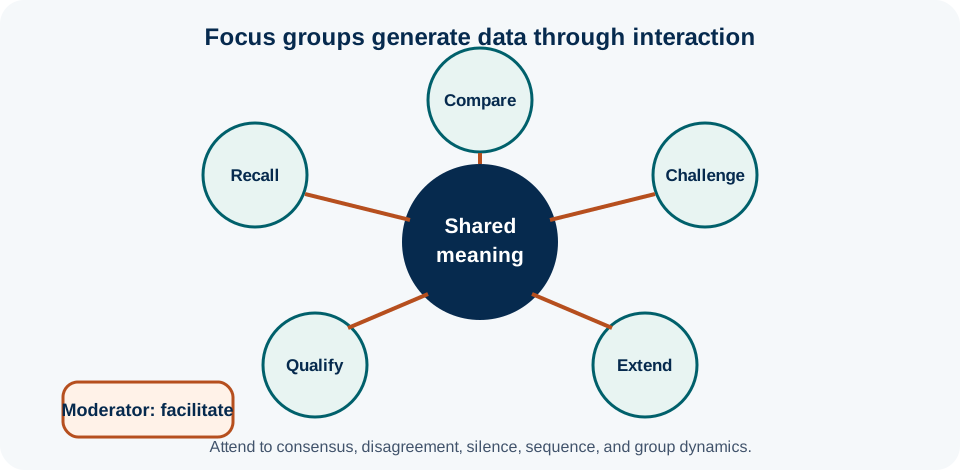
A focus group discussion is a facilitated group conversation organised around a research topic. Its distinctive value is not efficiency alone: participants respond to one another, compare experiences, challenge assumptions, build shared explanations and reveal social norms that may be less visible in individual interviews.[1]
Because interaction is part of the data, focus groups require methodological decisions about group composition, moderation, setting, confidentiality and analysis. They are not simply several interviews conducted at the same time.[1,2]
Why this matters
Group discussion can expose how views are socially negotiated. A participant may initially say that reminder messages are helpful, then revise or qualify that view after another participant describes receiving them while overwhelmed after childbirth. The conversation shows not only individual opinions but also how people recognise, contest or normalise experiences.
The same group dynamics can create problems. Senior clinicians may silence junior staff; one outspoken participant may dominate; participants may conform to a socially acceptable view; and confidentiality cannot be guaranteed once information has been shared with other group members.[2]
When to use focus groups
Focus groups are useful when
- The research question concerns shared norms, language, expectations or collective experiences.
- Participant interaction can stimulate memories and reveal agreement or disagreement.
- The study is developing an intervention, service or questionnaire and wants discussion of alternatives.
- Researchers want to compare perspectives across deliberately constructed groups.
- The topic is safe enough for group discussion and confidentiality limitations are acceptable.
Individual interviews may be preferable for highly sensitive personal experiences, topics that create substantial stigma or legal risk, or situations where hierarchy would inhibit disclosure. Observation may be preferable when researchers need to know how teams actually behave in practice rather than how they discuss practice.
Group composition
Composition should follow the research question. Homogeneous groups can help participants feel comfortable discussing shared experience, while separate groups can be compared across relevant characteristics. For example, nurses, medical officers and specialists may be separated if hierarchy is expected to constrain junior voices.
Heterogeneous groups may be valuable when the purpose is to observe debate across perspectives, but researchers should anticipate whether status differences make that interaction ethically or analytically problematic.[2]
How many participants and groups?
There is no universal number. Group size should allow diversity without making it impossible for everyone to contribute. Practical qualitative guidance often uses relatively small groups for complex or sensitive health topics, but adequacy depends on the aim, group stratification, topic complexity and analytic depth.[2,3]
Research on focus-group saturation shows that group stratification and the distinction between identifying issues and understanding their meaning affect the number of groups required.[3] The protocol should therefore explain the planned group structure and how adequacy will be reviewed rather than citing a ritual number.
Illustrative focus group sampling structure
illustrativeTable 1. Group composition for a service-redesign study
| Group | Participants sought | Why separate? |
|---|---|---|
| Women, completed testing | Recent postpartum experience | Explore what supported follow-up |
| Women, did not complete testing | Recent postpartum experience | Explore barriers without comparison pressure |
| Nurses and educators | Similar operational role | Discuss counselling and workflow |
| Medical officers | Similar professional level | Explore clinical responsibilities |
| Service managers | Governance perspective | Discuss resources and pathway design |
Note: This is illustrative. Final group structure should follow the question, feasibility and ethical context.
Developing the discussion guide
A focus group guide usually moves from easy introductory questions towards the central topic and then to prioritisation or reflection. Questions should be phrased for discussion rather than serial individual response.
For example:
- “When women leave pregnancy care, what do you think they expect will happen next?”
- “What makes postpartum testing feel worthwhile or not worthwhile?”
- “People have described reminders in different ways. What has your experience been?”
- “Which part of the pathway would you change first, and why?”
The moderator can use prompts, scenarios, ranking exercises or simple visual materials when they support discussion, but such activities should not overwhelm the conversation.
Moderation
Establish ground rules
Participants should understand the purpose, voluntary nature of participation, recording process and limits of confidentiality. The moderator can ask participants to respect one another’s privacy outside the group but cannot guarantee that all members will do so.
Encourage interaction
A moderator should often redirect questions to the group: “Does that fit with other people’s experience?” or “Has anyone had a different experience?” This encourages participants to engage with one another rather than speaking only to the researcher.[1]
Manage dominance without humiliating participants
Strategies include inviting quieter members, using a round for a specific question, acknowledging a dominant contribution and redirecting, or splitting a complex topic into pair reflection before whole-group discussion.
Attend to conformity and dissent
Agreement may reflect genuine shared experience or social pressure. The moderator should invite alternatives: “We have heard several similar views. Has anyone experienced this differently?” Dissenting or minority accounts can be analytically important.
Moderator and observer roles
Many studies use a moderator and a second researcher who manages recording, notes seating or speaker order, observes non-verbal interaction and identifies issues requiring clarification. The observer should not become a second competing moderator unless roles are planned.
Field notes can record:
- group atmosphere and disruptions;
- patterns of dominance or alliance;
- points of laughter, hesitation or discomfort;
- important non-verbal responses;
- seating arrangement when relevant; and
- immediate analytic reflections.
Analysis of focus group data
The transcript should retain enough information to identify speakers consistently within each group. Analysis should consider both content and interaction. Researchers may examine:
- themes across individuals;
- consensus and disagreement;
- how one contribution prompts another;
- stories that become collectively endorsed;
- differences between group types; and
- topics that are resisted or difficult to discuss.[1]
Counting how many people mention a point can occasionally provide descriptive context, but it does not turn the group sample into a survey. Moreover, one participant can introduce an idea that becomes important through the discussion even if only one person first raises it.
Unit of analysis can be participant, interaction or groupMMed extension
Researchers should be explicit about what constitutes evidence. Some analyses focus mainly on individual accounts collected in a group setting; others treat the interaction itself as central. Comparing whole groups may be appropriate when groups were deliberately stratified by role or context. The analytic unit should follow the question rather than being decided after transcription.
Ethical and governance considerations
Power relationships deserve specific attention. Staff should not be required to participate with their supervisor, and patients should not be placed in a group where their treating clinician is present unless the research question specifically requires that interaction and the risks are justified.
Worked example
Designing focus groups for postpartum pathway redesign
The team wants to understand how expectations about postpartum responsibility are negotiated among women and staff. They plan separate focus groups for women who completed testing, women who did not, nurses, medical officers and service managers.
The moderator opens with broad questions about the transition after birth, then asks participants to discuss how responsibility for arranging testing is understood. When one participant says, “It is the mother’s responsibility because she was given the appointment,” the moderator asks whether others agree and what happens when the appointment conflicts with infant care or transport.
The analysis examines not only which barriers appear but how participants construct responsibility, where groups disagree and how service-level explanations differ from patient accounts. The report does not state that a majority view in the focus groups represents the majority of the wider population.
Suggested protocol or reporting wording
Composing groups deliberately
Focus-group composition affects what can safely and productively be discussed. Homogeneous groups can create shared ground—for example, grouping junior nurses separately from senior managers may reduce hierarchical inhibition. Heterogeneous groups can expose contrasting perspectives but may also reproduce power differences that silence some members.[1,2]
Researchers should therefore define which characteristics need similarity and which need variation. The decision should follow the research question. If the study concerns how multidisciplinary teams negotiate discharge responsibility, mixed professional groups may be necessary. If it concerns experiences of managerial pressure, separating staff by hierarchy may be more appropriate.
Number and size of groups
There is no universal ideal number of focus groups. The plan should consider group composition, topic complexity, desired comparison across strata and the kind of saturation or information adequacy sought.[3] A single group is rarely sufficient to distinguish group-specific dynamics from broader patterns.
Group size should balance diversity and opportunity to speak. Very large groups can become difficult to moderate and transcribe; very small groups may provide depth but less interactional diversity. Practical decisions should also consider sensitivity, participants’ familiarity with one another and online versus in-person format.
Moderation as active facilitation
The moderator’s task is not simply to ask questions. Moderation involves creating an environment where participants respond to one another, managing dominant voices, inviting quieter members without coercion, clarifying disagreement and protecting respectful interaction.[1,2]
Useful prompts include:
- “Does anyone have a different experience?”
- “What happens when that does not work?”
- “You are nodding—what resonates with you?”
- “We have heard one view; are there other ways this happens?”
The moderator should not force consensus. Disagreement may reveal professional boundaries, contested norms or subgroup experiences that are central to the analysis.
Online focus groups
Video-based focus groups can widen geographical access and reduce travel, but they change interaction. Participants may have unstable connections, shared household space, limited privacy or difficulty reading group cues. Platform names and account images can disclose identities to other participants.
The protocol should specify privacy instructions, recording procedures, backup plans for connection failure, whether chat messages are part of the data and how participants should protect confidentiality. The team should avoid assuming that a participant joining from home necessarily has a private environment.
Recording interaction and preparing transcripts
A focus-group transcript should preserve enough information to analyse interaction. Speaker labels need to be reliable, and overlapping speech, laughter, long pauses or collective agreement may be analytically relevant. A transcript that collapses all voices into one text stream loses the feature that makes focus groups distinctive.
A second team member can support the moderator by tracking speaker order, non-verbal interaction, seating, technical problems and contextual notes. After the group, moderator and note-taker should debrief while interactional details remain fresh.
Analyse the group, not only individual statements
A recurring error is to code a focus-group transcript exactly like a collection of separate interviews. Researchers should also examine how participants build on, challenge, normalise or silence one another’s accounts.[1] For example, a staff member may initially criticise a reminder system, then withdraw the criticism after a senior colleague defends it. That interaction may reveal organisational hierarchy more directly than the content of either statement alone.
Using disagreement as focus-group data
In a mixed professional focus group, nurses state that postpartum counselling is frequently delayed because discharge orders arrive late. A physician responds that counselling is “already part of the routine checklist”. Several nurses become quiet, but one later explains that the checklist is often completed after patients have started preparing to leave.
The analysis does not code only late counselling and checklist exists. It also examines how formal protocol is invoked to challenge experiential accounts and how hierarchy shapes what participants continue to say. This interactional process contributes to the finding.
Managing dominant and quiet participation
A productive focus group is not one in which everyone speaks for exactly the same duration. The moderator should instead notice whether some participants are unable to enter the discussion, whether professional authority closes down disagreement, or whether one narrative is becoming the assumed group position. Techniques such as directed invitations, round-robin opening questions, paired reflection before group discussion, and explicit requests for contrasting experiences can widen participation without forcing individuals to disclose sensitive information. Moderation decisions should remain responsive to the group rather than mechanically equalising speaking time.
Reporting focus groups transparently
COREQ provides interview- and focus-group-specific reporting prompts, including moderator characteristics, group setting, recording, field notes and presentation of participant quotations.[4] These details support appraisal, but qualitative quality still depends on methodological coherence, reflexivity and sufficiently supported interpretation rather than checklist completion alone.[5]
Common mistakes
Knowledge check
What is the main methodological feature that distinguishes a focus group from several interviews conducted together?
Answer and reasoning
Participant interaction is part of the data. Researchers are interested not only in individual answers but also in how participants agree, disagree, elaborate, challenge and construct shared meanings.
Why might junior doctors and consultants be placed in separate focus groups?
Answer and reasoning
Hierarchy may inhibit junior participants from criticising practice or disagreeing. Separate groups can create safer conditions for open discussion, after which perspectives can be compared analytically.
Can the researcher guarantee confidentiality in a focus group?
Answer and reasoning
No. The research team can protect recordings and transcripts and ask participants to respect privacy, but it cannot control what group members disclose afterwards. This limitation should be explained during consent.
If one participant raises a novel issue that others discuss extensively, is it unimportant because only one person introduced it?
Answer and reasoning
No. Qualitative significance is not determined by frequency alone. The issue may be analytically important because it changes the discussion, reveals a mechanism or exposes a previously hidden assumption.
Key take-home messages
Key take-home messages
- Use focus groups when interaction and collective meaning are relevant to the question.
- Design group composition deliberately and anticipate hierarchy, stigma and confidentiality limitations.
- Moderate for discussion, dissent and balanced participation rather than serial answers.
- Analyse interaction as well as topic content when it is central to the study purpose.
- Justify the number and structure of groups using the research aim, stratification and desired analytic depth.
References
- Kitzinger J. Qualitative research: introducing focus groups. BMJ. 1995;311(7000):299-302. https://doi.org/10.1136/bmj.311.7000.299
- Tausch AP, Menold N. Methodological aspects of focus groups in health research: results of qualitative interviews with focus group moderators. Glob Qual Nurs Res. 2016;3:2333393616630466. https://doi.org/10.1177/2333393616630466
- Hennink MM, Kaiser BN, Weber MB. What influences saturation? Estimating sample sizes in focus group research. Qual Health Res. 2019;29(10):1483-1496. https://doi.org/10.1177/1049732318821692
- Tong A, Sainsbury P, Craig J. Consolidated criteria for reporting qualitative research (COREQ): a 32-item checklist for interviews and focus groups. Int J Qual Health Care. 2007;19(6):349-357. https://doi.org/10.1093/intqhc/mzm042
- Malterud K. Qualitative research: standards, challenges, and guidelines. Lancet. 2001;358(9280):483-488. https://doi.org/10.1016/S0140-6736(01)05627-6
These materials support learning and research planning. They require adaptation to the study context and do not replace methodological, statistical, ethical, or regulatory consultation.