
Part 12 · Module 2
Convergent Mixed-Methods Design
Design, conduct and interpret a convergent mixed-methods study that merges contemporaneous qualitative and quantitative evidence without forcing agreement.
Learning outcomes
After completing this lecture, you should be able to:
- Describe the defining structure and purpose of a convergent mixed-methods design.
- Plan conceptually aligned quantitative and qualitative strands conducted during a similar study period.
- Distinguish identical, nested, parallel and multilevel sample relationships.
- Use joint displays to examine convergence, complementarity, expansion and divergence.
- Interpret contradictory findings without assuming that one strand must be correct.
Overview
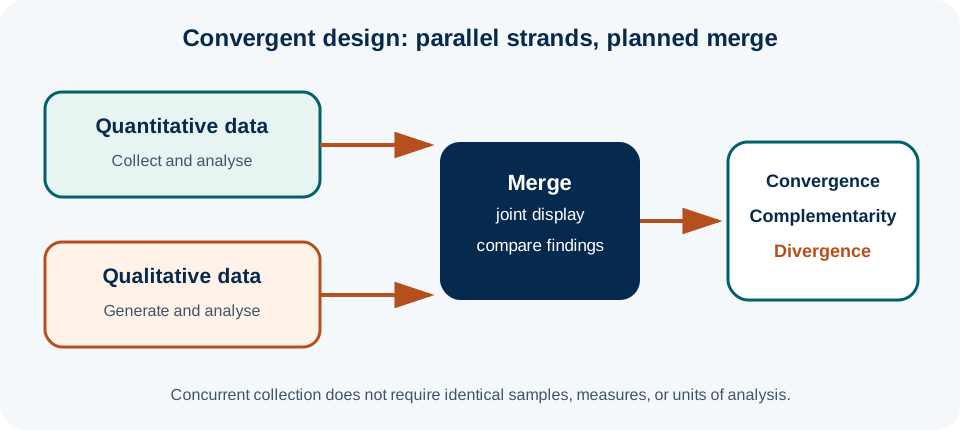
A convergent mixed-methods design collects and analyses quantitative and qualitative evidence during the same broad phase of a study and then intentionally brings the findings together. The core purpose is not simply to obtain two descriptions of the same problem. It is to examine how different forms of evidence converge, complement, extend or contradict one another and to use those relationships to develop an integrated interpretation.[1,2]
Convergent designs are attractive in health research because they can address magnitude and meaning without waiting for one phase to finish before the other begins. They are particularly useful when researchers need a contemporaneous view of a service, intervention or health experience. That apparent efficiency, however, creates a demanding integration problem: because one strand does not naturally build on the other, the team must plan in advance how constructs, samples, timing and analytic products will be aligned.
Why this matters
A common weak pattern is to conduct a cross-sectional survey, conduct interviews with a small group, and present the results in separate sections. The authors then write that the findings “were similar” without showing what was compared or whether the two components measured the same conceptual phenomenon. This is not sufficient integration.
In a strong convergent design, the quantitative and qualitative strands are deliberately designed so that selected findings can be brought into dialogue. The team decides which concepts are shared, which questions are intentionally different, how samples relate, how disagreement will be interpreted, and what integrated inference is needed.[2-4]
Key concepts
Concurrent does not mean identical
“Convergent” refers to the logic of bringing contemporaneous strands together. The qualitative and quantitative components do not need identical sample sizes, measures or analytic techniques. Each should be designed appropriately for its own question. What they need is a defensible basis for integration.[1]
Typical sequence
A practical convergent design can be represented as:
QUAN + QUAL → separate analyses → merging → integrated interpretation
The plus sign indicates approximate concurrency rather than equal sample size or equal methodological weight. Some convergent studies place greater emphasis on one strand, but the relative priority should be stated.
What can happen when findings are merged?
Four broad relationships are useful:
- Convergence — findings point toward a compatible interpretation.
- Complementarity — one strand adds detail, mechanism or context to the other.
- Expansion — the strands illuminate different dimensions of the problem.
- Divergence or dissonance — findings appear inconsistent or contradictory.[3,5]
Divergence should trigger methodological and substantive questions. Are the samples different? Did the quantitative measure fail to capture the qualitative construct? Is there temporal mismatch? Are participants describing socially desirable beliefs that differ from recorded behaviour? Or is the contradiction itself a real feature of the phenomenon?
When to use this approach
Conditions that favour a convergent design
Use a convergent design when:
- quantitative and qualitative questions can be addressed during the same broad study period;
- neither strand must logically determine the next;
- the team needs contemporaneous estimates and contextual explanations;
- the principal mixed-methods task is comparison or synthesis of findings; and
- sufficient expertise is available to conduct both strands rigorously in parallel.
Prefer a sequential design when findings from one phase must determine whom to recruit, what instrument to build or what questions to ask in the next phase.
Research question and methodological fit
A convergent protocol should include an integration question. For the postpartum example:
- Quantitative: What proportion of eligible women complete postpartum testing, and how are completion and reported barriers distributed?
- Qualitative: How do women and clinicians describe barriers, responsibility and risk communication around postpartum testing?
- Integration: In what ways do the measured barrier patterns and qualitative accounts converge, complement or diverge, and what do those relationships imply for service redesign?
The integration question determines which findings must be brought together. Without it, the team may collect two large datasets and only discover at the end that they cannot be meaningfully compared.
Design, setting and study population
Convergent mixed-methods design
Core structure: Quantitative and qualitative strands are conducted during a similar period, analysed using their respective methods, then merged for integrated interpretation.
Best suited for: Problems requiring simultaneous estimation and contextual understanding, particularly service evaluation, implementation research and patient-experience research.
Important limitations: Concurrent work is resource-intensive; strands can drift conceptually; and integration may be weak if shared constructs and sample relationships are not planned prospectively.
Aligning the unit of analysis
Researchers should ask whether both strands concern the same level. For example:
- patient survey data + patient interviews: individual-level relationship is possible;
- clinic-level completion rates + clinician focus groups: integration is at clinic or service level;
- patient outcomes + national policy documents: integration occurs conceptually rather than by direct case linkage.
Integrating evidence across levels can be valuable, but the resulting inference must respect those levels.
Sampling and recruitment
Convergent designs can use identical, nested, parallel or multilevel sample relationships.[6,7]
Identical samples
The same participants provide both quantitative and qualitative data. This facilitates case-level linkage but may burden participants and can make the qualitative sample unnecessarily large if every participant is interviewed.
Nested samples
A qualitative subsample is selected from a larger quantitative sample. This allows case-level linkage while retaining purposive qualitative sampling. For example, a survey of 600 women could be followed by interviews with 30 women selected to maximise variation in reported barriers even if the interviews occur within the same data-collection period.
Parallel samples
The two samples are drawn separately from the same broad population. This may be appropriate when direct case linkage is unnecessary, but claims about individual-level convergence must be avoided.
Multilevel samples
Different strands address different actors or organisational levels, such as patient outcomes combined with staff interviews and clinic workflow observations.
Sampling questions for a convergent protocol
- Are the strand populations the same, overlapping or different?
- Is case-level linkage required?
- If one sample is nested, how will the subsample be selected?
- Are time periods comparable?
- Are demographic or contextual differences between strands likely to affect integration?
- Will identifiers be retained securely to permit linkage where consent allows?
Data collection and measurement
The most important design task is to identify which constructs are intended to be compared and which are intentionally strand-specific.
Suppose a survey asks a single item, “Transport was difficult: agree/disagree”, while interviews explore transport cost, bus schedules, childcare, travel time, physical recovery and dependence on family members. The strands do not measure transport burden at the same conceptual depth. The integrated interpretation should not claim that the interview data “validated” the survey item. Instead, qualitative findings may show that the structured measure under-represented the construct.
A construct alignment table can be created before data collection:
| Domain | Quantitative evidence | Qualitative evidence | Intended integration |
|---|---|---|---|
| Risk understanding | knowledge score | accounts of perceived future diabetes risk | compare measured knowledge with meaning assigned to risk |
| Access burden | travel time and barrier items | narratives of transport, childcare and work | examine whether structured indicators capture lived burden |
| Continuity | documented referral and follow-up site | experiences of handover between services | connect process indicators with perceived responsibility |
This table is an illustrative design tool.
Analysis and integration
The strands should first be analysed according to their own methodological requirements. Prematurely forcing qualitative data into quantitative categories can erase important findings, while treating open-text statements as anecdotal confirmation of statistical results weakens qualitative analysis.
After component analyses, integration can occur through merging.[1] O’Cathain and colleagues describe practical techniques such as triangulation protocols, following a thread and mixed-methods matrices for bringing findings together.[5]
Joint displays
Joint displays arrange related findings side by side or in another integrated structure and can support analytic thinking, not merely presentation.[4]
Building a postpartum follow-up joint display
After separate analyses, the team constructs the following simplified display:
| Quantitative finding | Qualitative finding | Relationship | Integrated interpretation |
|---|---|---|---|
| Long travel time associated with lower completion | Women describe combining travel with infant care and dependence on family transport | Complementary | Travel time is a proxy for a broader coordination burden |
| Most women report receiving discharge advice | Many cannot recall who should arrange the test or where to attend | Divergent | Receipt of advice does not ensure actionable understanding |
| Higher risk-knowledge scores associated with completion | Some knowledgeable women still prioritise newborn care over self-care | Expansion | Knowledge may be necessary but insufficient when competing demands are high |
The mixed-methods contribution lies in the fourth column. It makes explicit what the combined evidence adds beyond repeating each component.
Investigating divergence
Divergence deserves a structured response:
- verify that the relevant findings concern the same construct and time period;
- check quantitative measurement validity and missingness;
- examine qualitative sampling, reflexivity and contradictory cases;
- assess whether strand populations differ;
- consider whether individual behaviour and reported beliefs legitimately differ; and
- preserve unresolved contradictions when the evidence does not support reconciliation.
A mixed-methods study can be more credible when it explains why findings differ rather than claiming artificial agreement.
Planning conceptual alignment before data collection
A convergent design works best when the team specifies integration-ready domains prospectively. This does not mean forcing both strands to ask identical questions. Instead, the protocol should identify which constructs are deliberately shared, which are complementary and which are expected to remain strand-specific. For each shared domain, researchers can record the quantitative indicator, the qualitative topic, the population or unit represented, the time point and the intended comparison.
This planning prevents a common end-stage problem: two rich datasets that use similar words but refer to different phenomena. For example, a survey item asking whether discharge advice was received measures exposure to communication, whereas an interview exploring whether a woman understood who was responsible for arranging testing examines actionable understanding. Both concern communication, but they should not be treated as equivalent measures.
The team should also decide how discordance will be handled before results are known. A useful rule is to investigate whether apparent disagreement arises from differences in construct, sample, level, timing or measurement quality before concluding that one strand is more credible. This makes integration an analytic process rather than a search for confirmation.
Bias, validity and quality assurance
Concurrent designs face a specific risk of parallel drift. Because teams work simultaneously, the survey may change one way while the interview guide evolves another way, leaving little common ground for integration. Regular cross-strand meetings should therefore review conceptual alignment without contaminating independent component analyses.
Another risk is shared-source bias. If both strands recruit only highly engaged clinic attendees, agreement between them does not establish representativeness of women lost to follow-up.
Ethics and governance
If case-level merging is planned, participants must understand that data from different study components may be linked. The team should also minimise deductive identification in joint displays. Combining age, clinic, unusual clinical history and a distinctive quotation may reveal identity even when names are removed.
Where the qualitative sample is nested within a quantitative survey, the recontact mechanism should be separated from analytic datasets as far as practical and access should be role-based.
Statistical interface
The quantitative analysis is chosen according to its question and design. In the postpartum example, completion may be described as a proportion with uncertainty and associations estimated using an appropriate regression model. Those numerical results should be carried into integration with their magnitude and confidence intervals, not converted into binary labels of “significant” and “non-significant”.
A joint display can therefore include effect estimates alongside qualitative themes. This helps prevent statistical uncertainty from disappearing during mixed-methods interpretation.
Suggested reporting
Common mistakes
Knowledge check
What feature distinguishes a convergent design from an explanatory sequential design?
Answer and reasoning
In a convergent design, the strands are conducted during the same broad phase and neither must wait for the other’s results before being designed. In an explanatory sequential design, quantitative results deliberately inform the later qualitative phase.
A survey and interview study use entirely separate populations. Can the findings still be integrated?
Answer and reasoning
Yes, but the level of inference must match the sample relationship. The team may integrate conceptually or at service level, but it should not claim that an individual’s survey response agrees with an interview account when participants are not linked.
Why should divergent findings be retained rather than automatically reconciled?
Answer and reasoning
Divergence may reveal measurement limitations, subgroup differences, context effects or genuine complexity. Eliminating contradiction merely to present a tidy story can reduce rather than improve validity.
What is the main analytical value of a joint display?
Answer and reasoning
It places related findings into an explicit comparative structure that helps the team identify relationships across strands and develop integrated interpretations or meta-inferences.[4]
Key take-home messages
Key take-home messages
- Convergent designs collect qualitative and quantitative evidence during a similar phase and merge findings deliberately.
- Plan conceptual alignment, sample relationships and integration before data collection.
- Analyse each strand rigorously before merging; do not reduce qualitative analysis to quotations that support the numbers.
- Examine convergence, complementarity, expansion and divergence.
- Joint displays can function as analytic tools for developing integrated interpretations.
- Preserve unresolved contradiction when the evidence does not justify reconciliation.
References
- Creswell JW, Fetters MD, Ivankova NV. Designing a mixed methods study in primary care. Ann Fam Med. 2004;2(1):7–12. https://doi.org/10.1370/afm.104
- Fetters MD, Curry LA, Creswell JW. Achieving integration in mixed methods designs—principles and practices. Health Serv Res. 2013;48(6 Pt 2):2134–2156. https://doi.org/10.1111/1475-6773.12117
- Schoonenboom J, Johnson RB. How to construct a mixed methods research design. Köln Z Soziol. 2017;69(Suppl 2):107–131. https://doi.org/10.1007/s11577-017-0454-1
- Guetterman TC, Fetters MD, Creswell JW. Integrating quantitative and qualitative results in health science mixed methods research through joint displays. Ann Fam Med. 2015;13(6):554–561. https://doi.org/10.1370/afm.1865
- O’Cathain A, Murphy E, Nicholl J. Three techniques for integrating data in mixed methods studies. BMJ. 2010;341:c4587. https://doi.org/10.1136/bmj.c4587
- Teddlie C, Yu F. Mixed methods sampling: a typology with examples. J Mix Methods Res. 2007;1(1):77–100. https://doi.org/10.1177/1558689806292430
- Collins KMT, Onwuegbuzie AJ, Jiao QG. A mixed methods investigation of mixed methods sampling designs in social and health science research. J Mix Methods Res. 2007;1(3):267–294. https://doi.org/10.1177/1558689807299526
These materials support learning and research planning. They require adaptation to the study context and do not replace methodological, statistical, ethical, or regulatory consultation.