
Part 15 · Module 3
Research Involving Vulnerable Populations
Design ethically inclusive research involving people whose circumstances may increase vulnerability, using additional protections without unjustified exclusion.
Learning outcomes
After completing this lecture, you should be able to:
- Define vulnerability as contextual rather than a permanent label.
- Identify individual, relational, social and institutional sources of vulnerability.
- Plan additional protections proportionate to the relevant vulnerability.
- Distinguish justified protection from unjustified exclusion.
- Apply assent, permission and independent-support concepts where appropriate.
Overview
Vulnerability in research is best understood as an increased likelihood of being wronged or harmed because a person or group has reduced ability to protect their interests in a particular context.[1,2] It may arise from impaired decision-making capacity, dependency, poverty, social marginalisation, emergency circumstances, limited access to care, language barriers or institutional power.
The ethical response is usually additional protection with fair inclusion, not automatic exclusion. Excluding groups can itself be unjust when it denies them the evidence needed for safe and effective care.
Why this matters
Many populations historically described as “vulnerable” have also been systematically under-represented in research. Overprotection can therefore produce evidence gaps affecting children, pregnant people, older adults, people with disabilities and disadvantaged communities. Ethical design must balance protection from exploitation with fair access to the potential benefits of research and to evidence relevant to their health needs.[1,2]
Core principles
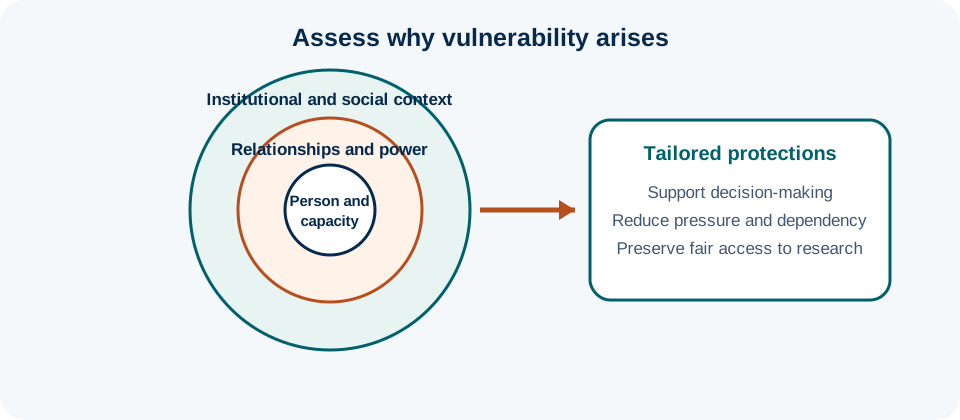
Vulnerability can arise at several levels. Individual factors include impaired or fluctuating capacity. Relational factors include dependency on clinicians, teachers, employers or caregivers. Social factors include poverty, stigma, discrimination or insecure legal status. Institutional factors include restricted liberty or hierarchical organisations. Situational factors include emergencies, disasters or severe illness.
These factors may overlap. The correct protection should target the mechanism: independent consent support for dependency, accessible materials for communication barriers, assent and parental permission for children where applicable, safeguards for confidentiality where disclosure could cause social harm, or deferred approaches when acute distress makes a voluntary decision unrealistic.
Fair inclusion and the problem of overprotection
Ethical guidance increasingly emphasises fair inclusion. If a population bears the disease burden or is expected to receive the intervention, systematic exclusion may shift uncertainty and risk into routine care rather than eliminate it.[1,2] Eligibility criteria should therefore be justified by scientific or safety reasons, not by investigator convenience or a generic vulnerability label.
Children, assent and parental permission
Children may have developing rather than absent decision-making abilities. Where applicable, research may require parental or guardian permission together with the child’s affirmative assent, tailored to age and maturity. Dissent deserves careful consideration, especially when participation offers no prospect of direct benefit. Exact legal requirements vary and must be checked locally.[3,4]
Cognitive impairment and fluctuating capacity
A diagnosis such as dementia, psychosis or intellectual disability does not by itself determine capacity for every research decision. Protocols should specify how capacity will be evaluated, how legally authorised representation will operate where permitted, and whether participants can express assent or dissent. For fluctuating capacity, re-evaluation may be necessary.
Economic disadvantage and dependent relationships
Payment, access to care, immigration concerns or employment relationships can alter how voluntary a decision feels. Researchers should avoid recruiting people simply because they are readily available or less able to refuse. Safeguards can include independent recruitment, clear separation from benefits or services, reasonable reimbursement and confidential complaint pathways.
Emergency and time-critical research
In emergency settings, potential participants may be unconscious, distressed or unable to deliberate. Some jurisdictions permit carefully defined exceptions or deferred consent under strict conditions. Because these rules are highly jurisdiction-specific, lectures and protocols should explain the ethical rationale but verify the applicable legal route rather than generalising one country’s rules.
A vulnerability assessment should be study-specific
A practical way to avoid stereotyping is to assess vulnerability at the person–study interface. The same individual may be able to participate autonomously in a low-risk questionnaire but require additional support for a complex first-in-human trial. Likewise, a population may be socially disadvantaged without lacking capacity. The research procedure, decision complexity, consequences of refusal and surrounding power relationships determine which protections are relevant.
The protocol can use a vulnerability matrix with columns for the population or circumstance, the potential ethical problem, the relevant study procedure and the proposed safeguard. For example, limited literacy may affect understanding of written consent; the safeguard is accessible communication, not exclusion. Financial hardship may make travel reimbursement particularly important; the safeguard is fair expense coverage, not withholding payment to prevent “influence”. Dependency on clinical services may affect voluntariness; the safeguard may be separation of recruitment from service decisions.
Protection without paternalism
Paternalistic protection can itself cause harm when it excludes people from research that addresses their health needs. Historically, the desire to avoid fetal risk led to widespread exclusion of pregnant people from research, leaving clinicians with limited evidence when medications were used during pregnancy. Similar concerns occur for older adults, people with disabilities and those with multimorbidity. Ethical inclusion requires careful risk assessment, not a presumption that uncertainty is safer outside research.
This does not mean every vulnerable group should be included in every study. The scientific rationale, expected benefit, alternative populations and feasibility of safeguards remain important. The ethical question is whether inclusion or exclusion is justified for this research question, not whether a category appears on a generic vulnerability list.
Community and group-level considerations
Some risks are not confined to individual participants. Research describing a small ethnic community, occupation, disease group or geographic area may stigmatise people who never enrolled. Genomic or infectious-disease findings can have implications for families and communities. Researchers should consider respectful terminology, community consultation where appropriate, disclosure strategies and whether group identity is scientifically necessary in public reporting.
Community engagement is not a substitute for individual consent where consent is required, and community leaders should not be treated as owning the decisions of individual members. Engagement and individual autonomy serve different purposes. The appropriate balance depends on cultural context, study risk and the nature of the community relationship.[1,2,5]
Safeguarding and disclosure of sensitive information
Research with children, dependent adults or people experiencing violence can reveal information that creates safeguarding obligations. Participants should be told, in age- and context-appropriate language, when confidentiality cannot be maintained. Investigators should have a referral and escalation plan before asking questions likely to uncover serious risk.
Poor planning can create an ethical trap: researchers invite disclosure of abuse, suicidality or unsafe conditions but have no trained staff or response pathway. The protocol should specify what constitutes an actionable disclosure, who assesses it, what local services are available and how the limits of confidentiality will be explained.
Monitor vulnerability over time
Vulnerability may change during longitudinal research. A participant can become acutely ill, lose decision-making capacity, become pregnant, enter a dependent relationship with study staff or experience worsening financial hardship. Protocols should identify circumstances requiring reassessment of consent, new safeguards or temporary suspension of study procedures.
For research lasting years, investigators should also consider transition points such as a child reaching the age of legal adulthood. Whether fresh consent is required depends on the framework and study, but the issue should be anticipated rather than discovered at database lock.
Designing a proportionate protection package
A protection package should be no broader than necessary. If the concern is language, provide translated materials and competent interpretation. If the concern is dependency, alter who recruits and how refusal is separated from services. If the concern is impaired capacity, establish a decision-specific assessment and representation pathway. If the concern is privacy, strengthen confidentiality. Overly broad protections can create new harms, including stigma and exclusion.
Researchers should also distinguish intrinsic study risk from background vulnerability. Poverty may make transport cost burdens more important but does not make a blood-pressure measurement biologically more dangerous. Severe illness may increase both procedural risk and dependency on clinicians. This distinction helps committees decide whether the study itself should change or whether supportive measures are sufficient.
In international or cross-cultural research, researchers should avoid assuming that community customs eliminate individual choice. Family consultation can be respected and supported where desired, but investigators should still identify the person whose consent or permission is ethically and legally required. Cultural sensitivity should not become a rationale for coercion or for ignoring individuals who wish to decide differently from family or community leaders.
Recruitment targets should be monitored for exclusion patterns. If people with limited literacy, disability or lower socioeconomic status are consistently not enrolling, the team should ask whether barriers in the study design—not participant preference—are responsible. Accessible scheduling, transport support, alternative communication formats and flexible visit options can improve fair opportunity without weakening standards.
For longitudinal studies, the protection plan should identify trigger events: loss of capacity, major clinical deterioration, disclosure of abuse, pregnancy, incarceration, relocation or transition from minor to adult status. Each trigger should have a predefined governance response, because improvising under pressure can produce inconsistent treatment and unreviewed decisions.
Appraising equitable inclusion in the final sample
After recruitment begins, investigators should compare the people screened, approached, enrolled and retained. Differences may reveal barriers that were invisible at protocol stage. For example, if participants who need interpreters are screened but rarely approached, the operational workflow may be excluding them despite formally inclusive eligibility criteria. If people with disability withdraw disproportionately because visits are inaccessible, retention procedures may be inequitable.
These observations should prompt corrective action where feasible, but they should not be manipulated to force demographic quotas unrelated to the question. The aim is to identify avoidable study-created barriers and ensure that the final sample reflects justified scientific decisions rather than convenience, prejudice or inaccessible procedures.
Reports should describe important exclusions and recruitment constraints transparently. This helps readers judge both justice and applicability and prevents vulnerable-population safeguards from becoming invisible after publication.
Reporting vulnerability without stigmatising participants
Manuscripts should explain the ethically relevant context without defining people solely by vulnerability. Describe the condition that required protection—for example impaired capacity, dependent recruitment or socioeconomic barriers—and the safeguard used. Avoid language implying that vulnerability is a defect in the participant. Where a group was excluded, report the scientific or safety rationale so future researchers can judge whether the evidence gap remains. This reporting discipline supports both respectful language and cumulative methodological learning.
Practical threshold for extra safeguards
Not every difference between participants requires a special procedure. Extra safeguards are most justified when the circumstance could materially affect voluntariness, understanding, exposure to harm or ability to seek redress. The protocol should therefore avoid both extremes: ignoring meaningful vulnerability and creating unnecessary special processes that stigmatise people. A short written rationale for each additional safeguard helps reviewers see that protection is proportionate and study-specific.
Final inclusion audit
Before opening recruitment, the team should review every exclusion criterion and ask whether it reflects safety, scientific validity, operational necessity or simple convenience. Criteria based on language, disability, age or social circumstance deserve particular scrutiny because they can unintentionally remove groups who will later receive the intervention in routine practice. When exclusion is necessary, the protocol should state the reason and acknowledge the resulting evidence gap. When inclusion is possible with proportionate support, that support should be budgeted and operationalised rather than left to individual staff discretion. Ethical inclusion depends on resources as well as principles.
A concise site-level accessibility checklist should also confirm language support, physical access, scheduling flexibility and communication accommodations before recruitment begins. These operational details are often where equitable inclusion succeeds or fails in practice.
Match protection to vulnerability
- What specific circumstance increases the risk of harm, exploitation or constrained choice?
- Is inclusion scientifically necessary or important for equity?
- Can the risk be reduced through communication, independent support, assent, monitoring or other safeguards?
- Who may legitimately provide permission if the person lacks decision-making capacity?
- How will dissent, withdrawal and changing capacity be handled?
Vulnerability protection plan
- Describe why inclusion of the population is scientifically and socially justified.
- Identify the specific vulnerability mechanisms relevant to the study.
- Specify additional consent, assent, permission or communication safeguards.
- Minimise dependency-related recruitment pressure.
- Plan safeguarding, referral and confidentiality responses to foreseeable harms.
- State how changing capacity or dissent will be managed.
Appraise vulnerable-population research
- Was the population chosen because the question requires it, or because recruitment is easy?
- Do safeguards respond to the actual vulnerability mechanism?
- Are people unjustifiably excluded from research likely to affect their care?
- Are assent, dissent and representation procedures appropriate to the population?
- Could compensation, dependency or access to services make refusal difficult?
Worked example
Including adolescents in a digital diabetes study
The investigators retain adolescents because the research question directly concerns their care. They create age-appropriate information materials, obtain the permissions required by the responsible ethics framework, seek adolescent assent, and specify that a young person’s dissent will be respected unless an exceptional prospect of important direct benefit justifies a different approach under approved rules.
Recruitment is performed by research staff rather than the clinician responsible for school or treatment decisions. Private questionnaire responses are collected separately from parents except where safeguarding obligations require action, and those limits are explained in advance.
Suggested protocol or governance wording
Common mistakes
Knowledge check
Why can exclusion of vulnerable groups be unethical?
Answer and reasoning
Because exclusion can deny groups evidence relevant to their care and shift uncertainty into routine practice. Protection and fair inclusion should be considered together.
Does vulnerability always mean impaired capacity?
Answer and reasoning
No. Vulnerability may arise from poverty, dependency, stigma, institutionalisation or other contexts even when decision-making capacity is intact.
What is assent?
Answer and reasoning
Assent is an affirmative agreement to participate from a person who may not have full legal authority to provide independent consent, commonly discussed in paediatric research. Its exact role depends on age, maturity, study context and applicable rules.
Why should researchers identify the mechanism of vulnerability?
Answer and reasoning
Because safeguards are more effective when they address the actual source of risk, such as communication difficulty, dependency, impaired capacity or social harm.
Key take-home messages
Key take-home messages
- Vulnerability is contextual and may arise from individual, relational, social or institutional factors.
- Additional protection should be proportionate to the actual vulnerability mechanism.
- Fair inclusion is an ethical goal; overprotection can create harmful evidence gaps.
- Capacity, assent, dissent and representation require population- and jurisdiction-appropriate planning.
- Dependent relationships and economic disadvantage deserve explicit recruitment safeguards.
References
- World Medical Association. Declaration of Helsinki: ethical principles for medical research involving human participants. Ferney-Voltaire: WMA; 2024. https://www.wma.net/what-we-do/medical-ethics/declaration-of-helsinki/
- Council for International Organizations of Medical Sciences. International ethical guidelines for health-related research involving humans. 4th ed. Geneva: CIOMS; 2016. https://cioms.ch/publications/product/international-ethical-guidelines-for-health-related-research-involving-humans/
- National Commission for the Protection of Human Subjects of Biomedical and Behavioral Research. The Belmont Report. Washington, DC: US Department of Health and Human Services; 1979. https://www.hhs.gov/ohrp/regulations-and-policy/belmont-report/
- US Office for Human Research Protections. Research with children FAQs. https://www.hhs.gov/ohrp/regulations-and-policy/guidance/faq/children-research/
- World Health Organization. Standards and operational guidance for ethics review of health-related research with human participants. Geneva: WHO; 2011. https://www.who.int/publications/i/item/9789241502948
These materials support learning and research planning. They require adaptation to the study context and do not replace methodological, statistical, ethical, or regulatory consultation.