
Part 8 · Module 7
Follow-Up, Person-Time and Loss to Follow-Up
Plan cohort follow-up, define person-time and censoring, distinguish administrative end from loss, and assess how incomplete observation threatens validity.
Learning outcomes
After completing this lecture, you should be able to:
- Define entry, exit, event, censoring and person-time for a cohort.
- Distinguish complete fixed-period follow-up from variable follow-up and dynamic populations.
- Design active and passive follow-up procedures and a retention-monitoring system.
- Explain when loss to follow-up can bias risk, rate and association estimates.
- Report follow-up completeness and specify sensitivity analyses for informative loss.
Overview
Follow-up converts a cohort at entry into longitudinal evidence. For each participant, investigators must know when observation begins, when it ends, whether the outcome occurred, and why observation ended. These dates define risk periods, person-time, cumulative incidence and survival analysis.[1,2]
Loss to follow-up is not every absence of an outcome record. It occurs when the research team can no longer determine outcome status over an interval in which the participant was intended to remain observable. Administrative study end, planned transfer, death and competing events are different exit mechanisms and should be coded separately.
This lecture explains follow-up architecture, person-time, censoring, retention, completeness measures and the conditions under which incomplete observation biases results.
Why this matters
A study may recruit a representative cohort but become selected over time. If participants with poor health, high exposure or limited access are more likely to disappear, the observed cohort no longer represents the original risk experience. Reporting only “10% lost” is insufficient: the timing, reasons and relation to exposure and outcome determine the consequences.[3,4]
Errors also arise when investigators:
- count time before participants are eligible or at risk;
- continue person-time after an event;
- treat death as ordinary loss when it precludes the outcome;
- classify a participant as lost despite valid registry linkage;
- divide events by baseline sample size despite unequal follow-up;
- compare groups with different contact intensity; or
- censor at the last clinic visit when outcome surveillance continued elsewhere.
Key concepts
Entry time
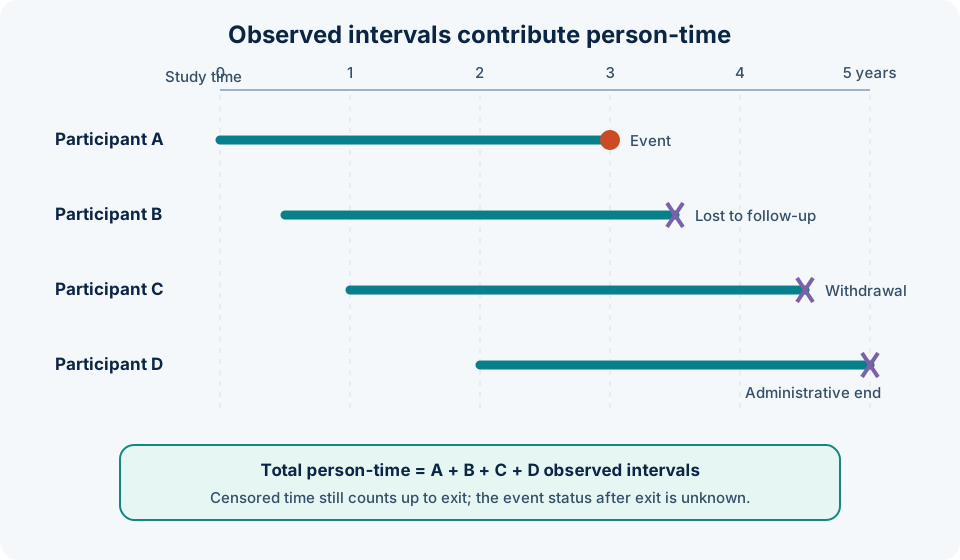
Entry is the date a participant first satisfies eligibility, exposure classification and at-risk requirements. In a fixed baseline cohort, entry may be common. In a dynamic cohort, participants enter on different dates. Delayed entry occurs when the biological or programme time origin precedes the date a participant becomes observable; analysis must then account for left truncation.
Exit time
Observation ends at the earliest relevant occurrence:
- primary event;
- death or specified competing event;
- withdrawal from the required data source;
- loss of coverage or inability to determine status;
- end of a fixed follow-up period; or
- administrative study end.
The protocol should define each reason and the information available after exit.
Person-time
Person-time sums the duration each participant is observed and at risk. Ten people followed for one year contribute approximately ten person-years, as does one person followed for ten years, but their information structures and changing hazards may differ. Person-time is the denominator for incidence rates, not an assurance that risks are comparable.[1]
Censoring
Censoring means the event time is not observed beyond a point. Standard survival methods rely on assumptions about the relationship between censoring and the event process, conditional on included variables. “Non-informative censoring” is not established merely by using software.
Planning follow-up
Building a follow-up system
- Define the event and the data source capable of detecting it.
- Set scheduled contacts or linkage intervals and permissible windows.
- Specify active, passive or combined follow-up.
- Record locator information and participant contact preferences ethically.
- Define event-free confirmation and the last-known-status date.
- Distinguish withdrawal from questionnaires, intervention, records and all research.
- Prespecify competing events, transfers and administrative censoring.
- Monitor follow-up by exposure group, site and prognostic strata.
Active follow-up
Active follow-up uses visits, calls, messages or home contact. It can collect outcomes and covariates not available routinely, but contact burden, differential response and interviewer knowledge can affect data.
Passive follow-up
Passive follow-up uses registries, health records or surveillance systems. It reduces contact burden and may retain people who stop attending study visits. Validity depends on linkage quality, system coverage, outcome coding and delays.
Combined follow-up
Many cohorts use active questionnaires plus passive record linkage. The protocol should define how discordant sources are adjudicated and which source establishes the event date.
Research question and methodological fit
The postpartum cohort estimates five-year cumulative incidence of diagnosed type 2 diabetes and compares exposure groups. Each woman enters at the six-month landmark. Follow-up ends at diagnosis, death, loss of observable data or five years.
If national diabetes and mortality registries remain complete after a participant stops questionnaires, she is not lost for those outcomes. She may be missing patient-reported covariates but still contribute event follow-up. Outcome-specific follow-up status is therefore necessary.
Design, setting and study population
Longitudinal follow-up in a cohort
Core structure: Each participant contributes a defined interval from cohort entry until event or a specified censoring or competing event.
Best suited for: Incidence, time-to-event, prognosis and repeated outcome measurement.
Important limitations: Differential surveillance, incomplete linkage, informative censoring and competing events can distort estimates.
A follow-up calendar should account for clinic schedules, registry refresh dates, seasonal migration and site closures. Long gaps may create interval-censored event times: the event is known to occur between two assessments but not on an exact date.
Sampling, retention and participant flow
Retention and tracking procedures
- Collect several participant-approved contact routes and update them periodically.
- Use reminders and contact attempts that respect burden and privacy.
- Separate missed visits from permanent withdrawal.
- Record every contact attempt, result and reason for discontinuation.
- Continue permitted passive follow-up after active participation stops.
- Avoid coercive incentives or excessive pursuit.
- Produce regular follow-up dashboards by group, site and calendar period.
- Prespecify escalation and closure rules for unresolved status.
Retention methods should be equitable. Digital-only contact can disadvantage participants with unstable connectivity. Home visits may increase completeness but raise privacy and safety concerns. The intensity of tracking should not differ by exposure unless justified and accounted for.
Variables and data structure
Illustrative follow-up record
illustrativeTable 1. Minimum time-to-event fields
| participant_id | entry_date | event_date | last_event_free_date | exit_date | exit_reason | event_indicator |
|---|---|---|---|---|---|---|
| 001 | 2026-07-01 | 2029-03-10 | 2028-12-01 | 2029-03-10 | Diabetes diagnosis | 1 |
| 002 | 2026-07-01 | — | 2031-07-01 | 2031-07-01 | Five-year end | 0 |
| 003 | 2026-07-01 | — | 2028-02-14 | 2028-02-14 | Data coverage ended | 0 |
| 004 | 2026-07-01 | — | 2029-06-20 | 2029-06-20 | Death | 0 |
Note: Death may be a competing event rather than ordinary censoring, depending on the estimand.
Additional fields should record source of status, contact dates, migration, withdrawal scope, competing events, time-varying exposure and repeated covariates. One final status variable is rarely sufficient for audit.
Measuring follow-up completeness
Simple proportions
The proportion with known outcome status at a fixed landmark is useful when everyone has the same planned follow-up. It becomes misleading when entry dates differ or some participants legitimately contribute shorter observation.
Person-time completeness
Observed person-time can be compared with potential person-time under a defined follow-up plan. This reflects timing of loss: a participant lost after one month contributes less than one lost near study end. The expected person-time must be defined consistently.
Distribution of follow-up
Report median and range or reverse Kaplan–Meier estimates of potential follow-up where appropriate. Numbers at risk over time show how much evidence supports later estimates.
Reasons and patterns
Counts should be disaggregated by death, withdrawal, migration, linkage failure, administrative end and unresolved status. Compare patterns by exposure and major prognostic variables without claiming that similar measured characteristics prove non-informative loss.
Procedures and quality assurance
A central follow-up manual should define source hierarchy, date rules, contact windows, event adjudication and status closure. Automated checks can flag exit before entry, follow-up after death, events after censoring, overlapping coverage gaps and implausible visit sequences.
Regular monitoring should distinguish operational performance from bias assessment. A low overall loss percentage is operationally reassuring, but even small differential loss can matter if those lost have very high event risk.[3,4]
Bias, validity and quality assurance
For example, women who did not complete postpartum testing may be more likely to move and also have higher undiagnosed diabetes risk. Censoring them at migration could make the untested group appear healthier. Conversely, sicker women may remain in care, making observed incidence appear higher.
Appraising follow-up validity
- Are entry, event and exit rules explicit and applied consistently?
- Is outcome status available after missed visits through other sources?
- Are follow-up opportunities and surveillance intensity similar across groups?
- Are reasons and timing of exit reported?
- Do baseline and time-updated predictors of loss differ by exposure?
- Are competing events handled according to the estimand?
- Are sensitivity analyses used when informative loss is plausible?
Ethical and governance considerations
Interface with statistical analysis
Risk denominators require known fixed-period status. Incidence-rate denominators use observed person-time. Kaplan–Meier and Cox methods handle right censoring under their assumptions; they do not correct informative censoring automatically. Competing-risk methods may be needed when death precludes the event.
Sensitivity approaches include inverse-probability-of-censoring weighting, multiple imputation of outcomes under explicit models, best–worst bounds and tipping-point analyses. These require measured predictors and assumptions that should be stated rather than presented as proof.[3]
The estimand determines the role of deathMMed extension
For the probability of diabetes diagnosis in a real population, death prevents subsequent diagnosis and is a competing event. For a hypothetical estimand in a world without death, stronger assumptions are needed. Treating every death as independent censoring can overstate cumulative incidence. The protocol should define the clinical question before selecting the method.
A follow-up analysis dataset should remain auditable
Derived follow-up time should be reproducible from original dates and coded exit reasons. Keep the raw event, contact, coverage and death dates; document the hierarchy used when sources disagree; and generate automated listings of participants whose status changes after a data refresh. This prevents a single opaque duration variable from concealing errors in entry, censoring or event ordering.
Retention targets should be linked to action rather than treated as decorative metrics. For example, a site-specific decline in verified outcome coverage can trigger data-source checks, participant contact review or ethics-approved tracing. Corrective action should preserve equal surveillance across exposure groups and should not selectively intensify follow-up after investigators see emerging outcomes.
Worked example
Classifying follow-up in the postpartum cohort
A participant stops answering annual questionnaires at year two but remains linked to national laboratory and mortality registries through year five. For the diabetes outcome she has complete passive follow-up; for patient-reported diet she has missing repeated data after year two.
Another participant leaves the country after 18 months and no approved data source remains. Her last event-free date is the final verified record, and subsequent time is censored. The team records migration rather than “unknown”.
Follow-up dashboards show that loss of observable data is more common among women who did not complete postpartum testing. The analysis reports this difference and performs inverse-probability-of-censoring and plausible outcome-scenario analyses. Conclusions acknowledge that residual informative loss cannot be excluded.
Suggested protocol or reporting wording
Common mistakes
Knowledge check
When does a participant stop contributing person-time for a first-event analysis?
Answer and reasoning
At the earliest of the first event, the relevant censoring or competing event, or administrative end. Time after the event is not at risk for that first event.
A participant stops clinic visits but remains in a complete disease registry. Is she lost to follow-up?
Answer and reasoning
Not for the registry-captured outcome. Follow-up is outcome specific. She may be missing visit-based measurements while still having valid event surveillance.
Does 5% loss guarantee negligible bias?
Answer and reasoning
No. Bias depends on who is lost, when, and how their unobserved outcome risk relates to exposure. A small but highly selective loss can materially change an estimate.
Why can death require competing-risk analysis?
Answer and reasoning
Death prevents a future diagnosis or event. If the question concerns real-world cumulative incidence, treating death as ordinary independent censoring imagines that deceased people remain capable of the event.
Key take-home messages
Key take-home messages
- Follow-up requires explicit entry, event, exit and last-known-status dates.
- Person-time includes only periods when participants are observable and at risk.
- Missed visits do not equal loss when valid passive surveillance continues.
- Follow-up completeness should include timing, reasons and group-specific patterns.
- Loss can bias estimates when it depends on exposure and unobserved outcome risk.
- Sensitivity analyses clarify assumptions but do not prove that censoring is harmless.
Complete reporting of participant flow, follow-up time, loss and numbers at risk is required under STROBE.[5]
References
- Rothman KJ, Greenland S, Lash TL. Modern epidemiology. 3rd ed. Philadelphia: Lippincott Williams & Wilkins; 2008.
- Kleinbaum DG, Klein M. Survival analysis: a self-learning text. 3rd ed. New York: Springer; 2012. https://doi.org/10.1007/978-1-4419-6646-9
- Howe CJ, Cole SR, Lau B, Napravnik S, Eron JJ Jr. Selection bias due to loss to follow up in cohort studies. Epidemiology. 2016;27(1):91–97. https://doi.org/10.1097/EDE.0000000000000409
- Kristman V, Manno M, Côté P. Loss to follow-up in cohort studies: how much is too much? Eur J Epidemiol. 2004;19(8):751–760. https://doi.org/10.1023/B:EJEP.0000036568.02655.f8
- von Elm E, Altman DG, Egger M, Pocock SJ, Gøtzsche PC, Vandenbroucke JP; STROBE Initiative. The Strengthening the Reporting of Observational Studies in Epidemiology statement. PLoS Med. 2007;4(10):e296. https://doi.org/10.1371/journal.pmed.0040296
These materials support learning and research planning. They require adaptation to the study context and do not replace methodological, statistical, ethical, or regulatory consultation.