
Part 11 · Module 1
When and Why to Use Qualitative Research
Understand when qualitative research is the right approach for studying experiences, meanings, processes and context in health research.
Learning outcomes
After completing this lecture, you should be able to:
- Describe the types of health-research questions that are well suited to qualitative inquiry.
- Distinguish qualitative research from quantitative measurement and from unstructured anecdotal enquiry.
- Explain how context, meaning, interaction and process shape qualitative research questions.
- Identify circumstances in which qualitative research should complement rather than replace quantitative research.
- Appraise whether a proposed qualitative study has methodological fit, reflexivity and an appropriate claim to transferability.
Overview
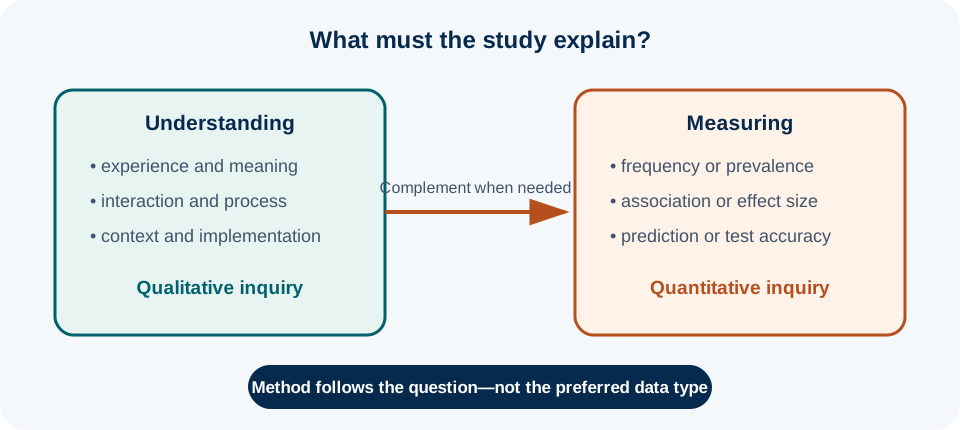
Qualitative research is used when the central aim is to understand experience, meaning, social process, interaction or context rather than to estimate a population quantity. In health sciences, it can explain why patients disengage from care, how clinicians make difficult decisions, how a new programme is experienced, how organisational routines shape implementation, or what a diagnosis means in everyday life.[1,2]
Qualitative research is not defined simply by collecting words instead of numbers. It is a systematic form of inquiry in which the research question, assumptions about knowledge, sampling, data generation, researcher role and interpretive analysis are deliberately aligned.[2,3] A transcript alone does not make a study qualitative; neither does adding one open-ended question to a questionnaire.
This lecture introduces the purposes and boundaries of qualitative health research. Later lectures address paradigms, qualitative methodologies, sampling, interviews, focus groups, observation, analysis, reflexivity and reporting.
Why this matters
Health problems occur within social and organisational worlds. A clinic may know that only 45% of eligible patients complete follow-up, but that estimate does not explain how transport, childcare, previous encounters, beliefs about illness, staff communication and competing responsibilities combine to produce the observed behaviour. Qualitative methods can reveal these mechanisms and meanings in ways that structured variables may not anticipate.[1]
They are also valuable when an intervention appears effective in one setting but not another. Interviews and observations may show that staff have adapted the intervention, that patients interpret it differently from designers, or that implementation depends on informal work that was never recorded in the protocol.
Key concepts
What qualitative research tries to know
Qualitative inquiry commonly addresses questions such as:
- What is it like to live with, receive or deliver a particular form of care?
- How do people interpret a diagnosis, risk message or treatment recommendation?
- How and why does a clinical or organisational process unfold as it does?
- Which contextual features help or hinder implementation?
- How do interactions among patients, families and professionals shape decisions?
- Which concepts matter to participants when researchers are developing an intervention or instrument?
Sofaer described qualitative methods as especially useful for rich description, complex phenomena, unexpected events, differing stakeholder perspectives and explanatory insight in health services research.[1]
Qualitative research is systematic
Rigorous qualitative inquiry usually includes:
- an explicit research question and methodological rationale;
- a sampling strategy linked to the phenomenon;
- planned but responsive data-generation procedures;
- documentation of researcher position and reflexivity;
- a transparent analytic process;
- active consideration of alternative or disconfirming interpretations;
- evidence linking interpretations to the dataset; and
- sufficient contextual description for readers to judge transferability.[2,4]
This differs from anecdotal enquiry. Informal conversations can generate ideas, but they do not automatically provide an auditable research process.
When to use qualitative research
Questions that commonly justify qualitative inquiry
- The phenomenon is poorly understood or existing categories seem inadequate.
- The aim concerns how, why, what it means or what it is like.
- Context and interaction are integral to the phenomenon rather than nuisance variables.
- A service, intervention or policy is being developed and participant perspectives are needed.
- Quantitative findings require explanation.
- Researchers need to understand implementation, acceptability, unintended consequences or variation in practice.
- The study aims to generate concepts or theory rather than estimate prevalence.
Qualitative research is less suitable when the primary question is the prevalence of an exposure, the average treatment effect, diagnostic sensitivity or another population parameter. Those questions require quantitative designs. Qualitative work may still complement them by explaining mechanisms or experiences.
Research question and methodological fit
A broad topic such as “postpartum follow-up” is not yet a qualitative research question. The question should identify the phenomenon, participants or setting, and the type of understanding required without forcing the answer into pre-existing categories.
Compare:
- Quantitative: What proportion of women complete postpartum glucose testing within 12 weeks?
- Qualitative: How do women describe the transition from antenatal diabetes care to postpartum follow-up?
- Process-oriented qualitative: How do reminder messages, family responsibilities and clinic routines interact to shape completion of postpartum testing?
- Mixed methods: What factors are associated with non-completion, and how do women and staff explain the observed patterns?
The wording does not determine the method by itself, but it reveals the intended inference.
From topic to qualitative question
illustrativeTable 1. Refining an exploratory health-services question
| Stage | Example |
|---|---|
| Broad concern | Low completion of postpartum glucose testing |
| What is already known | Completion proportion and appointment records |
| Missing knowledge | How women understand and navigate the follow-up pathway |
| Qualitative phenomenon | Experience of transition from pregnancy care to postpartum care |
| Qualitative question | How do women experience and make decisions about postpartum glucose follow-up after gestational diabetes? |
What qualitative research can and cannot claim
Qualitative studies can produce detailed interpretations that are credible and useful beyond the immediate participants when readers recognise relevant similarities in context. This is often discussed as transferability, not statistical generalisability. Transferability is strengthened by clear description of the setting, participants, sampling logic and circumstances in which a finding arose.[2,5]
A qualitative study usually cannot claim that a theme occurs in a specified percentage of the target population unless the study separately used a design capable of population estimation. Counting how many interviewees mentioned an issue can be descriptive within the dataset, but the denominator does not become a prevalence sample simply because a percentage is calculated.
Sampling, data generation and analysis as one design
Qualitative decisions are interdependent. A study seeking varied experiences may use maximum-variation purposive sampling. A phenomenological study may prioritise participants with direct experience and intensive interviewing. A grounded-theory study may alter sampling as categories develop. An ethnographic study may rely heavily on observation and prolonged engagement.
Likewise, the method of analysis must fit the question and methodology. Reflexive thematic analysis, qualitative content analysis, grounded-theory analysis and narrative approaches are not interchangeable labels for “coding”. Later lectures distinguish these choices.
Minimum elements of a qualitative protocol
- Central qualitative question or phenomenon.
- Methodological orientation or qualitative approach.
- Setting and participant group.
- Sampling strategy and rationale for sample adequacy.
- Data-generation methods and researcher role.
- Planned approach to analysis.
- Reflexivity procedures.
- Strategies for methodological quality or trustworthiness.
- Consent, privacy and management of potentially sensitive disclosures.
- Plan for secure handling of recordings, transcripts and field notes.
Reflexivity begins before data collection
Researchers are part of the research process. Professional background, clinical authority, prior beliefs, language, social position and relationship to the setting can influence which questions are asked, what participants choose to disclose and how data are interpreted.[2,5]
Reflexivity is not a declaration that subjectivity has been eliminated. It is a disciplined process of recognising and documenting how the research team participates in knowledge production. For example, a doctor interviewing former patients may obtain different accounts from a non-clinical researcher because participants may want to appear adherent or may avoid criticism.
Interface with quantitative research
Qualitative and quantitative methods answer different questions and can be complementary.[1] Qualitative work can precede a survey to identify constructs and language; follow a trial to explain implementation; sit within a cohort to explore experiences; or form an integrated mixed-methods design.
The mistake is to use qualitative research as a substitute for quantitative estimation when the real question is numerical, or to use a survey as a substitute for qualitative understanding when the important categories are unknown.
Qualitative explanation is not merely hypothesis generationMMed extension
Qualitative studies may generate hypotheses, but they can also produce substantive explanations in their own right. A carefully designed study of how clinicians interpret uncertainty, how patients negotiate stigma or how institutional routines shape practice can make an explanatory contribution without requiring subsequent conversion into a quantitative hypothesis.[1,2]
Worked example
Choosing qualitative inquiry for postpartum follow-up
The research team knows the completion rate from routine records and has already identified some measured predictors. Their unresolved problem concerns why women who were highly engaged during pregnancy sometimes disengage after birth.
They formulate the question: How do women who experienced gestational diabetes understand and navigate postpartum glucose follow-up during the first six months after birth?
They plan purposive sampling across women who completed testing early, completed late or did not complete it. Semi-structured interviews will explore transition from maternity care, risk understanding, practical constraints, family responsibilities and experiences with reminders. The team will keep reflexive memos because several interviewers work clinically in the same service.
The intended output is an interpretive account of how personal meaning and service organisation interact. The researchers explicitly state that the study will not estimate the prevalence of individual barriers. Findings may later inform redesign of the pathway and development of survey items for a larger population study.
Suggested protocol or reporting wording
Common mistakes
Knowledge check
A hospital wants to know what proportion of patients find its appointment app difficult to use. Is a qualitative interview study sufficient?
Answer and reasoning
Not for the prevalence question. Interviews can identify how and why patients experience difficulty and reveal problems not anticipated by a questionnaire, but estimating the proportion requires a quantitative sampling and measurement design.
Why is an open-ended question at the end of a survey not automatically a qualitative study?
Answer and reasoning
Qualitative research requires alignment of the research question, sampling, data generation, researcher role and interpretive analysis. A few free-text comments may be useful data, but their presence alone does not establish a qualitative methodology.
What does transferability mean in qualitative research?
Answer and reasoning
It concerns whether insights may be informative in other contexts because the original setting, participants and processes are described sufficiently for readers to judge similarity. It is different from statistical generalisability based on probability sampling.
Why should reflexivity start before interviewing begins?
Answer and reasoning
The researcher’s position influences question framing, recruitment, interaction and interpretation from the start. Reflexive planning helps the team anticipate these influences rather than discussing them only after results have been produced.
Key take-home messages
Key take-home messages
- Use qualitative research when the central question concerns meaning, experience, process, interaction or context.
- A qualitative study is defined by methodological alignment, not merely by collecting words.
- Qualitative findings are interpreted through context and transferability rather than statistical representativeness.
- Reflexivity and transparent analysis are central quality practices, not optional additions.
- Combine qualitative and quantitative approaches when the research problem genuinely requires both forms of knowledge.
References
- Sofaer S. Qualitative methods: what are they and why use them? Health Serv Res. 1999;34(5 Pt 2):1101-1118. PMID: 10591275.
- Malterud K. Qualitative research: standards, challenges, and guidelines. Lancet. 2001;358(9280):483-488. https://doi.org/10.1016/S0140-6736(01)05627-6
- Kuper A, Reeves S, Levinson W. An introduction to reading and appraising qualitative research. BMJ. 2008;337:a288. https://doi.org/10.1136/bmj.a288
- O’Brien BC, Harris IB, Beckman TJ, Reed DA, Cook DA. Standards for reporting qualitative research: a synthesis of recommendations. Acad Med. 2014;89(9):1245-1251. https://doi.org/10.1097/ACM.0000000000000388
- Tracy SJ. Qualitative quality: eight “big-tent” criteria for excellent qualitative research. Qual Inq. 2010;16(10):837-851. https://doi.org/10.1177/1077800410383121
These materials support learning and research planning. They require adaptation to the study context and do not replace methodological, statistical, ethical, or regulatory consultation.