
Part 15 · Module 9
Authorship, Conflicts of Interest and Transparency
Plan contribution-based authorship, transparent contributorship, conflict-of-interest management and disclosure of funder and sponsor roles.
Learning outcomes
After completing this lecture, you should be able to:
- Apply current ICMJE authorship principles.
- Distinguish authorship from contributorship and acknowledgement.
- Identify financial and non-financial competing interests.
- Plan authorship and contribution discussions prospectively.
- Report sponsor, funder and data-access roles transparently.
Overview
Authorship assigns both credit and accountability. Modern publication ethics therefore treats authorship as more than a reward for seniority, funding or supervision. The current ICMJE Recommendations, updated January 2026, use four authorship criteria that combine substantial contribution, drafting or critical revision, final approval and accountability.[1]
Transparency also requires disclosure of relationships or activities that readers may reasonably consider relevant, acknowledgement of non-author contributions, and clear statements about funder and sponsor roles. Publication-ethics guidance also addresses authorship problems such as guest, gift and ghost authorship.[2,3]
Why this matters
Authorship disputes often emerge late because teams never discuss expectations while contributions are still evolving. Gift authorship dilutes accountability; ghost authorship hides responsibility; exclusion of genuine contributors creates unfairness. Undisclosed conflicts can undermine trust even when the analysis itself is correct.
Prospective contribution planning does not freeze author order permanently, but it provides a fair framework that can be updated as work changes.
Core principles
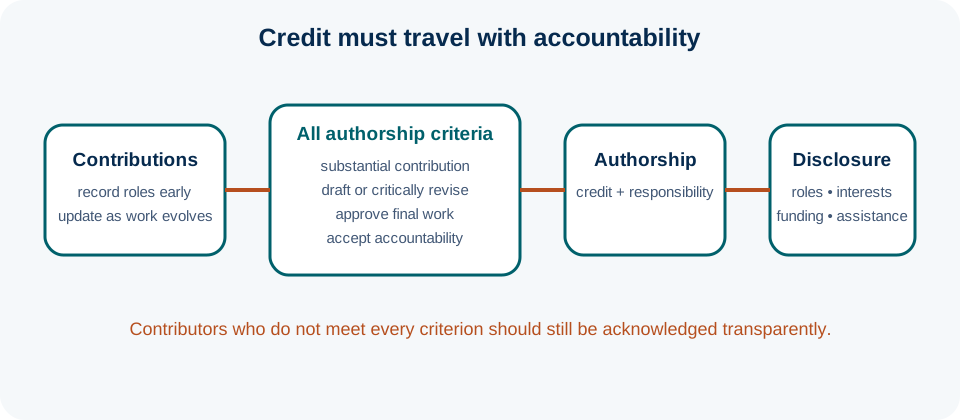
Under ICMJE recommendations, authors should satisfy all four criteria: substantial contribution to conception/design or acquisition/analysis/interpretation; drafting or critical intellectual revision; final approval; and accountability for the work.[1] Contributors who do not meet all criteria should be recognised appropriately rather than forced into or excluded from authorship for political reasons.
A contributorship statement can describe roles more granularly. CRediT is one structured taxonomy used by many journals, but journal requirements should be checked at submission.[4] Contribution roles complement rather than automatically replace the journal’s authorship policy.
Plan authorship early and revisit it
At project initiation, discuss expected roles, lead writing responsibilities, corresponding author duties and how order will be determined. Revisit the discussion at major milestones because contributions change. Record decisions without treating them as immutable contracts.
Gift, guest and ghost authorship
Gift or honorary authorship credits people who have not earned authorship; guest authorship may be used to increase prestige; ghost authorship hides someone who made a substantial contribution. All weaken transparency and can obscure accountability.[2,3]
Contributorship and acknowledgements
People who provide technical help, language editing, data collection, administrative support or access may deserve acknowledgement when they do not meet authorship criteria. Permission should be obtained where acknowledgement could imply endorsement. Contributorship statements should accurately describe who did what.
Conflicts and competing interests
A conflict of interest exists when secondary interests or relationships could reasonably be perceived to influence professional judgement. Financial interests are important, but personal, academic, institutional or intellectual relationships can also matter. Disclosure does not automatically disqualify a researcher; it enables appropriate management and reader judgement.[1,5]
Funder and sponsor roles
Reports should state who funded the work and what role the funder or sponsor had in design, data collection, analysis, interpretation, manuscript preparation and publication decisions. Research agreements should preserve appropriate investigator access to data and ability to report findings. Hidden sponsor control can distort the scientific record.[1]
Artificial intelligence and authorship
Current ICMJE recommendations include guidance on responsible AI use in publishing. AI tools cannot meet human accountability requirements for authorship. Researchers remain responsible for accuracy, originality, confidentiality and disclosure of AI use according to journal policy.[1]
Authorship decisions should follow the work as it evolves
A research project moves through conception, protocol development, data collection, analysis, interpretation and writing. Contributions can change substantially across these phases. A person expected to lead the analysis may leave; a junior researcher may become the intellectual lead; a new methodologist may make a critical contribution late in the project. Authorship planning should therefore be prospective but revisable.
A contribution log can record roles at major milestones. It should be a conversation aid rather than a points system. Mechanical scoring can create perverse incentives, such as fragmenting tasks merely to accumulate “authorship points”. The final decision must still follow the journal’s criteria and the team’s actual intellectual and accountability contributions.
Author order is a separate question from eligibility
First decide who qualifies as an author; then decide author order. Different disciplines use different conventions, and there is no universal ethical rule that first, last or corresponding author carries the same meaning everywhere. Teams should state their convention and resolve order through contribution rather than hierarchy.
Equal-contribution statements can be helpful when genuine, but should not be used to avoid a necessary discussion. The corresponding author has important coordination and communication duties and should have sufficient knowledge of the paper and co-author approvals.
Supervisors have responsibilities as well as power
Supervisors should create opportunities for trainees who contribute substantively to complete the writing, approval and accountability steps needed for authorship. Removing a student from authorship because the manuscript takes longer to finish can be unfair if the student remains willing and able to participate. Conversely, a student should not feel compelled to add a supervisor who has not contributed merely because of academic dependency.
Departments can reduce disputes by teaching authorship expectations before projects begin and providing a neutral process for disagreements.
Conflicts of interest require management proportional to risk
Disclosure is the first step, not the entire management plan. A researcher with substantial equity in a company whose product is being studied may need additional safeguards such as independent analysis, restricted decision authority or explicit oversight. A minor unrelated professional relationship may require disclosure but no operational restriction.
The relevant question is how the relationship could influence study design, conduct, interpretation or reporting and what safeguard makes the process credible.
Transparency includes access to data
Authorship accountability is weakened if no academic investigator can inspect the underlying data or challenge the sponsor’s analysis. Current ICMJE recommendations emphasise author access and accountability in sponsored research.[1] Contracts should be reviewed before the study begins so that publication freedom and data access are not discovered to be restricted after recruitment.
Multicentre studies also need a publication policy describing site papers, ancillary analyses and use of the shared dataset. Otherwise, authorship disputes can become disguised data-access disputes.
Acknowledgements can also create misleading impressions
Naming a respected clinician, patient group or institution in acknowledgements may imply endorsement. Contributors should usually be informed or permission obtained according to journal practice. Medical writers and editorial assistance should be disclosed where relevant, including the source of funding.
Transparent acknowledgement is preferable to hiding professional writing support, particularly in sponsored research.
AI use adds a new disclosure problem
Researchers increasingly use generative AI for language editing, coding assistance, summarisation or drafting. Journal policies differ regarding required disclosure. The stable principle is that human authors remain responsible for verifying facts, citations, originality, confidentiality and the final text. Confidential unpublished data should not be entered into systems unless the applicable privacy, institutional and contractual requirements allow it.
AI cannot consent to publication, disclose conflicts or answer for errors; it therefore cannot satisfy human authorship accountability.
A prospective publication agreement for multicentre studies
Multicentre collaborations should agree on publication governance before data are valuable enough to trigger competition. The agreement can define the role of a publication committee, how manuscript proposals are submitted, how overlapping analyses are resolved, expected review timelines, access to the analytic dataset and how disagreements are escalated.
This does not mean central control should suppress site investigators. A fair policy enables legitimate ancillary analyses while protecting the cohort from duplicate or contradictory papers based on inconsistent definitions. Decisions should be based on scientific overlap and contribution, not institutional prestige.
Author order should be revisited at manuscript initiation and again before submission. A person who was central to protocol design may have little role in a specific secondary analysis, whereas a junior analyst may contribute most of the intellectual work. Contribution to the particular paper, not only the parent project, should guide authorship.
Conflicts should be updated rather than collected once. New consultancy, intellectual property, employment or leadership roles can arise during a long study. The corresponding author can coordinate current disclosures before submission, but every author remains responsible for accurate declarations.
Transparency also includes reporting assistance. If a professional medical writer, translation service or statistical programming team materially supported the manuscript, the contribution and funding source should be acknowledged according to journal policy. Hidden support can make a paper appear more independent than it was.
When an authorship dispute cannot be resolved by the team, journals generally cannot investigate institutional contribution records themselves. Institutions or designated research-integrity structures may need to adjudicate. Teams should therefore preserve contribution documentation rather than expecting editors to reconstruct years of collaboration.
Authorship decisions at the analysis-plan stage
A useful moment to revisit authorship is when a specific analysis is approved. The team can identify who will lead the scientific question, who will create the analysis dataset, who will perform statistical work, who will interpret findings and who will draft the manuscript. This makes contribution expectations visible before the paper is nearly complete.
Large collaborative groups may use group authorship or consortium names according to journal policy. The manuscript should still identify which individuals accept authorship responsibility and how other contributors are listed. Group size does not remove accountability.
Where disagreements arise, separate three questions: Does the person qualify? What should the order be? What contribution should be acknowledged? Solving these separately is usually easier than arguing about one final author list as a proxy for status or ownership.
Conflicts of interest during peer review and dissemination
Competing interests do not end at manuscript submission. Researchers presenting at conferences, serving on guideline panels or speaking to media should disclose relationships relevant to the work according to the applicable setting. Co-authors should know about major sponsor or intellectual-property relationships before agreeing to public messages. Consistent disclosure across manuscripts, presentations and public communication reduces the appearance that interests are selectively revealed only when a journal form requires them.
Documenting contribution protects junior researchers
A dated contribution record can be particularly protective in hierarchical teams. It gives students, analysts and site investigators evidence of intellectual and practical work that may otherwise be forgotten when senior authors join near submission. The record should not be used as a rigid contract, but it makes later discussion more factual. Supervisors should model transparent revision of authorship plans when contributions change rather than treating author order as an entitlement attached to rank.
Authorship should not be used to settle unrelated disputes
Teams sometimes use author order to compensate for salary inequity, recruitment workload, institutional rivalry or disagreement about data ownership. These may be genuine problems, but authorship is a poor currency for solving them. Recruitment effort can be recognised through contributorship and project roles; contractual and resource disputes should be addressed directly. Keeping authorship tied to scholarly contribution and accountability makes both credit and responsibility clearer.
Revisit publication roles before submission
Immediately before submission, each author should review the final manuscript, contribution statement, disclosures and funding information. This is an opportunity to correct outdated affiliations, identify missing contributors and ensure that every listed author accepts accountability for the version being submitted. Authorship is therefore confirmed at the end of the process, not merely promised at the beginning.
Final authorship confirmation
No manuscript should be submitted with an author who has not reviewed and approved the final version. The corresponding author should confirm authorship, contribution statements, disclosures, affiliations and acknowledgement text with the entire group. This final confirmation is particularly important after major revisions because author contributions or interpretations may have changed. If someone can no longer accept accountability for the final work, the team should resolve that issue before submission rather than assuming an earlier agreement still applies.
Resolve authorship fairly
- What substantive contributions has each person made or committed to make?
- Has each proposed author participated in drafting or critical intellectual revision?
- Can each author approve and accept accountability for the work?
- Who contributed but does not meet authorship criteria and should be acknowledged?
- Which relationships or interests require disclosure or management?
Publication and authorship plan
- Discuss expected contributions before data analysis.
- Use a contribution log that can be updated.
- Define lead writer and corresponding-author responsibilities.
- Agree how authorship order will be revisited.
- Collect and update conflict-of-interest disclosures.
- State funder/sponsor roles and investigator data-access rights.
Appraise publication transparency
- Do listed authors meet the applicable authorship criteria?
- Are substantive non-author contributors hidden?
- Are conflicts and funder roles disclosed clearly?
- Could contractual arrangements suppress or delay unfavourable findings?
- Does the contribution statement match the actual work described by the team?
Worked example
Resolving authorship before submission
The team reviews contributions using the journal’s authorship policy. The department head is acknowledged for facilitating site access but is not added as an author unless he makes a qualifying intellectual contribution and accepts the remaining responsibilities. The statistician has substantially contributed to analysis and interpretation; she is invited to participate in critical manuscript revision, final approval and accountability, allowing her contribution to be recognised appropriately if all criteria are met.
The group documents author order based on contribution to the manuscript, adds a contributorship statement, and records the sponsor’s role and each author’s disclosures.
Suggested protocol or governance wording
Common mistakes
Knowledge check
Does obtaining funding automatically qualify someone for authorship under ICMJE criteria?
Answer and reasoning
No. Funding alone does not satisfy the full authorship criteria, although the contribution should be acknowledged and disclosed appropriately.
Why discuss authorship before manuscript writing?
Answer and reasoning
Early discussion makes expectations explicit, reduces hierarchy-driven disputes and allows people to undertake the responsibilities required for authorship.
Does declaring a conflict of interest mean the research is invalid?
Answer and reasoning
No. Disclosure enables management and interpretation. The problem is hidden or unmanaged influence, not the mere existence of every secondary interest.
Can an AI system be an author?
Answer and reasoning
No. It cannot accept responsibility and accountability in the way required of human authors. Human authors remain responsible for the work.
Key take-home messages
Key take-home messages
- Authorship combines substantive contribution, manuscript participation, approval and accountability.
- Seniority, funding or access alone should not determine authorship.
- Contributorship and acknowledgement improve transparency about roles.
- Conflicts should be disclosed and managed rather than hidden.
- Funder, sponsor and data-access roles should be reported explicitly.
References
- International Committee of Medical Journal Editors. Recommendations for the conduct, reporting, editing, and publication of scholarly work in medical journals. Updated January 2026. https://www.icmje.org/recommendations/
- Committee on Publication Ethics. COPE Core Practices and guidance. https://publicationethics.org/
- Committee on Publication Ethics. How to recognise potential authorship problems. 2023. https://publicationethics.org/guidance/flowchart/how-recognise-potential-authorship-problems
- NISO. CRediT: Contributor Roles Taxonomy. https://credit.niso.org/
- International Committee of Medical Journal Editors. Disclosure of interest. https://www.icmje.org/disclosure-of-interest/
These materials support learning and research planning. They require adaptation to the study context and do not replace methodological, statistical, ethical, or regulatory consultation.