
Part 16 · Module 5
Writing and Publishing a Research Manuscript
Learn an evidence-aligned workflow for writing, revising, submitting and publishing a health-research manuscript without overstating the findings.
Learning outcomes
After completing this lecture, you should be able to:
- Organise a research manuscript around a clear scientific message and appropriate reporting guideline.
- Write Methods and Results sections that preserve the distinction between planned and exploratory analyses.
- Develop a Discussion that interprets effect estimates without causal or clinical overstatement.
- Apply current authorship, disclosure, data-access and publication-integrity expectations.
- Plan journal submission and peer-review responses as part of transparent research reporting.
Overview
A scientific manuscript is the public reconstruction of a study: why it was needed, what was done, what was found and what those findings reasonably imply. Current ICMJE Recommendations address authorship, data access, conflicts, trial registration, data-sharing statements, peer review and the use of artificial intelligence in publishing.[1] Reporting guidelines from EQUATOR and design-specific statements such as CONSORT 2025 help authors provide the methodological detail required for appraisal.[2–5] Publication ethics guidance additionally emphasises correction of errors and transparent handling of authorship or integrity concerns.[6]
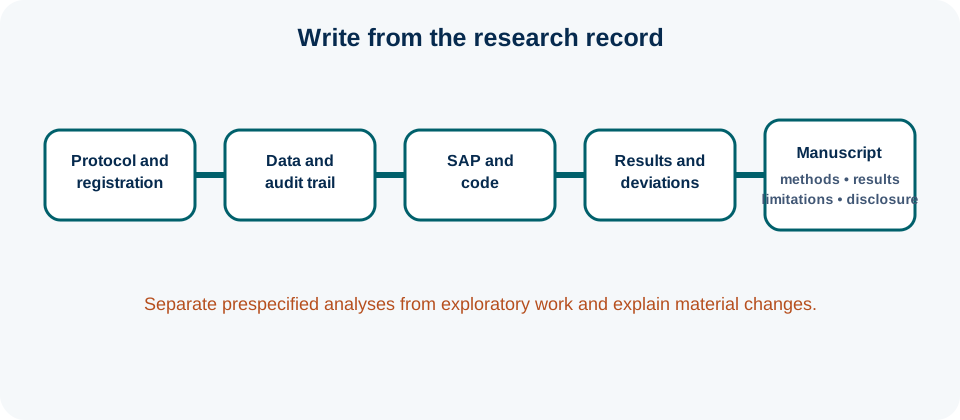
Good manuscript writing therefore begins before the first sentence of the Introduction. It begins with a stable protocol, a traceable analysis and a clear distinction between prespecified and exploratory work. Writing cannot compensate for weak methods, but poor writing can obscure strong methods and make valid research unusable.
Why this matters
Many manuscripts fail because authors treat writing as a chronological diary of the research rather than an argument structured around the primary question. Introductions become literature catalogues, Methods omit details that seem obvious to the investigators, Results repeat every software output, and Discussions equate statistical significance with clinical importance.
Publication also creates ethical responsibilities. All listed authors must satisfy authorship criteria and take appropriate responsibility for the work. Data access must be sufficient for authors to defend the integrity of the analysis. Conflicts of interest, funding roles, protocol registration and data-sharing plans should be disclosed. If AI tools are used in manuscript preparation, current journal and ICMJE policies should be checked and human authors remain responsible for accuracy, originality and confidentiality.[1]
Key concepts
Most empirical health-research manuscripts use an Introduction–Methods–Results–Discussion structure, but the function of each section matters more than the acronym. The Introduction establishes the problem, existing evidence, unresolved gap and study objective. The Methods provide enough detail to understand design, participants, measurements, analysis and ethics. The Results report what happened and the estimates generated by the prespecified analyses. The Discussion interprets those findings in relation to uncertainty, prior evidence, strengths, limitations and implications.
The manuscript should have one dominant narrative: the primary question. Secondary objectives can be reported, but they should not crowd out the main result. Effect estimates and confidence intervals generally deserve priority over isolated p-values. Negative or inconclusive findings should not be reframed as “trends” merely to make the paper sound positive. Exploratory findings can be valuable when labelled as exploratory.
Authorship is not a reward for seniority or data access. Current ICMJE criteria require substantial contribution, drafting or critical revision, final approval and accountability.[1] Contributor roles can be described more granularly using a contributor taxonomy where journals support it, but contributor statements do not automatically override journal authorship criteria.
Before drafting, decide the manuscript’s reporting spine
- What is the single primary research question and main estimate?
- Which reporting guideline and extensions apply?
- Which tables and figures are necessary to answer the objectives?
- Which analyses were prespecified, amended before analysis, or exploratory?
- What limitations materially affect validity or applicability?
- What authorship, contributor, funding, conflict, registration and data-sharing information must be disclosed?
A step-by-step methodological workflow
1. Build the manuscript from the results table shells
Start with the primary and key secondary results rather than polishing the Introduction. Decide which estimates, denominators and uncertainty intervals are essential. Create concise tables and figures that can stand alone with clear titles, units and footnotes. Once the results structure is stable, the Methods can be written to explain exactly how those results were generated.
2. Write the Methods from source documents
Use the protocol, SAP, data dictionary and reporting checklist. Do not rely on memory. State design, setting, dates, eligibility, sampling, measurements, outcomes, sample-size rationale, analysis and ethics with enough detail for appraisal. Report material deviations from the planned methods and identify exploratory analyses.
3. Write Results without interpretation creep
Begin with participant or record flow, denominators and baseline or descriptive context. Then report the primary estimate, confidence interval and supporting information. Avoid narrating every cell in a table. Do not introduce new methods in Results; if a sensitivity analysis appears there, its rationale and method should already be described.
4. Write a focused Introduction
Use a short sequence: why the problem matters, what is already known, what is uncertain, and what this study aimed to determine. Avoid turning the Introduction into a comprehensive literature review. The final paragraph should state objectives using the same terminology as the Methods and Results.
5. Write the Discussion as calibrated interpretation
Open with the principal finding in relation to the objective, not with a claim of novelty. Compare the estimate with relevant prior evidence and explain plausible mechanisms without presenting speculation as established fact. Discuss strengths and limitations according to direction and potential magnitude where possible. End with implications that are proportionate to design and uncertainty.
6. Prepare submission and peer-review materials
Check journal scope, article type, word and figure limits, reporting-checklist requirements, registration and data-sharing statements. Write a cover letter that explains fit rather than repeating the abstract. During peer review, respond point-by-point, distinguish corrections from disagreements, and revise transparently. Do not create analyses solely to satisfy a reviewer without labelling them as post hoc if they were not prespecified.
Before submission, verify these publication-integrity items
- all authors meet the applicable authorship criteria and approve the manuscript;
- contributor roles, funding and conflicts are disclosed accurately;
- protocol and registration identifiers are correct;
- the manuscript matches the final analysis dataset and code;
- exploratory and post hoc analyses are labelled;
- data- and code-availability statements match actual governance;
- reporting checklist and journal requirements are complete;
- AI-tool use, if any, complies with journal and ICMJE policies.
An auditable planning document
Manuscript evidence map
illustrativeTable 1. Illustrative map from source document to manuscript claim
| Manuscript element | Primary source | Verification |
|---|---|---|
| Primary outcome definition | Protocol/SAP | Same wording and time point |
| Participant flow | Screening/enrolment log | Denominators reconcile |
| Primary estimate | Locked analysis output | Regenerates from code |
| Subgroup finding | SAP or analysis log | Prespecified vs exploratory labelled |
| Ethics statement | Approval letter/protocol | Correct committee and reference |
| Registration | Registry record | Outcomes and dates reconciled |
| Data availability | DMP/governance decision | Feasible and consent-compatible |
Note: The map is an internal authoring tool, not usually part of the published article.
Quality, validity and governance
Manuscript quality depends on traceability. A number in the Abstract should match the Results, table and analysis output. The primary outcome should be identifiable in the protocol and registry. Participant counts should reconcile across the flow diagram and tables. The data-sharing statement should describe what can actually be shared, not what sounds desirable.
Statistical language also requires calibration. A confidence interval represents uncertainty under the model and assumptions; it is not a probability distribution for the true effect in ordinary frequentist interpretation. A non-significant p-value does not prove equivalence or no effect. An observational association should not automatically be described as an intervention effect. A predictive model’s discrimination does not establish clinical utility. These distinctions should survive editing for brevity.
Peer review can improve a manuscript but may also introduce post hoc work. Authors should retain an analysis log showing which analyses were added in response to reviewers. If a new analysis materially changes the interpretation, explain why it was added and label it appropriately. Transparency is stronger than pretending every final analysis was always planned.
Appraise a manuscript before submission
- Does the title and abstract accurately reflect the design and primary result?
- Can every main result be traced to a prespecified or transparently labelled analysis?
- Do the Methods contain the information required by the relevant reporting guideline?
- Are effect estimates and uncertainty prioritised over isolated significance labels?
- Does the Discussion distinguish evidence from mechanism speculation and causal overreach?
- Do authorship, data access, conflicts, registration and sharing statements match current policy and actual practice?
Practical decision audit
Audit the abstract independently
Many readers see only the abstract. Check that denominators, effect direction, confidence intervals and study design are accurate and that the conclusion does not become stronger than the full paper. Avoid “proved”, “safe” or “effective” unless the design and evidence justify those terms.
Audit table-text redundancy
The text should highlight patterns and primary estimates rather than restating all cells. If a table is essential only because the Results prose repeats it, redesign the display. Conversely, do not omit denominators or uncertainty from tables and expect prose to rescue them.
Audit selective emphasis
Compare the manuscript with the protocol and SAP. If the primary outcome is buried while a favourable secondary result dominates the title, abstract and discussion, the narrative may be outcome-driven. Rebalance the manuscript and disclose any change in emphasis.
Audit the publication record
Confirm that preprints, conference abstracts, registry records and earlier reports are cited or disclosed when relevant. Avoid duplicate publication or fragmented “salami” reports that obscure the relationship between datasets. When errors are found after publication, follow journal correction procedures rather than silently altering accessible files.
Building a manuscript around claims rather than sections
Before drafting prose, list the claims the manuscript intends to make. For each claim, identify the supporting result, the design feature that permits the claim, the principal uncertainty and the relevant limitation. A causal claim needs stronger design and assumptions than a descriptive claim. A prediction-performance claim requires validation metrics; a clinical-utility claim requires evidence about decisions or outcomes. This claim-first approach prevents the Discussion from outrunning the Methods.
The title and abstract should pass a stricter accuracy standard
Titles and abstracts are indexed, quoted and read independently of the full paper. They should therefore state the design accurately and avoid implying more certainty than the full analysis supports. If an observational study finds an association, the title should not present the exposure as a treatment that “reduces” risk unless a defensible causal analysis supports that wording. Abstract conclusions should include the population and important uncertainty rather than presenting a context-free headline.
Results selection should follow the objectives hierarchy
A manuscript rarely has room for every analysis produced during a dissertation. Selection should be based on the prespecified objective hierarchy and interpretive importance, not on statistical significance. A null primary result should not be buried behind a positive subgroup. Supplementary material can house extensive sensitivity analyses, additional tables, questionnaires or coding details, but the main paper should still contain enough information to judge the primary conclusion.
Discussion limitations should explain mechanisms of distortion
Generic phrases such as “the study has a small sample size” or “there may be bias” are weak. Explain how the limitation could affect the estimate. Loss to follow-up could bias results if missingness differs by prognosis and exposure; self-reported adherence may be overestimated because of social desirability; unmeasured disease severity may confound an observational association. Where possible, discuss likely direction and whether sensitivity analyses changed the interpretation.
Peer-review responses are part of the scientific record
A good response letter quotes or summarises each reviewer comment, states the action taken, and points to the revised location. When the authors disagree, they should explain the scientific reason rather than responding defensively. If reviewers request analyses that alter the estimand or were not prespecified, authors can provide them as exploratory or supplementary analyses while preserving the primary analysis. The goal is to improve clarity without rewriting the study history.
Preserving the chain from protocol to publication
Before drafting the Results, create a manuscript traceability table linking each stated objective to the corresponding protocol version, analysis population, table or figure, and planned analysis. Record any deviation and its reason. This prevents a common failure in which the published paper gradually becomes organised around the most interesting observed findings rather than the questions the study was designed to answer.
The same discipline should extend to the Discussion. Separate what the study directly estimated from mechanistic explanations, subgroup hypotheses and implications for practice. When exploratory findings are scientifically important, report them as exploratory and explain why they arose. Transparent qualification usually strengthens a manuscript because readers can distinguish confirmatory evidence from observations that should motivate future work.
Worked example
Condensing a dissertation without distorting the study
The trainee identifies the protocol’s primary objective and places its adjusted effect estimate with 95% CI in the first Results subsection and Abstract. Of the 14 dissertation tables, four are retained: participant flow and characteristics, the primary result, prespecified secondary outcomes, and sensitivity analyses. Detailed exploratory subgroup tables move to supplementary material with clear labels.
The Methods are rewritten from the protocol and SAP, not copied from the dissertation’s broad methods chapter. The trainee notices that one subgroup analysis was requested after supervisors saw the primary results, so it is described as exploratory rather than “planned”. The Discussion explains that residual confounding and incomplete capture of care outside the hospital may attenuate or distort the observed association.
The final paper is shorter but more transparent. It does not hide null findings, inflate novelty or imply causality. The author list is reviewed against current criteria, and the data-availability statement describes controlled access rather than claiming that confidential records are openly available.
Suggested protocol and manuscript wording
Common mistakes
Knowledge check
Why should the Methods section be written from protocol and SAP source documents?
Answer and reasoning
Because memory tends to reconstruct the final study rather than preserve what was prespecified, amended and actually implemented.
What should happen to an important analysis added after peer review?
Answer and reasoning
It may be included, but the manuscript should make its post hoc status and rationale transparent rather than implying it was prespecified.
Does a shorter manuscript justify omitting limitations that threaten validity?
Answer and reasoning
No. Space constraints should be managed by prioritising essential information and supplementary material, not by hiding validity concerns.
Who remains responsible for manuscript accuracy if an AI writing tool was used?
Answer and reasoning
Human authors. Current publication guidance does not transfer accountability to the tool, and confidentiality and journal-specific disclosure requirements must still be followed.
Key take-home messages
Key take-home messages
- Build the manuscript around the primary question and traceable results.
- Use reporting guidelines to preserve information needed for appraisal.
- Keep prespecified, amended and exploratory analyses distinct.
- Interpret effect estimates in proportion to design, uncertainty and bias.
- Publication integrity includes authorship, data access, conflicts, registration, sharing and correction of errors.
References
- International Committee of Medical Journal Editors. Recommendations for the conduct, reporting, editing, and publication of scholarly work in medical journals. Updated January 2026. https://www.icmje.org/recommendations/
- EQUATOR Network. Search for reporting guidelines. Oxford: EQUATOR Network. https://www.equator-network.org/reporting-guidelines/
- Hopewell S, Chan AW, Collins GS, et al. CONSORT 2025 statement: updated guideline for reporting randomised trials. BMJ. 2025;388:e081123. https://doi.org/10.1136/bmj-2024-081123
- von Elm E, Altman DG, Egger M, Pocock SJ, Gøtzsche PC, Vandenbroucke JP. The STROBE statement: guidelines for reporting observational studies. PLoS Med. 2007;4(10):e296. https://doi.org/10.1371/journal.pmed.0040296
- Page MJ, McKenzie JE, Bossuyt PM, et al. The PRISMA 2020 statement: an updated guideline for reporting systematic reviews. BMJ. 2021;372:n71. https://doi.org/10.1136/bmj.n71
- Committee on Publication Ethics. COPE Core Practices. https://publicationethics.org/core-practices
These materials support learning and research planning. They require adaptation to the study context and do not replace methodological, statistical, ethical, or regulatory consultation.