
Part 9 · Module 6
Parallel, Crossover and Factorial Trials
Compare parallel, crossover and factorial randomised designs and select the structure that matches intervention persistence, interactions and participant burden.
Learning outcomes
After completing this lecture, you should be able to:
- Describe parallel, crossover and factorial assignment structures.
- Identify carryover, period and interaction considerations.
- Select washout and sequence procedures for crossover trials.
- Interpret main effects and interactions in factorial trials.
- Align analysis with repeated or multi-factor allocation.
Overview
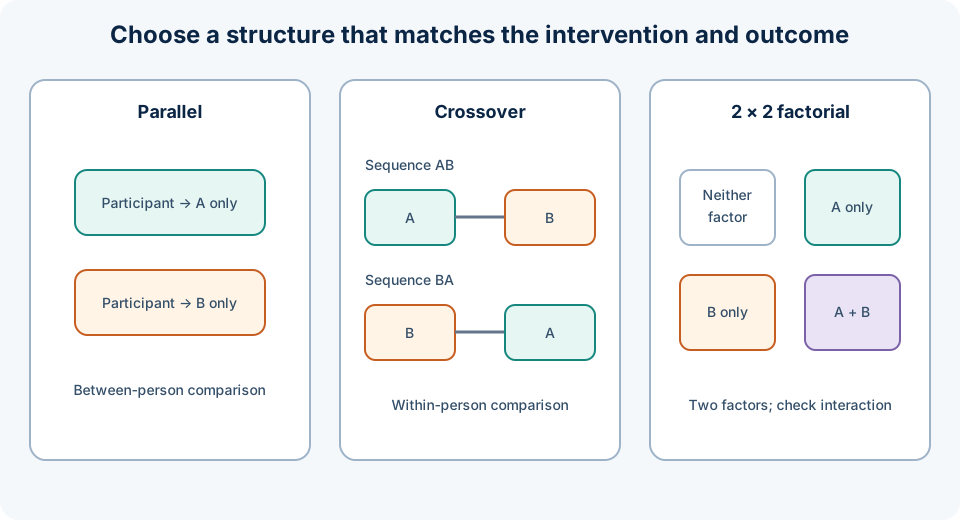
Parallel trials assign each participant to one strategy. Crossover trials expose participants to sequences of treatments across periods. Factorial trials randomise two or more intervention factors simultaneously. These designs answer different questions and impose different assumptions about persistence, interaction, timing and analysis.
The study question, design, participant pathway, measurements and analysis must be specified as one coherent system. A recognised design label is useful only when the operational details preserve the comparison or prediction that the study is intended to support.[1–3]
Why this matters
Crossover and factorial designs can be efficient, but efficiency disappears when assumptions fail. An intervention with lasting effects cannot be reset by a short washout. A factorial main-effect estimate can be misleading when interventions interact strongly. Design should follow clinical behaviour rather than arithmetic appeal.
Core concepts
Parallel trials preserve independent treatment paths
Each participant remains in one assigned strategy. They suit acute or lasting interventions and outcomes that cannot be repeated. Between-person variability affects precision but interpretation is direct.
Crossover trials use within-person comparison
Participants receive treatments in different sequences and act as their own controls. The condition should be stable, treatment effects reversible and outcomes measurable repeatedly. Period, sequence, carryover and washout require planning.
Washout is biological and behavioural
A washout period should be long enough for pharmacological and behavioural effects to dissipate. Some learning, surgery, vaccination and service outcomes cannot be washed out.
Factorial trials randomise multiple factors
A 2×2 design assigns participants independently to factor A or not and factor B or not. Main effects can be estimated using all participants when interaction is absent or clinically small.
Interaction changes interpretation and power
If the effect of one factor depends on the other, main-effect averages may conceal important combinations. Many factorial trials are powered for main effects, not interaction, so interaction objectives require explicit sample-size planning.
When to use this approach
Selecting a trial structure
- Can outcomes and treatment effects be repeated and reset?
- Is the condition sufficiently stable across periods?
- Are two interventions likely to interact?
- Is participant burden acceptable for sequences or multiple components?
- Which effect—component, combination or sequence—is the primary target?
Working through the key design decisions
Decision 1: Can outcomes and treatment effects be repeated and reset?. This point should be resolved before recruitment, extraction or assignment begins. For parallel, crossover and factorial trials, the protocol should state the operational rule, who applies it, when it is applied and what source documents demonstrate compliance. The investigators should also consider how a different choice would change the eligible population, comparison, timing, measurement or interpretation. A pilot review of realistic records or participant pathways can reveal ambiguities before they become irreversible exclusions or post hoc analytical choices. The decision should be reviewed across sites and subgroups because a rule that works in one clinic may operate differently where referral, resources or disease spectrum differ. Any permitted exception should be explicit, dated and reported with its frequency and likely consequence. The corresponding estimand or target contrast should be written in words, and the planned estimator should be checked against the sampling, clustering, matching or censoring mechanism. Sensitivity analyses should target plausible departures from the design assumptions rather than provide an undirected collection of alternative models.
Decision 2: Is the condition sufficiently stable across periods?. This point should be resolved before recruitment, extraction or assignment begins. For parallel, crossover and factorial trials, the protocol should state the operational rule, who applies it, when it is applied and what source documents demonstrate compliance. The investigators should also consider how a different choice would change the eligible population, comparison, timing, measurement or interpretation. A pilot review of realistic records or participant pathways can reveal ambiguities before they become irreversible exclusions or post hoc analytical choices. The decision should be reviewed across sites and subgroups because a rule that works in one clinic may operate differently where referral, resources or disease spectrum differ. Any permitted exception should be explicit, dated and reported with its frequency and likely consequence. The corresponding estimand or target contrast should be written in words, and the planned estimator should be checked against the sampling, clustering, matching or censoring mechanism. Sensitivity analyses should target plausible departures from the design assumptions rather than provide an undirected collection of alternative models.
Decision 3: Are two interventions likely to interact?. This point should be resolved before recruitment, extraction or assignment begins. For parallel, crossover and factorial trials, the protocol should state the operational rule, who applies it, when it is applied and what source documents demonstrate compliance. The investigators should also consider how a different choice would change the eligible population, comparison, timing, measurement or interpretation. A pilot review of realistic records or participant pathways can reveal ambiguities before they become irreversible exclusions or post hoc analytical choices. The decision should be reviewed across sites and subgroups because a rule that works in one clinic may operate differently where referral, resources or disease spectrum differ. Any permitted exception should be explicit, dated and reported with its frequency and likely consequence. The corresponding estimand or target contrast should be written in words, and the planned estimator should be checked against the sampling, clustering, matching or censoring mechanism. Sensitivity analyses should target plausible departures from the design assumptions rather than provide an undirected collection of alternative models.
Decision 4: Is participant burden acceptable for sequences or multiple components?. This point should be resolved before recruitment, extraction or assignment begins. For parallel, crossover and factorial trials, the protocol should state the operational rule, who applies it, when it is applied and what source documents demonstrate compliance. The investigators should also consider how a different choice would change the eligible population, comparison, timing, measurement or interpretation. A pilot review of realistic records or participant pathways can reveal ambiguities before they become irreversible exclusions or post hoc analytical choices. The decision should be reviewed across sites and subgroups because a rule that works in one clinic may operate differently where referral, resources or disease spectrum differ. Any permitted exception should be explicit, dated and reported with its frequency and likely consequence. The corresponding estimand or target contrast should be written in words, and the planned estimator should be checked against the sampling, clustering, matching or censoring mechanism. Sensitivity analyses should target plausible departures from the design assumptions rather than provide an undirected collection of alternative models.
Decision 5: Which effect—component, combination or sequence—is the primary target?. This point should be resolved before recruitment, extraction or assignment begins. For parallel, crossover and factorial trials, the protocol should state the operational rule, who applies it, when it is applied and what source documents demonstrate compliance. The investigators should also consider how a different choice would change the eligible population, comparison, timing, measurement or interpretation. A pilot review of realistic records or participant pathways can reveal ambiguities before they become irreversible exclusions or post hoc analytical choices. The decision should be reviewed across sites and subgroups because a rule that works in one clinic may operate differently where referral, resources or disease spectrum differ. Any permitted exception should be explicit, dated and reported with its frequency and likely consequence. The corresponding estimand or target contrast should be written in words, and the planned estimator should be checked against the sampling, clustering, matching or censoring mechanism. Sensitivity analyses should target plausible departures from the design assumptions rather than provide an undirected collection of alternative models.
The approach should be chosen because its structure answers the research question, not because the available dataset happens to resemble a familiar table. The investigator should state the target population, time origin, comparison, outcome and intended measure before collecting or extracting data.
Design and participant pathway
Parallel, crossover and factorial trials
Core structure: Assign fixed strategies, treatment sequences or multiple intervention factors according to the causal contrasts of interest.
Best suited for: Parallel designs for durable outcomes; crossover designs for stable reversible conditions; factorial designs for efficient component testing.
Principal threats: Carryover, period trends, sequence imbalance, treatment interaction, multiple testing, differential dropout and non-adherence across periods.
Crossover randomisation concerns sequences, such as AB and BA, rather than isolated periods. The analysis should use paired repeated observations and include relevant period structure. Factorial protocols should define whether the primary aim is one or more main effects, an interaction or a specific combination. A factorial trial is not equivalent to an uncontrolled bundle of interventions.
Protocol specification
Decisions to prespecify
- Define the primary contrast and design rationale.
- For crossover trials, specify sequences, periods and washout.
- For factorial trials, define factors, levels and interaction objective.
- Plan adherence and dropout by period or component.
- Choose outcome timing that avoids transient ambiguity.
- Prespecify repeated-measure or factorial analysis.
Protocol item 1: Define the primary contrast and design rationale. This item requires a reproducible definition rather than a broad intention. The study manual should identify the responsible role, data field or procedural record, permissible time window, quality check and response to deviations. Where judgement is unavoidable, assessors should receive examples and escalation rules, and a sample of decisions should be reviewed for consistency. The analysis dataset should retain enough provenance to distinguish planned exclusions, measurement failure, participant withdrawal and genuinely absent information. Because advanced designs often use weights, risk sets, clusters, thresholds or time-varying states, the derivation should be independently reproduced from raw dates and identifiers. Simulation or mock-data testing before database lock can verify that the prespecified estimator answers the stated question under the intended design.
Protocol item 2: For crossover trials, specify sequences, periods and washout. This item requires a reproducible definition rather than a broad intention. The study manual should identify the responsible role, data field or procedural record, permissible time window, quality check and response to deviations. Where judgement is unavoidable, assessors should receive examples and escalation rules, and a sample of decisions should be reviewed for consistency. The analysis dataset should retain enough provenance to distinguish planned exclusions, measurement failure, participant withdrawal and genuinely absent information. Because advanced designs often use weights, risk sets, clusters, thresholds or time-varying states, the derivation should be independently reproduced from raw dates and identifiers. Simulation or mock-data testing before database lock can verify that the prespecified estimator answers the stated question under the intended design.
Protocol item 3: For factorial trials, define factors, levels and interaction objective. This item requires a reproducible definition rather than a broad intention. The study manual should identify the responsible role, data field or procedural record, permissible time window, quality check and response to deviations. Where judgement is unavoidable, assessors should receive examples and escalation rules, and a sample of decisions should be reviewed for consistency. The analysis dataset should retain enough provenance to distinguish planned exclusions, measurement failure, participant withdrawal and genuinely absent information. Because advanced designs often use weights, risk sets, clusters, thresholds or time-varying states, the derivation should be independently reproduced from raw dates and identifiers. Simulation or mock-data testing before database lock can verify that the prespecified estimator answers the stated question under the intended design.
Protocol item 4: Plan adherence and dropout by period or component. This item requires a reproducible definition rather than a broad intention. The study manual should identify the responsible role, data field or procedural record, permissible time window, quality check and response to deviations. Where judgement is unavoidable, assessors should receive examples and escalation rules, and a sample of decisions should be reviewed for consistency. The analysis dataset should retain enough provenance to distinguish planned exclusions, measurement failure, participant withdrawal and genuinely absent information. Because advanced designs often use weights, risk sets, clusters, thresholds or time-varying states, the derivation should be independently reproduced from raw dates and identifiers. Simulation or mock-data testing before database lock can verify that the prespecified estimator answers the stated question under the intended design.
Protocol item 5: Choose outcome timing that avoids transient ambiguity. This item requires a reproducible definition rather than a broad intention. The study manual should identify the responsible role, data field or procedural record, permissible time window, quality check and response to deviations. Where judgement is unavoidable, assessors should receive examples and escalation rules, and a sample of decisions should be reviewed for consistency. The analysis dataset should retain enough provenance to distinguish planned exclusions, measurement failure, participant withdrawal and genuinely absent information. Because advanced designs often use weights, risk sets, clusters, thresholds or time-varying states, the derivation should be independently reproduced from raw dates and identifiers. Simulation or mock-data testing before database lock can verify that the prespecified estimator answers the stated question under the intended design.
Protocol item 6: Prespecify repeated-measure or factorial analysis. This item requires a reproducible definition rather than a broad intention. The study manual should identify the responsible role, data field or procedural record, permissible time window, quality check and response to deviations. Where judgement is unavoidable, assessors should receive examples and escalation rules, and a sample of decisions should be reviewed for consistency. The analysis dataset should retain enough provenance to distinguish planned exclusions, measurement failure, participant withdrawal and genuinely absent information. Because advanced designs often use weights, risk sets, clusters, thresholds or time-varying states, the derivation should be independently reproduced from raw dates and identifiers. Simulation or mock-data testing before database lock can verify that the prespecified estimator answers the stated question under the intended design.
A protocol should make these decisions before outcome-dependent choices become tempting. It should also distinguish the design population from the analysis population, document exclusions after enrolment or sampling, and explain how missing or indeterminate observations will be handled. Any deviation should be dated, justified and retained in the study record.[2–4]
Measurements, timing and analysis interface
Crossover outcomes should be assessed in the same manner and at comparable positions within each period. Baseline measurements may be needed at every period. Factorial trials should record receipt of each component separately. Participant-reported burden and intervention interference can reveal whether combined delivery changes the component itself.
The analysis should reflect how participants or clusters entered the study, how observations are related, and how the effect or performance measure was defined. Statistical adjustment cannot repair a comparison that was invalid at the design stage. Conversely, a sound design can still be undermined by an analysis that ignores matching, clustering, censoring, sampling fractions or prespecified thresholds.
Worked example
Using a factorial design for reminders and peer support
Women are randomised independently to digital reminders versus none and peer support versus none, producing four groups. The primary objectives estimate the average main effect of each component on six-month testing. The protocol specifies an interaction analysis as secondary and recognises that it has lower precision. Component delivery and contamination are recorded separately.
The example should be interpreted in the population and time frame created by the design. The numerical result does not by itself establish causation, transportability or clinical usefulness; those conclusions require additional assumptions and evidence.
Appraising methodological quality
Questions for critical appraisal
- Fit: Does the outcome reset and the condition remain stable for crossover?
- Sequence: Were order and periods randomised and balanced?
- Interaction: Was a factorial interaction anticipated and powered appropriately?
- Analysis: Did methods respect repeated observations or multiple factors?
- Attrition: Was period- or component-specific dropout reported?
A reporting guideline can improve transparency, but it is not a substitute for sound design. Appraisal should ask whether the reported methods could generate an unbiased, clinically meaningful answer—not merely whether every checklist item has been mentioned.[3–6]
Suggested reporting
Reporting should identify the design in the title or abstract when appropriate, describe the source and flow of participants, define all key variables, report missing and indeterminate observations, and present estimates with uncertainty. The direction and denominator of every comparison must be explicit.
Higher-order and fractional factorial designsMMed extension
Multi-factor optimisation studies can screen components using full or fractional factorial designs. Aliasing and model hierarchy determine which effects can be separated. These designs require strong intervention theory and differ from a definitive trial of an optimised package.
Common mistakes
Knowledge check
Why is postpartum test completion unsuitable for crossover?
Answer and reasoning
Completion is an irreversible event; the participant cannot return to the untreated outcome state for another period.
What is randomised in a crossover trial?
Answer and reasoning
The sequence in which each participant receives the treatments.
What does a factorial main effect average over?
Answer and reasoning
The levels of the other randomised factor, under the design and analysis.
When must interaction be planned as a major objective?
Answer and reasoning
When clinical theory suggests combined effects may differ meaningfully and the decision depends on that interaction.
Key take-home messages
Key take-home messages
- Use parallel designs for lasting or non-repeatable outcomes.
- Use crossover only for stable, reversible settings.
- Randomise sequences and address period and carryover.
- Define factorial main effects and interactions prospectively.
- Let clinical assumptions determine efficiency.
References
- Dwan K, Li T, Altman DG, Elbourne D. CONSORT 2010 statement: extension to randomised crossover trials. BMJ. 2019;366:l4378. https://doi.org/10.1136/bmj.l4378
- Hopewell S, Chan AW, Collins GS, et al. CONSORT 2025 statement: updated guideline for reporting randomised trials. BMJ. 2025;389:e081123. https://doi.org/10.1136/bmj-2024-081123
- Butcher NJ, Monsour A, Mew EJ, et al. SPIRIT 2025 statement: updated guideline for protocols of randomised trials. BMJ. 2025;389:e081477. https://doi.org/10.1136/bmj-2024-081477
- Jones B, Kenward MG. Design and analysis of cross-over trials. 3rd ed. Boca Raton: CRC Press; 2014.
- Montgomery AA, Peters TJ, Little P. Design, analysis and presentation of factorial randomised controlled trials. BMC Med Res Methodol. 2003;3:26. https://doi.org/10.1186/1471-2288-3-26
- McAlister FA, Straus SE, Sackett DL, Altman DG. Analysis and reporting of factorial trials. JAMA. 2003;289(19):2545–2553. https://doi.org/10.1001/jama.289.19.2545
These materials support learning and research planning. They require adaptation to the study context and do not replace methodological, statistical, ethical, or regulatory consultation.