
Part 11 · Module 3
Phenomenology, Grounded Theory, Ethnography and Case Study
Compare phenomenology, grounded theory, ethnography and case study so that the qualitative methodology matches the health-research question and intended product.
Learning outcomes
After completing this lecture, you should be able to:
- Describe the defining purpose and unit of inquiry of phenomenology, grounded theory, ethnography and case study.
- Distinguish qualitative methodology from data-collection method.
- Select a qualitative methodology that fits a health-research question and setting.
- Identify sampling, data-generation and analytic implications of each approach.
- Appraise common forms of methodological mislabelling and incoherence.
Overview
Qualitative research is not one method. Phenomenology, grounded theory, ethnography and case study are distinct methodological approaches with different questions, sampling logics, data sources and intended products. An interview can appear in all four, but the reason for interviewing and the way the data are interpreted differ.[1-4]
Methodological labels matter because they create expectations. A grounded-theory study should involve iterative category development and theoretical sampling; an ethnography should engage seriously with culture and practice in context; a phenomenological study should focus on lived experience; and a case study should define and investigate a bounded case using multiple relevant sources.[1-4]
This lecture provides a practical comparison for health researchers rather than a complete philosophical history of each tradition.
Why this matters
A common weakness in health research is methodological decoration: the paper calls itself “phenomenological” because it contains interviews, “grounded theory” because codes were developed inductively, or “case study” because the research occurred in one hospital. These labels do not follow automatically from the data source or setting.
Misclassification creates downstream problems. Sampling may be wrong, analysis may not answer the stated question, and readers cannot judge what the findings are intended to represent. Methodological fit is therefore more important than choosing the most sophisticated-sounding label.[1]
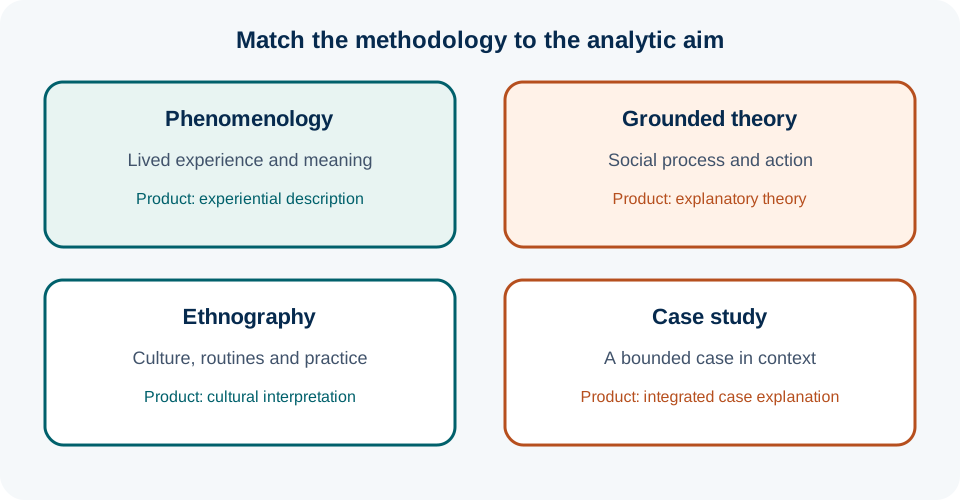
Phenomenology
Phenomenology
Core structure: Intensive exploration of lived experience and how a phenomenon is experienced and understood by people who have encountered it.
Best suited for: Questions about what an experience is like, how it is perceived, embodied or made meaningful.
Important limitations: Requires philosophical and analytic coherence; it is not simply any study based on personal experiences.
Phenomenology has multiple traditions, including descriptive and interpretive forms. Across traditions, the researcher attends closely to experience rather than reducing it immediately to variables or causal categories.[1,5]
A suitable question is: What is the lived experience of transitioning from intensive gestational-diabetes care to postpartum self-management? Participants should have direct experience of the phenomenon. Data are often generated through in-depth interviews, but diaries, written accounts or other experiential materials may also contribute.
Phenomenological analysis seeks the structure or meaning of experience. A generic list of barriers is usually too superficial if the study claims phenomenology.
Grounded theory
Grounded theory
Core structure: Iterative data collection and analysis aimed at developing an explanatory theory or conceptual model grounded in empirical data.
Best suited for: Social processes, actions, interactions and trajectories that are insufficiently explained by existing theory.
Important limitations: Requires iterative comparison and theoretical sampling; it should not be claimed merely because coding is inductive.
Grounded theory asks how a process works. Data collection and analysis proceed together. Early categories shape later sampling, questions and comparisons. Researchers use constant comparison and memoing to refine relationships among categories, with theoretical sampling used to seek data that develop or challenge the emerging explanation.[1,6]
A suitable question is: How do women move from pregnancy-focused diabetes management to longer-term prevention after birth? The product would be a conceptual explanation of stages, conditions, strategies and consequences rather than a catalogue of themes.
Ethnography
Ethnography
Core structure: Sustained study of social practices, meanings, interactions and culture within a group or setting, commonly using observation alongside interviews and artefacts.
Best suited for: Questions about what people actually do, how routines and norms are organised, and how culture shapes practice.
Important limitations: Requires meaningful engagement with the setting; brief interviews conducted at one site do not by themselves constitute ethnography.
Ethnography is particularly useful when formal descriptions of care differ from everyday practice. The researcher may observe clinic flow, staff handovers, counselling interactions, informal workarounds and the physical organisation of services, while interviewing staff and patients about how they interpret these practices.[2]
A suitable question is: How do routines and professional norms in maternity and primary-care services shape postpartum diabetes follow-up? The analytic focus is the culture and organisation of practice, not only individual opinion.
Case study
Case study
Core structure: In-depth investigation of a clearly bounded case in its real-world context using multiple relevant sources of evidence.
Best suited for: Complex programmes, organisations, events, teams or implementation processes in which context is inseparable from the phenomenon.
Important limitations: The case boundary and rationale must be explicit; studying one location is not automatically case-study methodology.
A case may be one integrated postpartum programme, one hospital network, one implementation episode or several purposefully compared cases. Case-study research often combines interviews, observations, documents, routine data and artefacts to build a contextualised account.[3]
A suitable question is: How and why did an integrated postpartum follow-up programme achieve high retention during its first year? The programme is the bounded case. The study may examine governance, workflow, staff roles, patient experiences and local context.
Comparing the four approaches
Choosing among four qualitative methodologies
illustrativeTable 1. Methodological fit
| Approach | Central focus | Typical question | Sampling emphasis | Common data sources | Intended product |
|---|---|---|---|---|---|
| Phenomenology | Lived experience | What is this experience like? | People with direct experience | In-depth interviews, experiential texts | Interpretation of experiential meaning |
| Grounded theory | Social process | How does this process unfold? | Iterative and theoretical | Interviews, observation, documents | Explanatory theory or model |
| Ethnography | Culture and practice | How is practice organised in context? | People, places, activities and events | Observation, interviews, artefacts | Cultural or practice account |
| Case study | Bounded complex case | How and why does this case function? | Evidence relevant to the case | Multiple sources | Contextualised case explanation |
Research question and methodological fit
The same topic can support different questions. Methodology should follow the intended knowledge product, not the researcher’s preferred software or data-collection method.
Choose the qualitative methodology
- Choose phenomenology when lived experience is the central phenomenon.
- Choose grounded theory when the aim is to build an explanatory theory of a process or interaction.
- Choose ethnography when culture, routines, norms and situated practice are central.
- Choose case study when the object of inquiry is a bounded real-world case requiring multiple sources.
- Use a generic qualitative design only when a named methodology would add false precision; if so, describe the qualitative orientation and analytic method transparently.
Not every qualitative project needs one of these labels. A focused applied study may reasonably describe itself as a qualitative descriptive or interpretive interview study if that accurately represents its aims and procedures. False specificity is worse than transparent modesty.
Sampling implications
Sampling should follow methodology. Phenomenology commonly seeks participants with rich direct experience. Grounded theory uses theoretical sampling as the analysis develops. Ethnography samples settings, times, events and social actors as well as interview participants. Case study samples evidence within the defined case and, in multiple-case designs, may also justify why particular cases are compared.[3,4,6]
The Part 6 qualitative sampling lecture provides the broader concepts of purposive sampling, information power and saturation. Here, the crucial point is that sample adequacy is methodology-specific.
Data generation and analysis
Methodology-specific decisions to document
- The central phenomenon or case.
- The reason the selected methodology fits the research question.
- The unit or boundary of inquiry.
- Sampling logic and how it may evolve.
- Main data sources and researcher involvement.
- Analytic procedures specific to the methodology.
- Reflexivity and positionality.
- The form of final interpretive or theoretical product.
Interviews are common across approaches, but they are used differently. A phenomenological interviewer may probe the texture and meaning of an experience. A grounded-theory interviewer increasingly pursues emerging categories. An ethnographer interprets interviews alongside observed practice. A case-study researcher triangulates interviews with documents, events and other case evidence.[1-3]
Quality and methodological integrity
Appraising a named qualitative methodology
- Does the research question fit the stated methodology?
- Are sampling and data generation consistent with that methodology?
- Does the analysis use the defining logic of the approach rather than generic coding alone?
- Is the role of the researcher described?
- Does the final product match what the methodology is designed to produce?
- Are deviations from the planned approach explained transparently?
A paper can be high quality without rigidly following one textbook, because qualitative methodologies contain variants. The critical issue is whether the authors identify their version and maintain internal coherence.
Ethical and governance considerations
Ethnographic observation requires particular attention to who is present, who has consented, whether the setting is genuinely public, and how field notes record identifiable information. Case-study reports may require careful masking because rich contextual detail can reveal the institution even without naming it.
Interface with analysis and mixed methods
Qualitative analysis should remain consistent with methodology. Statistical tests are not the core analysis, although descriptive quantitative information may contextualise participants or cases. If the broader project includes quantitative outcomes, Part 12 addresses how qualitative and quantitative strands can be integrated without collapsing one into the other.
Methodological pluralism and hybrid designsMMed extension
Experienced researchers sometimes combine methodological traditions, but hybridisation should be purposeful. For example, an ethnographically informed case study can use prolonged observation within one bounded implementation programme. The report should explain which methodological logic is primary and how additional traditions contribute. Combining labels without explaining their relationship creates ambiguity rather than sophistication.
Worked example
Selecting a design for postpartum follow-up research
The team considers four aims:
- Experience: “What is it like to move from intensive diabetes care in pregnancy to self-directed prevention after birth?” → phenomenology.
- Process: “How do women navigate decisions and service transitions over the first year postpartum?” → grounded theory if the aim is to develop a process model.
- Practice culture: “How do clinic routines, professional roles and informal work shape postpartum follow-up?” → ethnography.
- Programme explanation: “How did one integrated maternity–primary-care programme achieve sustained follow-up?” → case study of the programme using interviews, observation, documents and routine service data.
The researchers choose the fourth because the practical object of interest is the integrated programme as a bounded system. They define its organisational boundary, first-year implementation period and participating clinics. Their Methods section does not call the work ethnography merely because observations are included; observation is one data source within the case study.
Suggested protocol or reporting wording
Distinguishing the unit and product of inquiry
The four methodologies can also be distinguished by what ultimately becomes the analytic product. Phenomenology seeks an account of the structure or meaning of lived experience; grounded theory seeks an explanatory theory or process grounded in data; ethnography seeks an interpretation of cultural or organisational practices in context; and case study develops an intensive, bounded understanding of a case using multiple forms of evidence.[1-3,5,6]
This distinction matters when choosing data sources. A phenomenological project dominated by administrative documents but containing little access to lived experience may not fit its stated methodology. An ethnography based only on one-off interviews without meaningful engagement with practice or setting may be ethnographic in topic but not in design. A grounded theory that collects all interviews before any analysis cannot use theoretical sampling in the usual sense because emerging categories never influence further data collection.[6]
Boundaries are methodological decisions
Case study especially requires an explicit boundary: what is the case, where does it begin and end, and what makes it one case rather than a broad topic?[3] A “case” might be one hospital’s postpartum follow-up programme during a defined implementation period, not postpartum diabetes care throughout Malaysia. Clear boundaries make purposeful data-source selection possible and prevent the project from expanding without limit.
Avoid methodology by labelMMed extension
Advanced qualitative work should be judged by methodological enactment, not the presence of a prestigious label. If the question is adequately answered by a qualitative descriptive approach, calling it phenomenology or grounded theory without following the relevant logic makes the design weaker, not stronger. Select the methodology because its assumptions and analytic product fit the research purpose.
Reporting the methodology accurately
In the final report, name the methodology only when its defining logic is visible in sampling, data generation and analysis. Where a study borrows selected techniques without adopting the full methodology, describe those techniques directly. Accurate naming allows readers to appraise the study against appropriate expectations.
Common mistakes
Knowledge check
A study wants to understand the lived experience of receiving a new cancer diagnosis. Which of the four methodologies is most directly aligned?
Answer and reasoning
Phenomenology is most directly aligned because the primary phenomenon is lived experience and meaning. Interviews may be used, but the methodological choice is based on the intended experiential understanding rather than the interview method itself.
A research team codes interviews inductively and develops themes. Can it automatically call the study grounded theory?
Answer and reasoning
No. Grounded theory requires a process of theory development, constant comparison and typically theoretical sampling as categories evolve. Inductive coding alone is insufficient.
Why might observation be essential in ethnography?
Answer and reasoning
Ethnography seeks to understand culture and practice in context. What people say about routines may differ from what occurs in everyday interactions, so observation provides access to situated practice and social organisation.
What must be defined before calling a project a case study?
Answer and reasoning
The case and its boundaries—such as programme, organisation, event, period or network—must be explicit. The study then gathers evidence needed to understand that bounded case in context.
Key take-home messages
Key take-home messages
- Phenomenology, grounded theory, ethnography and case study answer different forms of qualitative question.
- Data-collection methods such as interviews do not determine methodology by themselves.
- Sampling, analysis and final knowledge product should reflect the chosen methodological logic.
- Use named methodologies accurately; a transparent generic qualitative design is preferable to false labelling.
- Appraise methodological coherence across question, sampling, data sources, analysis, reflexivity and claims.
References
- Starks H, Trinidad SB. Choose your method: a comparison of phenomenology, discourse analysis, and grounded theory. Qual Health Res. 2007;17(10):1372-1380. https://doi.org/10.1177/1049732307307031
- Reeves S, Kuper A, Hodges BD. Qualitative research methodologies: ethnography. BMJ. 2008;337:a1020. https://doi.org/10.1136/bmj.a1020
- Crowe S, Cresswell K, Robertson A, Huby G, Avery A, Sheikh A. The case study approach. BMC Med Res Methodol. 2011;11:100. https://doi.org/10.1186/1471-2288-11-100
- Malterud K, Siersma VD, Guassora AD. Sample size in qualitative interview studies: guided by information power. Qual Health Res. 2016;26(13):1753-1760. https://doi.org/10.1177/1049732315617444
- Neubauer BE, Witkop CT, Varpio L. How phenomenology can help us learn from the experiences of others. Perspect Med Educ. 2019;8(2):90-97. https://doi.org/10.1007/s40037-019-0509-2
- Sbaraini A, Carter SM, Evans RW, Blinkhorn A. How to do a grounded theory study: a worked example of a study of dental practices. BMC Med Res Methodol. 2011;11:128. https://doi.org/10.1186/1471-2288-11-128
These materials support learning and research planning. They require adaptation to the study context and do not replace methodological, statistical, ethical, or regulatory consultation.