
Part 12 · Module 1
Rationale and Foundations of Mixed-Methods Research
Explain why and how qualitative and quantitative approaches are integrated to answer complex health-research questions within one coherent design.
Learning outcomes
After completing this lecture, you should be able to:
- Define mixed-methods research and distinguish it from parallel multimethod work.
- Explain substantive rationales for combining qualitative and quantitative evidence.
- Compare convergent, explanatory sequential, exploratory sequential, embedded and multiphase design logics.
- Identify timing, priority, sample relationships and points of interface in a mixed-methods protocol.
- Formulate an integration question and describe how meta-inferences are developed.
Overview
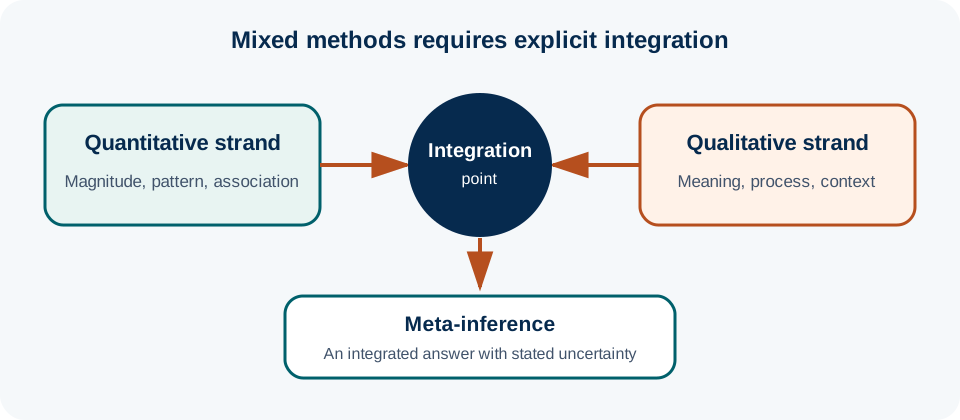
Mixed-methods research intentionally combines quantitative and qualitative approaches within one programme of inquiry and, crucially, integrates them so that the combined study answers a question that neither strand could answer as well on its own.[1,2] Merely collecting a questionnaire and several interviews does not make a study mixed methods. The researcher must state why both forms of evidence are needed, how the strands relate in time and priority, where they interact, and what is learned from bringing them together.[2,3]
In health sciences, this approach is useful when a problem contains both measurable patterns and context-dependent mechanisms. A service may know how many patients fail to attend follow-up but not why; an intervention may improve an average outcome while clinicians still need to understand who found it unacceptable; an instrument may require qualitative work before meaningful quantitative validation. Mixed methods provides a design framework for such questions rather than a licence to collect every available form of data.
Why this matters
Health research problems are often multilevel. Clinical outcomes arise from biology, behaviour, communication, service organisation and social context. Quantitative methods are powerful for estimating distributions, associations and effects, whereas qualitative methods can examine meaning, process, experience and context. Mixed methods is valuable when these forms of knowledge must interact.[1]
Poorly designed mixed-methods studies, however, can consume twice the resources while producing little added value. Common failures include parallel studies that never meet, a qualitative component added after disappointing quantitative results without prior logic, or a quantitative survey built from qualitative findings without showing how concepts became items. Integration must therefore be planned as a methodological operation, not left to a final discussion paragraph.[2,4]
Key concepts
Mixed methods is more than multiple methods
A multimethod study may use several methods within one broad tradition, such as a survey plus routinely collected quantitative records, or interviews plus observation. A mixed-methods study intentionally combines qualitative and quantitative approaches and includes an integration strategy.[2,5]
The distinction matters because mixed methods creates an additional layer of design decisions. Researchers must judge the quality of each strand and the quality of the relationship between them.
Rationale for mixing methods
Greene and colleagues described several purposes for combining methods in evaluation research, including triangulation, complementarity, development, initiation and expansion.[6] These purposes remain useful for health research when translated carefully.
- Triangulation seeks convergence or corroboration across approaches, while recognising that disagreement may be informative rather than an error to hide.
- Complementarity uses one form of evidence to elaborate or clarify another.
- Development uses findings from one strand to shape the next, such as using interviews to build a questionnaire.
- Initiation deliberately examines contradictions or new perspectives that challenge the initial interpretation.
- Expansion extends the breadth or range of inquiry, for example combining an effectiveness estimate with a process evaluation.
A protocol should state the substantive reason for mixing methods rather than merely saying that a “more comprehensive understanding” is desired.
Timing
The strands may occur concurrently or sequentially. Timing should follow the research logic.
- In a concurrent design, both strands may be collected during the same study period and integrated after separate analyses.
- In a sequential design, one strand informs the next. The first phase is therefore not finished until its findings have been translated into a deliberate decision about sampling, data collection or analysis in the second phase.
Priority
Some studies give roughly equal emphasis to the quantitative and qualitative strands. Others have a dominant strand with a secondary embedded component. Priority should reflect the principal research question and be visible in resources, sample planning, team expertise and reporting.
Points of interface
Fetters and colleagues describe integration at design, methods, and interpretation/reporting levels.[2] At the methods level, common mechanisms are:
- connecting: results or participants from one strand determine sampling for another;
- building: findings from one strand shape the data-collection instrument or procedures of the next;
- merging: datasets or findings are brought together for comparison or synthesis; and
- embedding: one strand is nested within a larger design such as a trial.[2]
A joint display can place quantitative and qualitative findings in the same table, matrix or figure so that relationships, contradictions and new inferences become visible.[7]
Meta-inference
A meta-inference is an interpretation generated from the integrated evidence, not merely a summary of two separate results. For example, finding that younger mothers have lower testing completion is a quantitative result. Finding that younger mothers describe fragmented discharge communication is a qualitative result. A mixed-methods meta-inference might propose that lower completion among younger mothers is partly linked to how risk communication and competing responsibilities interact in that subgroup, while clearly distinguishing this integrated interpretation from a proven causal mechanism.
When to use this approach
When mixed methods adds genuine value
Consider mixed methods when:
- one research question requires both an estimate or comparison and an explanation of meaning, context or process;
- results from one method are needed to design the next phase;
- an intervention or programme requires simultaneous outcome and implementation understanding;
- findings from different evidence sources need purposeful comparison, including examination of disagreement; or
- the intended conclusion explicitly depends on integrating qualitative and quantitative evidence.
Do not select mixed methods merely because both types of data are available, because a funding call values innovation, or because the researcher is uncertain which method to choose.
Research question and methodological fit
A strong mixed-methods study commonly has three linked layers of questions:
- quantitative question — what is the magnitude, distribution, association or effect?
- qualitative question — how is the phenomenon experienced, interpreted or produced in context?
- integration question — how do the findings relate, and what additional explanation or decision follows from their integration?
For the postpartum example:
- Quantitative: What proportion of women complete postpartum glucose testing, and which measured factors are associated with completion?
- Qualitative: How do women and clinicians explain decisions, barriers and service processes surrounding postpartum testing?
- Integration: How do the qualitative explanations help account for quantitative patterns of completion and identify modifiable service mechanisms?
The third question prevents the study from becoming two parallel projects.
Design families
Core mixed-methods design families
Convergent design: Collect and analyse qualitative and quantitative data during a similar period, then merge findings to examine convergence, complementarity or divergence.
Explanatory sequential design: Begin with quantitative data and use a subsequent qualitative phase to explain selected findings, patterns, outliers or mechanisms.
Exploratory sequential design: Begin with qualitative exploration and use those findings to build a later quantitative phase, such as an instrument, taxonomy, intervention component or hypothesis.
Embedded design: Place a secondary qualitative or quantitative strand within a larger design, often a clinical trial or programme evaluation.
Multiphase design: Coordinate several linked qualitative, quantitative and mixed phases across a longer programme of research.
The three core designs—convergent, explanatory sequential and exploratory sequential—are widely used in health research, while embedded and multistage frameworks extend the architecture for complex programmes.[2,3]
Sampling and recruitment
Mixed-methods sampling cannot be planned by choosing two sample sizes independently and stopping there. Researchers should specify the relationship between samples. The same participants may contribute to both strands, one sample may be nested within another, the strands may use parallel samples from the same source population, or they may intentionally represent different levels such as patients and clinics.[8]
For the postpartum example, an explanatory sequential design might analyse all eligible records first and then purposively select interview participants from quantitatively defined profiles: women who completed testing despite major access barriers, women who did not complete despite apparently good access, and women representing common patterns. The sampling rule itself becomes a point of integration.
Data collection and analysis
Each strand still requires method-specific rigour. The quantitative component must have an appropriate design, measurement plan and statistical analysis. The qualitative component needs a coherent qualitative methodology, sampling rationale, data-collection process and analytic approach. Mixed methods does not compensate for weak component methods.[1,4]
The analysis plan should state:
- which strand is analysed first;
- which results trigger the next phase, if sequential;
- what information is carried across the interface;
- how findings will be brought together; and
- how integrated conclusions will be developed and checked against the component findings.
A useful planning device is an integration matrix containing the research objective, quantitative evidence, qualitative evidence, integration mechanism and intended meta-inference.
Bias, validity and quality assurance
Mixed-methods quality has at least three layers:
- quality of the quantitative strand;
- quality of the qualitative strand; and
- quality of integration and the resulting interpretation.[4]
Threats can arise specifically at the interface. For example, an explanatory study may select only statistically significant quantitative findings for interviews and therefore overlook clinically important null or contradictory patterns. A convergent study may claim agreement because both strands use similarly biased recruitment. An exploratory study may lose important qualitative concepts when turning them into closed questionnaire items.
Mixed-methods design decisions to specify before data collection
- State the substantive rationale for mixing methods.
- Name the mixed-methods design and show the sequence or concurrency.
- Identify priority of strands where relevant.
- Define the sample relationship.
- State each point of interface.
- Prespecify how findings will be integrated.
- Identify expertise required for quantitative, qualitative and integration work.
- State how discrepant findings will be examined rather than automatically reconciled.
- Plan resources and time for the interphase between strands.
Ethics and governance
Mixed-methods studies may create linkage risks that are less obvious when each dataset is considered separately. A participant who is anonymous in a survey may become identifiable when their unusual quantitative profile is linked to an interview quotation. Sequential studies may also involve recontacting participants based on sensitive characteristics revealed in phase one.
Worked example
Choosing a design for postpartum follow-up research
A team proposes three options.
Option A: administer a survey and conduct interviews at the same time, then report them in separate chapters.
Option B: analyse routine records first, identify patterns of completion and non-completion, purposively select women from informative profiles, conduct interviews, and integrate explanations with the quantitative patterns in a joint display.
Option C: conduct interviews only because barriers are poorly understood.
The research objective is to estimate completion patterns and explain why those patterns occur. Option B is the strongest fit because the quantitative findings determine what requires explanation and help guide purposive selection for the qualitative phase. This is an explanatory sequential logic. Option A could become a convergent mixed-methods design only if a clear merging strategy were added. Option C could answer an important qualitative question but could not estimate the population pattern.
The choice is therefore driven by the inferential need, not by a preference for methodological complexity.
Statistical interface
Mixed-methods design does not prescribe one statistical test. Statistical methods follow the quantitative question and data structure. The important interface is that quantitative results may determine whom to sample, what to ask next, or which findings require integrated interpretation. Effect estimates and uncertainty should remain visible when they are transferred into qualitative follow-up; reducing quantitative findings to “significant” versus “not significant” can distort the second phase.
Suggested reporting
Common mistakes
Knowledge check
A study conducts a survey and interviews, but the two datasets are analysed and reported independently. Is it necessarily a mixed-methods study?
Answer and reasoning
No. Use of qualitative and quantitative methods is necessary but not sufficient. The study should have a rationale for mixing and a planned point of integration. Without interaction between the strands or an integrated inference, it may be better described as a multimethod project with separate components.
Which design is most appropriate when quantitative results identify an unexpected subgroup pattern that researchers want to understand in depth?
Answer and reasoning
An explanatory sequential design is often appropriate because the quantitative phase identifies the pattern and the qualitative phase is deliberately designed to explain it. The protocol should state how the first-phase result will guide sampling and interview questions.
Why is a joint display more than a presentation device?
Answer and reasoning
A well-designed joint display places related quantitative and qualitative findings together so the research team can compare convergence, complementarity and contradiction and develop an integrated interpretation. It can therefore support analysis as well as communication.[7]
What additional quality question arises in mixed methods beyond the quality of each component?
Answer and reasoning
Researchers must assess whether the strands were integrated appropriately and whether the meta-inferences are supported by the combined evidence. Two individually rigorous components do not guarantee a rigorous mixed-methods conclusion.[4]
Key take-home messages
Key take-home messages
- Mixed methods is defined by intentional integration of qualitative and quantitative approaches, not by data variety alone.
- Begin with a research problem that genuinely requires both forms of evidence.
- State the rationale, design, timing, priority, sample relationship and points of interface prospectively.
- Protect the methodological quality of each strand as well as the integrity of integration.
- Use integrated findings to generate explicit meta-inferences while preserving uncertainty and contradiction.
- Choose the simplest design capable of answering the research question; complexity is not a marker of quality.
References
- Creswell JW, Klassen AC, Plano Clark VL, Smith KC. Best practices for mixed methods research in the health sciences. Bethesda (MD): National Institutes of Health, Office of Behavioral and Social Sciences Research; 2011, revised 2018. https://obssr.od.nih.gov/sites/g/files/mnhszr296/files/Best_Practices_for_Mixed_Methods_Research.pdf
- Fetters MD, Curry LA, Creswell JW. Achieving integration in mixed methods designs—principles and practices. Health Serv Res. 2013;48(6 Pt 2):2134–2156. https://doi.org/10.1111/1475-6773.12117
- Schoonenboom J, Johnson RB. How to construct a mixed methods research design. Köln Z Soziol. 2017;69(Suppl 2):107–131. https://doi.org/10.1007/s11577-017-0454-1
- O’Cathain A, Murphy E, Nicholl J. The quality of mixed methods studies in health services research. J Health Serv Res Policy. 2008;13(2):92–98. https://doi.org/10.1258/jhsrp.2007.007074
- Johnson RB, Onwuegbuzie AJ, Turner LA. Toward a definition of mixed methods research. J Mix Methods Res. 2007;1(2):112–133. https://doi.org/10.1177/1558689806298224
- Greene JC, Caracelli VJ, Graham WF. Toward a conceptual framework for mixed-method evaluation designs. Educ Eval Policy Anal. 1989;11(3):255–274. https://doi.org/10.3102/01623737011003255
- Guetterman TC, Fetters MD, Creswell JW. Integrating quantitative and qualitative results in health science mixed methods research through joint displays. Ann Fam Med. 2015;13(6):554–561. https://doi.org/10.1370/afm.1865
- Teddlie C, Yu F. Mixed methods sampling: a typology with examples. J Mix Methods Res. 2007;1(1):77–100. https://doi.org/10.1177/1558689806292430
These materials support learning and research planning. They require adaptation to the study context and do not replace methodological, statistical, ethical, or regulatory consultation.