
Part 8 · Module 4
Nested Case-Control and Case-Cohort Designs
Use nested case-control or case-cohort sampling to analyse expensive cohort measurements efficiently while preserving the cohort’s risk-set logic.
Learning outcomes
After completing this lecture, you should be able to:
- Explain how nested case-control and case-cohort studies sample participants from an established cohort.
- Distinguish risk-set controls from a baseline subcohort and state the principal estimand of each design.
- Select a design according to assay cost, outcome structure and reuse of a comparison group.
- Specify specimen timing, sampling probabilities, data structure and analysis requirements.
- Recognise biases caused by incorrect control eligibility, depleted specimens and analysis that ignores two-phase sampling.
Overview
An established cohort may contain thousands of participants and years of follow-up, but an exposure measurement may be costly: genomic sequencing, biomarker assays, image re-reading or detailed record abstraction. Measuring the exposure for everyone can be unnecessary. Nested case-control and case-cohort designs retain the cohort’s temporal structure while collecting expensive information from all cases and a sample of non-cases.[1–4]
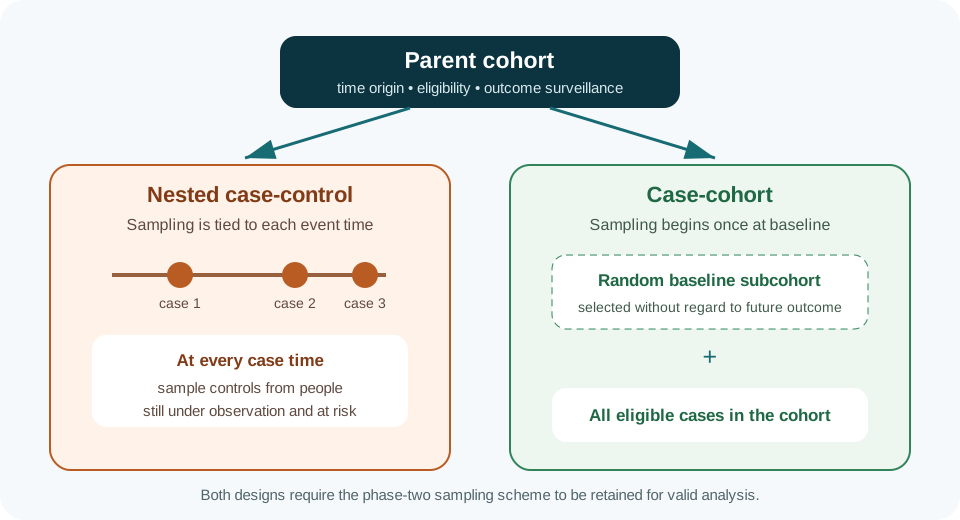
In a nested case-control study, controls are sampled from participants at risk when each case occurs. In a case-cohort study, a subcohort is sampled from the cohort—usually at baseline—independently of later outcome, and cases outside that subcohort are added. Both are two-phase designs: inexpensive information exists for the full cohort, while detailed exposure data are obtained for a subsample.
The designs resemble ordinary case-control studies in data volume, but their sampling probabilities and time-at-risk structure must be preserved in analysis.
Why this matters
Efficient sampling can transform an unaffordable biomarker project into a feasible study and conserve irreplaceable specimens. However, common errors include:
- selecting “controls” who were no longer at risk when a case occurred;
- excluding a participant from control sampling because that person later became a case;
- treating the subcohort as a conventional disease-free control group;
- failing to account for stratified or unequal sampling probabilities;
- ignoring repeated control selection or membership in both subcohort and case groups;
- assaying case and control specimens in different batches; and
- analysing sampled observations as though they were a simple random cohort.
Key concepts
Nested case-control sampling
When a case occurs, one or more controls are sampled from cohort members who are still under observation and at risk immediately before that event time. Controls are matched or stratified on time and possibly age, site or other design variables. A participant can be selected as a control, remain at risk and later become a case. The same person may be sampled for more than one risk set if sampling is with replacement.[1,2]
Because controls represent person-time at risk, conditional logistic regression using the risk sets estimates a hazard or incidence-rate ratio under the design assumptions.
Case-cohort sampling
A subcohort is sampled from the full cohort without regard to future outcome. All eligible cases from the full cohort are then included, whether or not they belong to the subcohort. Subcohort members contribute comparison person-time and may themselves become cases.[3,4]
One subcohort can be reused to study several outcomes, which is valuable when assays or covariates support a research programme. Analysis uses weighted risk-set methods and robust variance because the same sampled subcohort represents the full cohort.
Two-phase data structure
Phase 1 includes the complete cohort and variables available for everyone, such as age, site and outcome. Phase 2 includes detailed exposures measured only in cases and sampled comparison participants. The phase-2 sampling probability should be stored, especially when sampling is stratified by phase-1 variables.
Choosing between the designs
Nested case-control or case-cohort?
Choose a nested case-control design when:
- the primary focus is one outcome;
- risk-set matching on age, calendar time or specimen storage duration is important;
- assays can be organised around each event set; and
- efficient control of time-related factors is valuable.
Choose a case-cohort design when:
- one comparison sample should support several outcomes;
- baseline exposure measurement is central;
- a reusable biobank resource is planned;
- stratified subcohort sampling can enrich important groups; and
- the analysis team can implement weighted survival methods.
Neither design is automatically superior. Efficiency depends on exposure prevalence, event timing, matching, number of outcomes, specimen logistics and available phase-1 information.
Research question and methodological fit
The question is:
Among women in the postpartum cohort, is baseline inflammatory-biomarker concentration associated with subsequent myocardial infarction?
The exposure precedes outcome and specimens are stored for the cohort. The full outcome history and follow-up times are available. The design objective is not to redefine the population but to reduce the number of assays while estimating the association that would have been studied in the full cohort.
For a single event outcome and strong concern about age and storage-time differences, nested case-control sampling is attractive. If the same biomarker panel will later be studied for stroke, diabetes and mortality, a case-cohort design may offer more reuse.
Design, setting and study population
Nested case-control design
Core structure: Every incident case is included, and controls are sampled from the parent cohort members at risk at that case time.
Best suited for: One or a few outcomes, time-matched specimen studies and efficient estimation of relative rates.
Important limitations: Controls are outcome-specific; repeated risk-set sampling and matching must be retained.
Case-cohort design
Core structure: A baseline subcohort is sampled independently of outcome, and all cases in the full cohort are added.
Best suited for: Multiple outcomes, reusable biomarker resources and research programmes built on one cohort.
Important limitations: Weighted survival analysis and robust variance are required; members can have overlapping roles.
The parent cohort must itself be well defined. If loss to follow-up or outcome misclassification threatens the full cohort, efficient phase-2 sampling cannot repair those deficiencies.
Sampling and recruitment
Nested case-control sampling steps
- Define the cohort time origin, event and censoring rules.
- Identify each incident case at its event time.
- Construct the risk set of people still under observation and event free immediately before that time.
- Apply matching or stratification rules.
- Randomly sample the specified number of controls.
- Retain risk-set identifiers, repeated selections and later case status.
Case-cohort sampling steps
- Define the eligible baseline cohort.
- Sample the subcohort using known probabilities, possibly within strata.
- Retain all sampled members regardless of later events.
- Add every eligible case from the full cohort.
- Store whether each observation is in the subcohort, is a case, or both.
- Preserve sampling weights and stratum identifiers.
Sampling details to preserve
- Parent-cohort eligibility and follow-up dates.
- Event definitions and adjudication.
- Phase-1 variables available for everyone.
- Risk-set or subcohort sampling algorithm.
- Sampling fraction within every stratum.
- Matching factors and risk-set identifier where applicable.
- Specimen availability, quantity and exclusion reasons.
- Participant identifiers that allow later events and repeated selection to be recognised.
Stratified subcohort sampling
A simple random subcohort may contain few participants from small but scientifically important groups. Stratified sampling can oversample these groups. The analysis must then use inverse sampling fractions or equivalent design weights. The phase-1 distribution permits estimates to be reweighted to the cohort.
Specimen depletion and availability
Availability is part of selection. If specimens are missing because of clinical severity, site or exposure-related handling, restricting analysis to available samples can introduce bias. Inventory checks, minimum-volume rules and reasons for missingness should be determined before sampling.
Variables, constructs and measurements
Case-cohort analytical roles
illustrativeTable 1. Possible roles in a case-cohort dataset
| participant | subcohort | myocardial-infarction case | biomarker assayed | analytical role |
|---|---|---|---|---|
| A | Yes | No | Yes | Comparison person-time |
| B | Yes | Yes | Yes | Comparison person-time before event and case at event |
| C | No | Yes | Yes | Case added from full cohort |
| D | No | No | No | Phase-1 cohort member only |
Note: A subcohort member who becomes a case legitimately occupies both roles.
Biomarker values should be measured using blinded, randomised laboratory batches that mix cases and comparison samples. Batch, plate, freeze-thaw cycles, storage duration and quality-control results should be stored. Selecting controls with identical specimen age can improve comparability, but matching decisions must be reflected in analysis.
Procedures and data collection
A reproducible workflow links the parent-cohort database to the biobank inventory, freezes the eligible case list, generates sampled identifiers, prepares blinded aliquots and imports assay results without manual re-identification. The sampling seed or code should be archived.
Laboratory personnel should be blinded to case status where possible. Cases and controls should be distributed across batches, and duplicate quality-control samples should estimate laboratory variation. Assay failure should trigger predefined repeat rules rather than discretionary testing by outcome group.
Bias, validity and quality assurance
Other threats include:
- incorrect event times or risk-set eligibility;
- differential specimen availability;
- degradation related to storage time;
- outcome-dependent laboratory batches;
- sampling fractions omitted from the dataset;
- informative loss to follow-up in the parent cohort; and
- model analysis that ignores matching, weighting or repeated roles.
Appraising a sampled cohort design
- Is the parent cohort and its follow-up sufficiently valid?
- Were cases incident and identified consistently?
- For nested case-control sampling, were controls at risk at each event time?
- For case-cohort sampling, was the subcohort selected independently of future outcome?
- Are sampling probabilities, strata and overlapping roles retained?
- Were specimens processed comparably and blinded to outcome?
- Does the statistical method correspond to the sampling design?
Ethical and governance considerations
Interface with statistical analysis
Nested case-control studies with risk-set matching commonly use conditional logistic regression, with each event and its sampled controls forming a stratum. The coefficient estimates the relative hazard or rate associated with exposure under the sampling design.[1,2]
Case-cohort studies use weighted Cox-type methods, such as Prentice or related weighting schemes, with robust variance to account for subcohort sampling and overlapping roles.[3,4] A standard Cox model applied only to sampled participants without weights generally treats the subcohort as though it were the entire cohort and is not valid.
The statistical analysis plan should specify time scale, delayed entry, event ties, weighting method, variance estimator, stratified sampling and handling of assay missingness before outcomes are examined.
Efficiency and phase-1 covariatesMMed extension
Two-phase methods can gain efficiency by using variables measured for the full cohort. Stratified sampling may oversample participants with exposure proxies or high event risk, and calibrated or augmented estimators can use phase-1 information. These extensions require specialist planning; the simple sampled dataset alone is insufficient to reconstruct them after the study.[4,5]
Outcome-specific versus reusable sampling
A nested case-control sample is naturally tied to one event process because each control is selected from the risk set at that event time. It can sometimes support closely related outcomes, but the sampled controls are not automatically representative of risk sets for a different outcome. By contrast, a baseline case-cohort subcohort is selected independently of all later outcomes and is therefore reusable, provided the relevant outcome is validly ascertained in the full cohort.
This reuse has governance and laboratory implications. A subcohort should not be repeatedly depleted without an inventory plan, and each new outcome analysis requires confirmation that consent, specimen integrity and phase-1 variables remain adequate. A reusable resource is not permission for unlimited secondary analysis.
Assay failure and phase-two missingness
After sampling, exposure measurement may fail because a specimen is insufficient, an image cannot be read or a record is unavailable. This is different from not being selected for phase two. The dataset should distinguish sampling status, specimen availability, assay attempt and valid result. If assay failure relates to case status, site, storage duration or the true exposure, complete-assay analysis may be biased.
Preventive measures include inventory checks before sampling, randomised batch allocation, blinded repeat rules and reserve specimens. Analysis may use weighting or imputation when assumptions are defensible, but these methods require phase-1 predictors of failure and cannot recover information when failure mechanisms are unknown.
Handoff to the statistical analysis plan
The sampling code, design strata and probability of phase-two inclusion should be frozen before assay results are opened. The analysis plan should state whether a participant can be selected repeatedly, how ties are handled, which case-cohort weighting estimator is used, and how robust variance is calculated. These details are not software preferences; they define how the sampled observations represent the parent cohort.
A final design review should be performed jointly by the cohort investigator, laboratory lead, data manager and statistician. This review should verify that each sampled identifier is traceable to the parent cohort, event times are frozen, sampling probabilities are reproducible, and laboratory batches can be generated without revealing outcome. Resolving these details before specimen release prevents irreversible depletion and post-hoc changes to the sampling scheme.
Worked example
Choosing a case-cohort design for a biomarker programme
The investigators expect to study myocardial infarction, stroke and diabetes using the same biomarker panel. They select a 10% subcohort at baseline, stratified by site and age group, and include all incident cases for each outcome from the full cohort. Sampling probabilities are stored for every stratum.
Stored samples are checked before selection. Cases outside the subcohort and all subcohort members with adequate specimens are assayed in mixed, blinded laboratory batches. A woman sampled into the subcohort who later has myocardial infarction contributes comparison time before her event and contributes as a case at the event.
The analysis uses a prespecified weighted Cox approach with robust standard errors. A conventional comparison of “cases versus subcohort non-cases” is rejected because it would discard time at risk, mishandle subcohort cases and ignore the sampling design.
Suggested protocol or reporting wording
Common mistakes
Knowledge check
What defines a nested case-control control?
Answer and reasoning
The control is a member of the parent cohort who is still under observation and at risk immediately before the corresponding case event time. Later outcome status does not invalidate that earlier eligibility.
Why can one case-cohort subcohort support several outcomes?
Answer and reasoning
It is sampled from the baseline cohort independently of future outcome. The same representative comparison sample can contribute person-time to separate analyses, with all cases for each outcome added from the full cohort.
A subcohort member later becomes a case. Should the person be removed from the subcohort?
Answer and reasoning
No. The person contributes comparison person-time before the event and case information at the event. This overlapping role is expected and handled by case-cohort methods.
Why must stratified subcohort sampling fractions be stored?
Answer and reasoning
Participants from different strata have different probabilities of entering phase 2. Weights based on those probabilities are needed to represent the full cohort and obtain valid estimates and variance.
Which design is generally more attractive for a programme studying many outcomes with one biomarker panel?
Answer and reasoning
A case-cohort design is often attractive because one subcohort can be reused. The choice still depends on specimen logistics, matching needs, efficiency and availability of specialist analysis.
Key take-home messages
Key take-home messages
- Nested case-control and case-cohort studies are efficient samples within a defined cohort.
- Nested controls are sampled from risk sets at each event time.
- A case-cohort subcohort is sampled independently of future outcome and can be reused.
- People may be controls before later becoming cases, and subcohort members can occupy both roles.
- Sampling probabilities, time scales, specimen handling and design identifiers must be preserved.
- Conditional or weighted survival methods are required; ordinary analysis of the sampled participants is inadequate.
Reporting should identify the parent cohort, sampling algorithm, specimen flow, phase-2 numbers and design-specific analysis clearly.[6]
References
- Ernster VL. Nested case-control studies. Prev Med. 1994;23(5):587–590. https://doi.org/10.1006/pmed.1994.1093
- Langholz B, Thomas DC. Nested case-control and case-cohort methods of sampling from a cohort: a critical comparison. Am J Epidemiol. 1990;131(1):169–176. https://doi.org/10.1093/oxfordjournals.aje.a115471
- Prentice RL. A case-cohort design for epidemiologic cohort studies and disease prevention trials. Biometrika. 1986;73(1):1–11. https://doi.org/10.1093/biomet/73.1.1
- O’Brien KM, Lawrence KG, Keil AP. The case for case-cohort: an applied epidemiologist’s guide to reframing case-cohort studies to improve usability and flexibility. Epidemiology. 2022;33(3):354–361. https://doi.org/10.1097/EDE.0000000000001469
- Rothman KJ, Greenland S, Lash TL. Modern epidemiology. 3rd ed. Philadelphia: Lippincott Williams & Wilkins; 2008.
- von Elm E, Altman DG, Egger M, Pocock SJ, Gøtzsche PC, Vandenbroucke JP; STROBE Initiative. The Strengthening the Reporting of Observational Studies in Epidemiology statement. PLoS Med. 2007;4(10):e296. https://doi.org/10.1371/journal.pmed.0040296
These materials support learning and research planning. They require adaptation to the study context and do not replace methodological, statistical, ethical, or regulatory consultation.