
Part 14 · Module 6
Missing Data and Attrition
Understand why missing data and attrition threaten validity, distinguish missingness assumptions, and plan prevention, analysis and sensitivity strategies before data collection.
Learning outcomes
After completing this lecture, you should be able to:
- Distinguish item missingness, missing outcomes, intermittent missingness and attrition.
- Explain MCAR, MAR and MNAR as assumptions about missingness rather than labels proven by a statistical test.
- Describe how missing data can reduce precision and introduce selection bias.
- Plan preventive follow-up and documentation strategies that minimise avoidable missingness.
- Align complete-case, likelihood, multiple-imputation, weighting and sensitivity approaches with the study estimand and missingness assumptions.
Overview
Missing data arise whenever a planned variable or outcome is not observed for some study units. The pattern may involve individual questionnaire items, laboratory values, entire visits, intermittent measurements or permanent loss to follow-up. Missingness reduces information and can bias estimates when the probability of being observed is related to variables that also determine the outcome.[1]
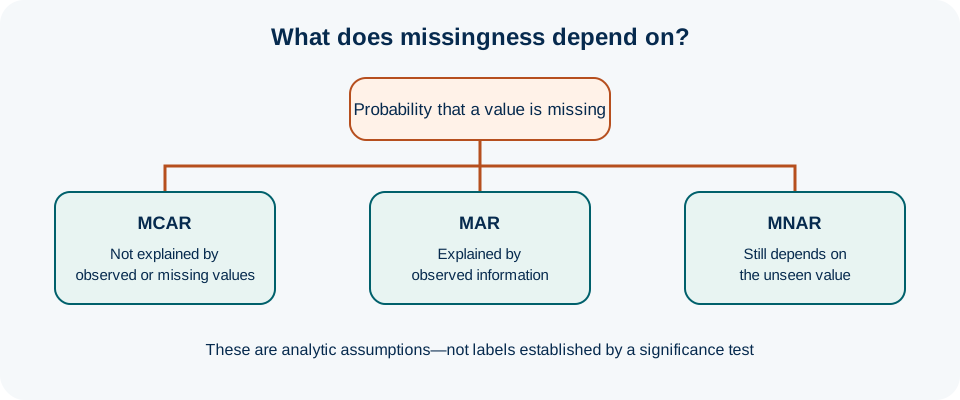
The familiar terms missing completely at random (MCAR), missing at random (MAR) and missing not at random (MNAR) describe assumptions about the relationship between missingness and the unseen data. They are not diagnoses established by a single test. In most substantive studies, the missing-data strategy combines prevention, documentation, a primary analysis under explicit assumptions and sensitivity analysis for departures from those assumptions.[1,2]
Why this matters
Missing data are often treated as a statistical problem discovered after data collection. By then, many opportunities for prevention have been lost. Retaining contact, collecting primary outcomes after intervention discontinuation when ethically and operationally appropriate, recording reasons for missingness, and maintaining alternative contact routes can be more valuable than sophisticated imputation later.
In clinical trials, missing outcomes must also be interpreted alongside the estimand and intercurrent events. ICH E9(R1) emphasises aligning the target treatment effect, handling of post-randomisation events and sensitivity analyses.[3]
Key concepts
Under MCAR, missingness does not depend on observed or unobserved values relevant to the analysis. Under MAR, after conditioning on observed information, missingness no longer depends on the missing value itself. Under MNAR, missingness still depends on unobserved values even after accounting for observed data.[1]
MAR is an assumption conditional on the variables included in the model; collecting good auxiliary variables can make it more plausible. MNAR does not mean that analysis is impossible. It means the primary analysis requires stronger assumptions and sensitivity analysis should examine plausible departures.
Describe the pattern before choosing the method
Report how much data are missing for each critical variable and time point, not only the percentage of participants with any missing value. In longitudinal studies, distinguish monotone dropout from intermittent missingness. Compare reasons by study group or exposure when appropriate. Visualise missingness patterns and examine whether missingness concentrates by site, period, staff member or participant characteristic.
These summaries do not prove MAR or MNAR, but they reveal operational problems and guide plausible models.
Attrition as a selection process
Loss to follow-up can create selection bias when remaining under observation depends on exposure, treatment, prognosis or outcome-related variables. Similar baseline characteristics between retained and lost participants do not prove absence of bias. Missingness may depend on unmeasured factors or on post-baseline events.
Trial participants who discontinue treatment should not automatically be removed from outcome follow-up. Treatment discontinuation and data collection are different processes unless consent is withdrawn or the protocol specifies otherwise.
Complete-case analysis
Complete-case analysis uses observations with all variables required for the model. It is easy to implement but can waste information and may be biased unless assumptions appropriate to the estimand and missingness mechanism hold. The often repeated claim that complete-case analysis is valid only under MCAR is too simplistic; validity depends on which variables are missing and the analysis model. Nevertheless, routine deletion without examining the mechanism is poor practice.
Likelihood-based approaches
Many mixed models and other likelihood-based analyses can use partially observed outcome trajectories under MAR-type assumptions conditional on variables in the model. They do not “handle any missing data automatically”. The plausibility of the missingness assumptions still depends on the observed information and model specification. Missing covariates often require additional handling.
Multiple imputation
Multiple imputation creates several completed datasets by drawing plausible values from an imputation model, analyses each dataset, and combines estimates to reflect both within- and between-imputation uncertainty. Chained equations are flexible for mixed variable types.[2] The imputation model should include variables in the analysis, predictors of missingness and useful predictors of the incomplete variable.
Imputation is not fabrication: it is model-based uncertainty propagation. But implausible models, incompatible transformations, ignoring clustering or imputing variables that should be derived can produce misleading results.
Weighting for incomplete observation
Inverse-probability weighting models the probability that an observation is available and reweights observed records. It can be useful when missingness is naturally conceptualised as selection. As with other weights, extreme values and positivity problems require attention. Weighting and imputation are not interchangeable simply because both address incomplete data.
MNAR and sensitivity analysis
Because MAR and MNAR cannot generally be distinguished from observed data alone, important analyses should assess departures from the primary assumption. Pattern-mixture models, selection models, delta adjustments and tipping-point analyses are examples. The sensitivity parameter should be interpretable: for example, how much worse the unobserved outcomes would need to be than predicted under MAR before the conclusion changes.[1,3]
Missing data in prediction models
Prediction research has additional concerns. Missing predictors may occur during model development and later at deployment. A method that works only because the development dataset has variables unavailable in practice can undermine clinical utility. The validation dataset should reproduce the intended real-world handling of missing predictors rather than receiving privileged information that will not exist in implementation.
Reporting requirements
Report the number analysed for each main result, amount and pattern of missing data, reasons when known, assumptions of the primary method, variables in the imputation or weighting model as appropriate, diagnostics and sensitivity analyses. STROBE requests explanation of how missing data were addressed, and CONSORT reporting similarly requires transparent accounting in trials.[4,5]
Plan missing-data handling in sequence
- Define the estimand and which observations are critical to it.
- Prevent avoidable missingness through follow-up design and source redundancy.
- Record reasons and predictors of missingness during study conduct.
- Describe the amount and pattern before analysis.
- Choose the primary method under an explicit missingness assumption.
- Use sensitivity analyses to examine plausible departures from that assumption.
Illustrative missing-data plan
illustrativeTable 1. Missing-data strategy by variable
| Variable | Likely missingness | Prevention | Primary handling | Sensitivity question |
|---|---|---|---|---|
| 12-week testing status | Lost contact / external care | Record linkage and alternate contacts | Model using observed outcome and auxiliary data | What if unobserved women are less likely to have tested than MAR predicts? |
| Access-burden score | Skipped questionnaire items | Short form and item review | Prespecified scale rule / imputation if justified | Does conclusion change under stricter scoring? |
| Income | Non-response | Prefer bands and confidentiality | Multiple imputation if used as covariate | Compare with analysis using alternative socioeconomic proxies |
The strategy is planned before viewing study results.
Questions for appraising missing data
- How much information is missing for each critical variable and time point?
- Why are data missing, and do reasons differ by exposure or treatment group?
- What assumptions does the primary analysis make about unobserved values?
- Were auxiliary variables that predict missingness and outcome used appropriately?
- Do sensitivity analyses examine plausible departures rather than arbitrary alternative methods?
Estimands, intercurrent events and missing dataMMed extension
An intercurrent event is not automatically missing data. Treatment discontinuation, rescue therapy or switching may occur while the outcome can still be measured. ICH E9(R1) requires the estimand to state how such events are handled conceptually. Missing data arise when an outcome relevant to that estimand is not observed. Confusing the two leads to inappropriate imputation or exclusion. A treatment-policy estimand, for example, may require continued outcome collection after discontinuation.[3]
Preventing missing data is part of study design
Missing-data methods are important, but prevention usually provides more reliable information than post hoc correction. A protocol should identify variables and time points whose absence would most threaten the primary objective, then design collection procedures around them. Examples include widening visit windows for a primary outcome, allowing home or telephone collection of selected measures, separating withdrawal from intervention from withdrawal of outcome follow-up, and recording outcomes after treatment discontinuation when ethically and operationally possible.[1,3]
Monitoring should distinguish several quantities: participants who discontinued the assigned intervention, participants who withdrew consent for further contact, participants who missed one visit but remained in follow-up, and observations that are technically unusable. Collapsing all of these into “dropout” hides different missingness mechanisms. Site dashboards should therefore track missingness by variable, visit, treatment or exposure group, site and reason, with escalation thresholds for critical outcomes.
Reasons for missingness should be captured prospectively using a concise controlled vocabulary plus free text when necessary. “Lost to follow-up” is an endpoint of a tracing process, not an explanation. Knowing whether a visit was missed because of recovery, deterioration, transport barriers, treatment dissatisfaction, migration or administrative failure can inform both prevention and sensitivity analyses.
Compatibility between imputation and the substantive analysis
Multiple imputation is not a generic data-filling step. The imputation model should preserve relationships that matter in the substantive analysis. Variables strongly associated with missingness or the incomplete variable can make the missing-at-random assumption more plausible and improve efficiency. The model should also reflect important transformations, interactions, nonlinear terms, clustering and longitudinal structure where these features are central to the analysis.[2]
An imputation model that ignores a treatment-by-time interaction while the primary model estimates that interaction can attenuate the very relationship of interest. Similarly, imputing repeated outcomes as unrelated cross-sectional variables can fail to preserve within-person trajectories. When the outcome model includes restricted cubic splines, multilevel effects or other complex terms, investigators should check that the imputation strategy is compatible enough to support those features.
This issue is sometimes called congeniality or compatibility between the imputation and analysis models. Perfect compatibility is not always achievable, but the protocol should show that imputation was planned around the substantive research question rather than performed mechanically after the final model was chosen.
Clustered and longitudinal missing data
In clustered studies, missingness can occur at more than one level. An individual participant may miss an assessment, but an entire clinic may stop recruiting, a laboratory may fail for a period, or a cluster may withdraw. Treating all missing observations as independent can understate this structure. Multilevel imputation or likelihood methods may be required when between-cluster variation is material.[2]
Longitudinal studies similarly distinguish intermittent missingness from monotone dropout. A participant may miss month 3 and return at month 6, whereas another leaves permanently after month 3. Repeated measures observed before and after an intermittent gap can provide useful information for model-based analysis. The missingness mechanism may also evolve over time, particularly when previous outcomes or adverse events influence subsequent attendance.
For trials, ICH E9(R1) further emphasises that missing data should not be discussed separately from intercurrent events and the estimand.[3] Treatment discontinuation, rescue medication or switching may change what outcome is scientifically relevant even when data can still be collected. Defining the estimand therefore precedes deciding which observations are “missing”.
Reporting sensitivity parameters and uncertainty
A sensitivity analysis is most useful when readers can understand what assumption was changed. Instead of reporting only that a “pattern-mixture model was performed”, investigators should state the departure imposed—for example, that unobserved outcomes were assumed to be a specified amount worse than predicted under the primary missing-at-random analysis. Results can then be shown across a clinically plausible range.[3]
The aim is not to find a secondary analysis that reproduces the preferred result. It is to identify the magnitude of departure from the primary assumptions required to alter the substantive conclusion. When plausible departures materially change the estimate, uncertainty due to missing data should become part of the conclusion rather than being hidden in a supplementary table.
Interface with statistical analysis
Detailed multiple-imputation, likelihood and weighting procedures are taught in the Biostatistics missing-data lecture. The methodological task is to align the method with the estimand, data structure and plausible missingness mechanism. Report sensitivity analyses as assumption checks rather than as a collection of competing p-values.
Worked example
Planning analysis for incomplete postpartum outcomes
The study enrols 800 women. Twelve-week testing status is observed for 690, while access-burden scores are complete for 740. Reasons for missing outcomes show that external care and unreachable telephone numbers are more common among women with high burden. Baseline clinic, distance, education and prior appointment attendance predict outcome availability.
The team does not use a single complete-case dataset for every analysis. For the primary outcome model, they use all participants with available information under the chosen analysis framework and include prespecified auxiliary predictors where appropriate. For missing covariates, a multiple-imputation model preserves variable types, interactions required by the substantive model and site structure.
The primary assumption is that, conditional on measured auxiliary information, outcome missingness is compatible with MAR. A sensitivity analysis applies progressively lower probabilities of testing to women whose outcome remains unobserved. The report identifies the tipping point at which the substantive conclusion changes.
This approach separates the observed data from the assumptions and allows readers to judge whether the conclusion is robust to plausible unobserved outcomes.
Suggested protocol or reporting wording
Common mistakes
Knowledge check
Can observed data prove that missingness is MAR rather than MNAR?
Answer and reasoning
Generally no. MAR and MNAR differ in dependence on unobserved values, so observed data alone cannot usually distinguish them. Clinical knowledge and sensitivity analysis are required.
Why can collecting auxiliary variables improve a multiple-imputation analysis?
Answer and reasoning
Variables that predict missingness or the incomplete outcome can make the MAR assumption more plausible and improve imputation efficiency, provided they are measured reliably and modelled appropriately.
Is treatment discontinuation itself missing data?
Answer and reasoning
No. It is an intercurrent event. Missing data occur if an outcome relevant to the estimand is not observed. Outcomes may still be collected after treatment discontinuation.
What is the purpose of a tipping-point analysis?
Answer and reasoning
It identifies how far assumptions about unobserved outcomes would need to depart from the primary model before the substantive conclusion changes, making robustness easier to interpret.
Key take-home messages
Key take-home messages
- Missing-data prevention and reason documentation are design responsibilities, not only statistical tasks.
- MCAR, MAR and MNAR are assumptions about the missingness mechanism, not labels established by one test.
- Attrition can create selection bias when outcome observation depends on exposure, treatment or prognosis.
- Complete-case, likelihood, imputation and weighting methods rely on different assumptions and should be matched to the estimand.
- Sensitivity analysis is essential when important conclusions depend on untestable missingness assumptions.
References
- National Research Council. The prevention and treatment of missing data in clinical trials. Washington, DC: National Academies Press; 2010. https://doi.org/10.17226/12955
- White IR, Royston P, Wood AM. Multiple imputation using chained equations: issues and guidance for practice. Stat Med. 2011;30(4):377-399. https://doi.org/10.1002/sim.4067
- International Council for Harmonisation of Technical Requirements for Pharmaceuticals for Human Use. ICH E9(R1): Addendum on estimands and sensitivity analysis in clinical trials. Geneva: ICH; 2019. https://database.ich.org/sites/default/files/E9-R1_Step4_Guideline_2019_1203.pdf
- von Elm E, Altman DG, Egger M, Pocock SJ, Gøtzsche PC, Vandenbroucke JP. The Strengthening the Reporting of Observational Studies in Epidemiology (STROBE) statement. Lancet. 2007;370(9596):1453-1457. https://doi.org/10.1016/S0140-6736(07)61602-X
- Hopewell S, Chan AW, Collins GS, Hróbjartsson A, Moher D, Schulz KF, et al. CONSORT 2025 statement: updated guideline for reporting randomised trials. BMJ. 2025;389:e081123. https://doi.org/10.1136/bmj-2024-081123
These materials support learning and research planning. They require adaptation to the study context and do not replace methodological, statistical, ethical, or regulatory consultation.