
Part 15 · Module 2
Informed Consent
Plan informed consent as an ongoing communication process involving capacity, disclosure, comprehension, voluntariness, documentation and justified exceptions.
Learning outcomes
After completing this lecture, you should be able to:
- Describe informed consent as a process rather than a form.
- Assess capacity, disclosure, comprehension and voluntariness in a consent pathway.
- Design consent procedures that reduce coercion and undue influence.
- Distinguish consent, assent, permission and legally authorised representation.
- Explain when waiver or alteration requires specific ethical justification.
Overview
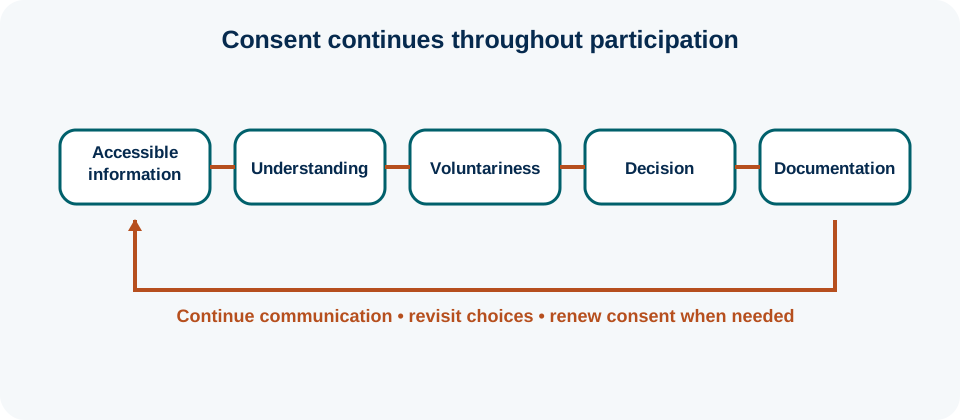
Informed consent is a continuing process in which a person receives relevant information, has an opportunity to ask questions, understands what participation involves, decides voluntarily and has that decision appropriately documented.[1–4] The signed form is evidence of part of that process; it is not the process itself.
Good consent design adapts communication to the population, study complexity and level of risk. It also anticipates circumstances in which capacity is impaired, literacy is limited, language support is needed, or a waiver or alteration of consent may be ethically considered by the responsible committee.
Why this matters
Consent protects more than autonomy in the abstract. It affects trust, recruitment fairness, adherence, willingness to report adverse experiences, and expectations about data or biospecimen use. Poorly designed consent can create therapeutic misconception, hide optional procedures, exaggerate benefit or make refusal feel unsafe. Classic research-ethics principles likewise emphasise voluntariness and protection from coercion or undue influence.[5]
Researchers should therefore design consent with the same care used for measurement instruments: define the information participants need, test whether it is understandable, identify contextual sources of pressure and document the actual conversation. In interventional trials, current GCP guidance also treats informed consent as a fundamental participant-protection process.[6]
Core principles
A defensible consent process has several components. Capacity is decision-specific and concerns the person’s ability to understand, appreciate, reason about and communicate a choice. Disclosure means presenting the information reasonably needed for the decision. Comprehension requires communication in language and formats the person can use. Voluntariness requires freedom from coercion and inappropriate influence. Documentation records the decision and approved process.[2,3,5]
Consent should also explain the difference between research and clinical care, foreseeable risks and burdens, potential benefits, alternatives where relevant, privacy and data use, compensation or reimbursement, contact arrangements, withdrawal, and what happens to data already collected if a participant withdraws.
Capacity, comprehension and communication
Capacity should not be inferred solely from diagnosis, age, educational level or disagreement with the researcher. Where capacity is uncertain, the protocol should identify how it will be assessed and whether a legally authorised representative is relevant under applicable requirements.
Comprehension can be supported by plain language, translated materials, interpreters, diagrams, teach-back and time for questions. A readability score cannot substitute for testing whether the intended population understands the actual research choices.
Voluntariness, coercion and undue influence
Coercion involves a threat of harm used to obtain compliance. Undue influence is different: an offer, relationship or context may compromise voluntariness without an explicit threat.[5] Dependent relationships deserve particular attention—for example, students recruited by supervisors, employees by managers, or patients by a clinician on whom they depend.
The remedy is not automatically to prohibit recruitment. It may be to separate clinical and research roles, use an independent recruiter, emphasise that care or employment will not be affected, and ensure that compensation is not presented as a benefit of treatment.
Ongoing consent, new information and withdrawal
Consent continues after enrolment. Material new information, changes in risk, new optional procedures or major amendments may require participants to be informed and, depending on the circumstances and committee decision, re-consented. Participants should know whom to contact and how withdrawal operates. Researchers should specify what can and cannot be withdrawn once data have been de-identified, aggregated or used in completed analyses.
Waiver or alteration of consent
Some minimal-risk secondary-data, record-based or public-health research may justify a waiver or alteration under applicable ethical and legal frameworks. The investigator should not decide this unilaterally. The protocol should explain why the research cannot practicably be conducted as proposed with conventional consent, why rights and welfare remain protected, what privacy safeguards apply and whether additional information should be provided later. Jurisdiction-specific criteria must be verified before being taught as requirements.[2,3]
Designing consent as an operational workflow
Consent should be mapped as a sequence rather than a document. The workflow begins before the signature: how potential participants are identified, who first contacts them, where the discussion occurs and whether the timing allows meaningful deliberation. It continues through explanation, questions, documentation and the period after enrolment. A study may therefore need several consent-related encounters rather than one event.
A useful protocol distinguishes the information function from the documentation function. The information function ensures that participants receive what they need to decide. The documentation function records the decision in a form accepted by the ethics and regulatory framework. Written signatures are common, but in some approved circumstances electronic consent, witnessed oral consent or waiver of documentation may be appropriate. Researchers should not assume that the most paperwork necessarily produces the most autonomy.[2–4]
Layer information according to decision importance
Long consent forms can satisfy administrative expectations while overwhelming readers. A better communication strategy places the most decision-relevant information first: why the study is being done, what will happen, which procedures are experimental or optional, important risks and burdens, realistic potential benefit, alternatives, privacy and the right to decline. More detailed information can follow without burying the core decision under legalistic text.
Complex studies may benefit from layered materials such as a concise summary plus a detailed information sheet. Multimedia can help, but only if it is accessible and does not introduce persuasive imbalance. Videos with enthusiastic investigators and testimonials may inadvertently function as advertising rather than neutral information. Whatever the format, the participant should be able to ask questions of an appropriately knowledgeable person.
Therapeutic misconception and dual-role clinicians
Clinical research often occurs in settings where patients already trust the investigator as their treating clinician. Participants may assume that every research procedure is chosen for their personal medical benefit or that randomisation represents the clinician’s preferred treatment. Consent should explicitly distinguish individualised care from protocol-driven research decisions when that distinction matters.
Dual-role clinicians are not automatically prohibited from obtaining consent, but the risk of dependency should be considered. In higher-stakes or particularly vulnerable settings, an independent consent discussion or confirmation may be preferable. Staff should avoid language implying that a “good patient” helps research, that the doctor will be disappointed by refusal, or that participation is necessary to retain clinical services.
Consent to data and biospecimen use
Modern studies often involve future contact, record linkage, storage of biospecimens, genetic analysis or secondary research. These activities may outlast the active study and may have different implications from the primary objective. Consent materials should therefore describe the scope of future use in terms participants can understand and separate choices where ethically meaningful.
Broad consent does not mean a blank cheque. Governance still matters: future use may be limited by the consent wording, ethics review, institutional policy, re-identification risk and the sensitivity of the proposed research. If commercial collaboration, international transfer or return of individual findings is reasonably foreseeable and material to decision-making, the protocol should address it rather than relying on vague statements such as “your samples may be used for research”.
Assessing comprehension without becoming paternalistic
Researchers can improve comprehension by asking participants to explain key points in their own words: that joining is optional, what the main procedures are, what important risks exist and that they may withdraw. A misunderstanding triggers clarification, not automatic exclusion. The purpose is to identify communication failure, not to test intelligence.
If a person continues to misunderstand material facts despite appropriate support, the team should consider whether valid consent can be obtained at that time. Capacity and comprehension are related but not identical: a capable person can misunderstand a poorly explained study, while a person with some cognitive impairment may still understand a simple research decision with appropriate support.
Documentation should preserve the consent history
The study file should show which approved information sheet and consent version were used, who conducted the process, the date, any representative or witness involvement and whether optional choices were accepted. If re-consent occurs, the reason and new version should be traceable. This protects participants and allows investigators to determine which permissions apply to which data or specimens later.
Practical consent quality assurance
Consent quality should be monitored during conduct, not assumed from training attendance. Early in recruitment, supervisors can review a sample of consent records for correct versions, signatures, dates and optional choices, while observation or role-play can assess whether staff explain the study neutrally. Problems should trigger process improvement rather than retroactive completion of missing information.
Sites should also track consent-process deviations separately from ordinary documentation errors. Using an obsolete information sheet, missing a required representative signature, performing a study procedure before consent or failing to document an optional choice can have different implications. The response should consider participant rights, whether re-consent is needed, whether affected data can be used, and whether ethics or sponsor notification is required under the applicable framework.
Electronic consent deserves the same ethical analysis as paper consent. Investigators should verify identity where necessary, ensure the participant can access and retain the information, provide a route for questions, protect electronic records and avoid interfaces that nudge users toward acceptance. A checkbox at the bottom of a webpage is not automatically meaningful consent simply because it is digital.
Remote consent can improve access for geographically dispersed participants, but it may also create digital exclusion. Protocols should offer reasonable alternatives for people without devices, connectivity, digital literacy or private space. Accessibility needs—visual, hearing, cognitive or language-related—should be considered prospectively rather than handled as exceptions after recruitment begins.
Finally, consent materials should be reviewed after study completion. Questions repeatedly asked by participants, reasons for refusal and recurring misunderstandings are valuable evidence for improving future studies. This quality-improvement use of recruitment experience does not alter the consent already obtained, but it helps convert ethical practice into organisational learning.
Consent audit questions for a protocol review
Before approval, reviewers should be able to answer four practical questions from the submitted documents: who asks, what is explained, how understanding and voluntariness are supported, and what is recorded. If any answer depends on unwritten custom, the protocol should be strengthened. Particular attention is needed when recruitment occurs during acute illness, when clinicians recruit their own patients, when optional procedures are complex, or when data may be retained for future use.
Consent quality can also be evaluated through participant experience. High refusal is not automatically evidence of poor consent; it may show that people genuinely understand an unattractive study. Conversely, extremely high enrolment in a dependent population may deserve scrutiny if refusal seems socially difficult. Ethical recruitment values authentic decisions, not maximum conversion.
Final consent implementation note
Consent processes should be tested under realistic conditions before recruitment begins. A short role-play can reveal whether the discussion is too long for the clinic workflow, whether staff can explain randomisation or optional procedures consistently, and whether translated materials correspond to the approved master version. Investigators should also define who answers questions that exceed the recruiter’s knowledge and how urgent clinical concerns discovered during the discussion are redirected to care. This final rehearsal is useful because many consent failures arise from workflow pressure rather than from missing text in the form. A defensible process is one that remains understandable and voluntary even on a busy recruitment day.
Design the consent pathway
- What decision must the participant make, and which procedures are optional?
- Who will approach the participant, and could that relationship create pressure?
- What information is essential for a reasonable decision?
- How will comprehension, language and accessibility needs be addressed?
- Could capacity fluctuate, and how will ongoing consent or re-consent be handled?
Consent process specification
- Identify who is authorised and trained to obtain consent.
- State where and when the discussion will occur.
- List approved language versions and interpreter arrangements.
- Describe capacity and legally authorised representative procedures where relevant.
- Explain how optional procedures and future use choices are separated.
- State how consent, refusal, withdrawal and re-consent are documented.
Appraise informed consent
- Was the participant given a genuine choice rather than a form to sign?
- Could a clinical, educational or employment relationship create pressure?
- Are benefits described without therapeutic misconception or overstatement?
- Are privacy, future use and withdrawal explained realistically?
- If consent was waived or altered, is the ethical justification explicit and independently approved?
Worked example
Redesigning consent for a postpartum cohort
The team replaces a rushed waiting-room signature with a staged process. Eligible women receive a short study summary before the research visit, followed by an approved information sheet in their preferred language. A trained research staff member who is not responsible for treatment discusses participation, checks key points using teach-back and records questions. Optional future contact and optional biospecimen storage are presented as separate choices.
Women may take additional time unless the study procedure is time-sensitive. Refusal is recorded only for recruitment accounting and does not affect clinical care. This design treats consent as communication rather than paperwork.
Suggested protocol or governance wording
Common mistakes
Knowledge check
Why is teach-back useful during consent?
Answer and reasoning
It provides evidence about whether key information has been understood and identifies explanations that need to be clarified; it is not an examination that participants must “pass”.
Is a large payment automatically coercive?
Answer and reasoning
No. Coercion involves threat. A large payment may raise concern about undue influence or distorted decision-making, which should be assessed in context.
Does withdrawal necessarily mean all previously collected data must be deleted?
Answer and reasoning
Not always. What can be withdrawn depends on the study, consent, data state, legal requirements and prior use. The protocol and consent materials should explain this accurately.
Who decides whether consent may be waived?
Answer and reasoning
The relevant ethics committee or other competent authority under applicable rules, not the investigator acting alone.
Key take-home messages
Key take-home messages
- Informed consent is an ongoing communication and decision process.
- Capacity, disclosure, comprehension, voluntariness and documentation should all be planned.
- Dependent relationships and therapeutic misconception can undermine voluntariness even when a form is signed.
- Optional future uses should be separated when their implications materially differ.
- Waivers or alterations require explicit, jurisdiction-appropriate ethical justification and independent review.
References
- World Medical Association. Declaration of Helsinki: ethical principles for medical research involving human participants. Ferney-Voltaire: WMA; 2024. https://www.wma.net/what-we-do/medical-ethics/declaration-of-helsinki/
- Council for International Organizations of Medical Sciences. International ethical guidelines for health-related research involving humans. 4th ed. Geneva: CIOMS; 2016. https://cioms.ch/publications/product/international-ethical-guidelines-for-health-related-research-involving-humans/
- World Health Organization Research Ethics Review Committee. Templates for informed consent forms. https://www.who.int/groups/research-ethics-review-committee/guidelines-on-submitting-research-proposals-for-ethics-review/templates-for-informed-consent-forms
- US Office for Human Research Protections. Informed consent FAQs. https://www.hhs.gov/ohrp/regulations-and-policy/guidance/faq/informed-consent/
- National Commission for the Protection of Human Subjects of Biomedical and Behavioral Research. The Belmont Report. Washington, DC: US Department of Health and Human Services; 1979. https://www.hhs.gov/ohrp/regulations-and-policy/belmont-report/
- International Council for Harmonisation. ICH E6(R3) guideline for good clinical practice: principles and Annex 1. Step 4. 2025. https://database.ich.org/sites/default/files/ICH_E6%28R3%29_Step4_FinalGuideline_2025_0106.pdf
These materials support learning and research planning. They require adaptation to the study context and do not replace methodological, statistical, ethical, or regulatory consultation.