
Part 11 · Module 7
Observation, Documents and Digital Qualitative Data
Plan and appraise qualitative studies that use observation, documents and digital materials while preserving context, reflexivity, privacy and ethical integrity.
Learning outcomes
After completing this lecture, you should be able to:
- Distinguish observation, documentary analysis and digital qualitative data as different forms of evidence.
- Choose data sources that fit the research question and qualitative methodology.
- Plan field notes, document sampling and digital-data capture so context and provenance are retained.
- Identify ethical and privacy issues in observed, documentary and online settings.
- Integrate multiple qualitative data sources without treating triangulation as automatic proof of truth.
Overview
Qualitative researchers are not limited to interviews and focus groups. Many health-research questions concern what people do, how services operate, how documents construct practice, and how interactions unfold in physical or digital settings. Observation, documents and digital materials can therefore provide evidence that participants may not be able to recall, articulate or recognise in an interview.[1]
These data sources are not interchangeable. Observation generates situated accounts of actions and interactions. Documents are produced for particular organisational, legal, clinical or communicative purposes. Digital qualitative data may combine text, images, audio, traces of interaction and platform-specific metadata. Each source has its own sampling logic, context and ethical challenges.
This lecture focuses on designing and documenting studies that use these sources rigorously. Detailed coding and interpretation are developed in RM-P11-M08.
Why this matters
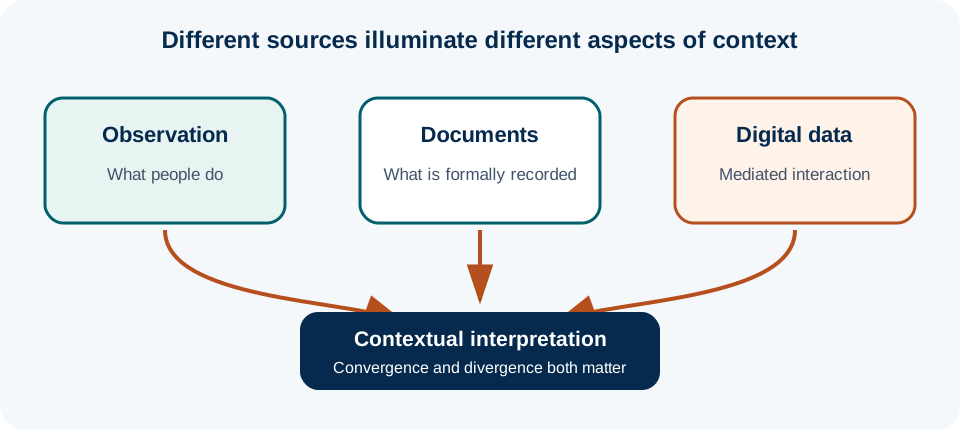
A service may have a written protocol stating that every woman with previous gestational diabetes receives postpartum glucose-testing counselling. Interviews with staff may also report that counselling is routinely delivered. Yet direct observation may show that counselling is shortened when the clinic is busy, while appointment documents may contain unclear instructions and patient messages may reveal uncertainty about where testing should occur.
The apparent contradiction is not a problem to be eliminated. It may be the finding: different data sources illuminate different layers of practice.
Observation as qualitative data
What observation can reveal
Observation is useful when the research question concerns behaviour, interaction, routines, use of space, informal workarounds or the relationship between stated procedures and enacted practice. Ethnographic research often relies heavily on observation because meaning is examined within the social and organisational setting in which behaviour occurs.[1]
An observer might record who initiates counselling, how privacy is managed, what interruptions occur, how printed materials are used, whether family members participate and what happens when the clinic becomes crowded. These details may be difficult to reconstruct retrospectively.
Observation does not provide direct access to another person’s internal thoughts. Interpretation of an action should therefore be distinguished from the action observed. A field note such as “the nurse appeared frustrated” is an interpretation; “the nurse paused, sighed, closed the file and said, ‘we have five more patients waiting’” preserves more observable evidence.
Participant and non-participant roles
In non-participant observation, the researcher mainly observes without joining the activity being studied. In participant observation, the researcher participates to some degree in the setting. In practice, researcher involvement lies on a continuum. Even a silent observer can influence behaviour by being present.
The protocol should therefore state:
- where observation occurs;
- what activities or interactions are within scope;
- the researcher’s role;
- whether people know when observation is occurring;
- what is recorded and when;
- how consent or other ethical authorisation is managed; and
- how the researcher’s presence may shape the setting.
Designing an observation component
Research purpose: Understand how discharge counselling and appointment arrangements operate in everyday practice.
Observation unit: One discharge-counselling encounter and the surrounding workflow.
Sampling: Purposively vary time of day, weekday, ward workload and staff role.
Researcher role: Overt non-participant observer positioned outside direct clinical care.
Recording: Contemporaneous jottings where feasible, followed promptly by expanded field notes.
Reflexive record: Separate notes on researcher assumptions, access negotiations, emotional reactions and possible influence on the encounter.
Protection: Do not record unnecessary clinical identifiers or information unrelated to the approved research purpose.
Producing high-quality field notes
Field notes are not an afterthought. They are a primary research record. A useful structure distinguishes several layers:
- descriptive notes — what occurred, who was involved, the sequence and setting;
- verbatim or near-verbatim phrases — only where accurately captured;
- contextual notes — crowding, interruptions, physical arrangements, timing;
- analytic memos — emerging interpretations, questions and comparisons; and
- reflexive notes — how the researcher’s position or expectations may have influenced attention and interpretation.
The distinction need not be mechanically rigid, but the reader should be able to tell what was observed from what was inferred.
Observation protocol essentials
- Define the setting, activities and observation unit.
- Specify overt or covert status and justify it ethically.
- Describe researcher participation and relationships in the setting.
- Plan temporal and situational sampling rather than observing only convenient periods.
- Use a field-note template without making it so restrictive that unexpected phenomena disappear.
- Expand field notes promptly after observation.
- Record contextual and reflexive information.
- Protect incidental information about non-participants.
- Define secure handling of notes, recordings and identifiers.
Documents as situated evidence
Health systems generate referral forms, policies, clinical pathways, minutes, educational leaflets, complaint records, websites, patient instructions and electronic templates. These materials can be analysed qualitatively, but they should not be treated as neutral containers of facts.
A document was created by someone, for an audience, at a particular time and for a purpose. A policy describes an authorised version of practice; it does not establish that the policy is implemented. A clinic poster may show what the organisation wishes patients to know, not what patients actually understand.
Sampling documents
Document sampling should answer four questions:
- Which document types are relevant?
- What time period is relevant?
- Which versions or sites should be included?
- What does absence of a document mean?
For example, analysing only the current reminder script may miss substantial changes made during the study period. If three hospitals use different forms, the document sample may need to preserve site-level variation.
Provenance and authenticity
For every document, record provenance: source, date or version, author or issuing body when relevant, intended audience and whether the document is complete. Researchers should distinguish official documents from drafts, local adaptations or patient-generated copies.
Illustrative document inventory
illustrativeTable 1. Document inventory for a postpartum follow-up study
| Document | Source | Version/date | Intended function | Analytic question |
|---|---|---|---|---|
| Discharge instruction sheet | maternity ward | version 4, 2026 | patient instructions | Is testing timing and location explicit? |
| Appointment slip | diabetes clinic | current template | schedule follow-up | What information is required from staff? |
| Reminder script | call centre | March 2026 | telephone reminder | How is urgency framed? |
| Local clinical pathway | hospital intranet | January 2026 | staff guidance | Who is assigned responsibility? |
| Frequently asked questions | service account | current | patient support | Which uncertainties are anticipated? |
Digital qualitative data
Digital environments include discussion forums, messaging platforms, social-media posts, online communities, telehealth interactions, app-based diaries and comments submitted through service portals. Digital data can preserve naturally occurring interaction, but easy technical access does not make the material ethically unrestricted.[2]
The Association of Internet Researchers emphasises contextual ethical judgement rather than a universal public-versus-private rule for internet research.[3] Researchers should consider users’ reasonable expectations, platform norms, vulnerability, identifiability, consent, quotation practices, data security and potential harm.
Public availability is not the same as ethical permission
A technically public post may have been written for a small community rather than an academic audience. A verbatim quotation can be searchable and lead directly back to the author. Removing a username may therefore be insufficient anonymisation.
Sampling digital material
Digital datasets can be enormous. “We downloaded everything” is not a sampling rationale. Define:
- platform or digital setting;
- account, channel, thread or community boundaries;
- observation period;
- eligible contributors or content types;
- treatment of reposts, bots, spam or deleted material;
- whether interaction chains are preserved; and
- how sampling changes if analysis identifies new relevant periods or communities.
Researchers should also consider platform effects. Features such as character limits, recommendation algorithms, moderation and visibility settings shape what becomes observable. Digital text is therefore produced within a sociotechnical environment, not outside context.
Integrating multiple data sources
Using interviews, observations and documents in one study can deepen interpretation, but simply having several sources does not create methodological rigour. The rationale should explain what each source contributes.
Choose data sources by what must be understood
- Use interviews for participants’ accounts, meanings and interpretations.
- Use focus groups when interaction and shared or contested understandings matter.
- Use observation for situated practice, behaviour, workflow and interaction.
- Use documents for formal representations, institutional communication and historical traces.
- Use digital data when the phenomenon occurs partly online or naturally occurring digital interaction is itself relevant.
- Combine sources when their different vantage points are necessary to answer the question.
Triangulation does not mean majority voting
If three data sources agree, that convergence may strengthen confidence in an interpretation. If they disagree, the disagreement can be analytically important. Staff interviews may describe reminder calls as supportive while recordings reveal highly scripted interactions and patient messages describe them as confusing. The task is to explain the pattern, not declare one source correct because it outnumbers another.
Standards for qualitative reporting require enough methodological detail for readers to understand how data sources were selected and analysed.[4] Broader qualitative reporting standards similarly emphasise transparency about context, researcher characteristics and analytic processes.[5]
Worked example
Combining observation, documents and patient messages
The research team observes 24 discharge-counselling encounters across different wards and shifts, samples six versions of patient-facing documents used during the preceding year, and analyses 120 de-identified message exchanges from a dedicated follow-up account after obtaining appropriate governance approvals.
Observation shows that counselling is frequently interrupted and the laboratory location is rarely discussed. Document analysis shows that older forms specify a hospital laboratory whereas newer forms state only “complete glucose test at 6–12 weeks”. Messages commonly ask whether testing can be performed at community clinics.
The integrated interpretation is not that any single source is “more truthful”. Rather, the three sources identify a communication mechanism: service decentralisation changed where testing could occur, but patient-facing instructions did not consistently explain that change, and busy counselling encounters provided limited opportunity to clarify it.
Appraising studies using these data
Questions for appraisal
- Does the selected data source actually illuminate the stated research question?
- Is the observation or document/digital sampling strategy described?
- Are setting, time period and boundaries explicit?
- Are field notes and analytic memos distinguished from raw observation where appropriate?
- Is document provenance documented?
- Are platform context and digital ethics addressed?
- Does the analysis preserve interactional or contextual features needed for interpretation?
- Is the researcher role and access relationship discussed?
- Are disagreements among sources explored rather than suppressed?
- Are confidentiality protections credible for quoted or digitally searchable material?
Suggested protocol wording
Temporal context and change over time
Observation and documentary datasets can become misleading if time is ignored. A service pathway may change during data collection, staff may adapt after an audit, and digital discussions can be shaped by a new policy or media event. Researchers should therefore timestamp field notes and documents and consider whether the phenomenon is stable enough to combine across periods.[1]
A longitudinal qualitative design may intentionally examine change. For example, observations before and after decentralising postpartum testing could explore how the same written policy is enacted under different organisational conditions. The analysis should preserve period-specific context rather than merge all observations into one timeless account.
Incidental and third-party data
Observation can expose information about people who were not directly recruited, such as relatives, other patients or staff passing through a clinical area. Digital message threads may also mention family members or clinicians. Ethical data minimisation means recording only what is necessary for the approved question and avoiding identifiable third-party material whenever possible.[2,3]
When an unexpected sensitive event occurs during observation, the researcher should follow a prospectively defined escalation plan—for example, for immediate safety concerns—without converting the study into covert clinical surveillance. The boundaries of the researcher’s role should be clear to both the field team and the host service.
Stopping data collection
Adequacy should be judged against the research question and the contribution of each source. Researchers need not continue observing merely because another clinic session is available or collect every historical document. Stop when additional material is unlikely to change the analytic understanding required for the study, while documenting the basis for that judgement and any important unobserved contexts.
Common mistakes
Knowledge check
A hospital protocol states that every eligible woman receives counselling before discharge. Can the protocol alone establish that counselling occurs in practice?
Answer and reasoning
No. The protocol is evidence of the authorised or intended process. Observation or other empirical evidence is needed to examine how the process is enacted. The difference between written policy and practice may itself be analytically important.
Why should descriptive field notes be distinguished from analytic interpretation?
Answer and reasoning
The distinction helps preserve the evidential basis of interpretation. Readers and researchers can see what was observed and what meaning the researcher subsequently attributed to it, strengthening reflexive transparency.
A patient posts publicly about a stigmatised diagnosis. Is anonymising the username always sufficient for research quotation?
Answer and reasoning
No. A verbatim quotation may be searchable and lead back to the original post. Ethical decisions should consider reasonable expectations, sensitivity, identifiability, platform context and potential harm, not merely technical public access.
Interviews describe a reminder service as supportive, but patient messages show repeated confusion. Does this invalidate triangulation?
Answer and reasoning
No. Divergence is potentially informative. It may indicate that different actors experience the same service differently or that intended processes do not translate into patient understanding. The researcher should analyse the divergence rather than force agreement.
Key take-home messages
Key take-home messages
- Observation, documents and digital materials answer different kinds of qualitative questions.
- Observation should preserve the distinction between situated evidence and researcher interpretation.
- Documents must be analysed in relation to provenance, purpose, audience and context.
- Digital accessibility does not remove duties concerning privacy, consent, confidentiality and harm.
- Multiple data sources strengthen inquiry when their distinct contributions and disagreements are analysed transparently.
References
- Reeves S, Kuper A, Hodges BD. Qualitative research methodologies: ethnography. BMJ. 2008;337:a1020. https://doi.org/10.1136/bmj.a1020
- Eysenbach G, Till JE. Ethical issues in qualitative research on internet communities. BMJ. 2001;323(7321):1103-1105. https://doi.org/10.1136/bmj.323.7321.1103
- Franzke AS, Bechmann A, Ess CM, Zimmer M, editors. Internet research: ethical guidelines 3.0. Association of Internet Researchers; 2020.
- O’Brien BC, Harris IB, Beckman TJ, Reed DA, Cook DA. Standards for reporting qualitative research: a synthesis of recommendations. Acad Med. 2014;89(9):1245-1251. https://doi.org/10.1097/ACM.0000000000000388
- Levitt HM, Bamberg M, Creswell JW, Frost DM, Josselson R, Suárez-Orozco C. Journal article reporting standards for qualitative primary, qualitative meta-analytic, and mixed methods research in psychology: the APA Publications and Communications Board task force report. Am Psychol. 2018;73(1):26-46. https://doi.org/10.1037/amp0000151
These materials support learning and research planning. They require adaptation to the study context and do not replace methodological, statistical, ethical, or regulatory consultation.