
Part 15 · Module 4
Risk, Benefit, Burden and Participant Compensation
Evaluate research risks, potential benefits and participant burdens, and design reimbursement and compensation that are fair without distorting voluntariness.
Learning outcomes
After completing this lecture, you should be able to:
- Distinguish risk, burden, direct benefit and social value.
- Assess probability, magnitude and reversibility of foreseeable harms.
- Plan burden minimisation and risk monitoring.
- Distinguish reimbursement, compensation for time and inconvenience, and compensation for research-related harm.
- Evaluate payment for fairness and potential undue influence.
Overview
Ethical risk–benefit assessment asks whether foreseeable harms and burdens have been minimised and whether the remaining risks are reasonable in relation to potential benefits and the value of the knowledge expected from the study.[1–3] Risk is broader than physical adverse events: privacy loss, stigma, anxiety, inconvenience, financial cost, time and family disruption may matter.
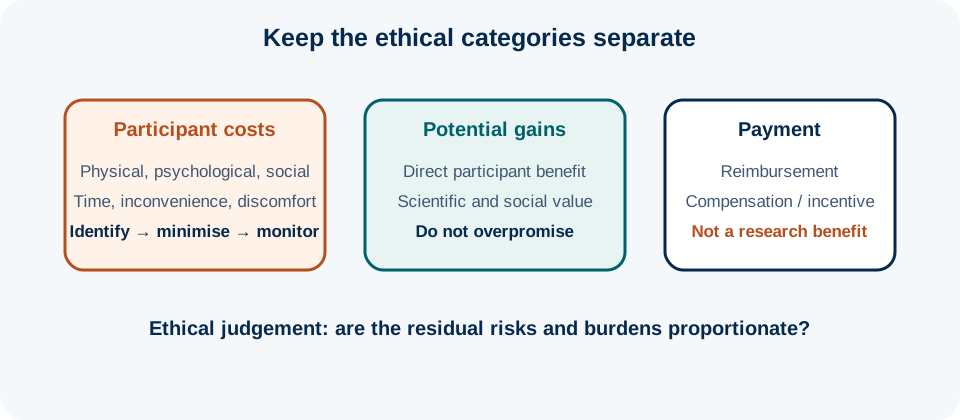
Participant payment also requires conceptual clarity. Reimbursement replaces reasonable expenses; payment may compensate time and inconvenience; separate arrangements may address research-related injury where applicable. None should be presented as proof that risk is acceptable.
Why this matters
Researchers often describe a study as “minimal risk” without analysing the actual procedures or local context. A blood draw, repeated travel, location tracking or disclosure of stigmatising information can have very different implications in different populations. Burden that seems minor to a research team may be substantial for participants with caregiving, disability, transport or employment constraints.
A structured risk–burden map improves both ethics review and feasibility by connecting each foreseeable problem to prevention, monitoring and response.
Core principles
Risk assessment should consider probability, magnitude, duration, reversibility and who is exposed. Benefits should be separated into possible direct benefit to participants and social or knowledge value. Payment should be analysed separately from clinical benefit; money does not transform a research procedure into a health benefit.[1,2]
Risk minimisation comes before balancing. If a blood test can be combined with routine care, an unnecessary visit removed, a questionnaire shortened or remote follow-up used safely, the avoidable burden should not be retained merely because the committee might approve it.
Physical, psychological, social, economic and privacy harms
A useful protocol identifies harms by domain rather than relying on one global risk label. Physical harms include adverse events or procedural complications. Psychological harms include distress or anxiety. Social harms can arise from stigma, discrimination or disclosure. Economic harms include travel expenses and lost wages. Privacy harms can persist even when no physical procedure occurs.
Direct benefit versus social value
An intervention may offer a prospect of direct clinical benefit, but many observational studies, questionnaires and early-phase trials do not. The consent process should not imply otherwise. Social value—the expected contribution to knowledge or future care—can ethically justify some burden but should not be described as a personal benefit to the participant.[1,2]
Reimbursement, time and inconvenience
Reimbursement aims to prevent participants from being financially worse off because they joined research. Payments for time and inconvenience recognise contribution and burden. Ethical concern arises when payment structures exploit disadvantage, obscure risk or make a person feel unable to decline. The size of payment alone is not a universal test of undue influence; the context, risks, alternatives and population matter.[2,4]
Research-related injury and treatment costs
Interventional protocols should explain arrangements for medical management and financial responsibility if research-related injury occurs, according to applicable sponsor, institutional, regulatory and legal requirements. Researchers should not invent a generic promise such as “all costs will be covered” unless the responsible policy actually provides that coverage.
Monitoring and stopping rules
Risk management should identify who reviews accumulating safety information, which events require expedited action, when recruitment may be paused, and how new information reaches participants and ethics committees. For low-risk non-interventional studies, monitoring may be simpler but still includes incident response for distress, privacy breaches or safeguarding concerns.
Build a procedure-level risk–burden table
Global labels such as “minimal risk” can hide important differences among study activities. A better protocol lists each procedure and assesses physical risk, psychological impact, privacy consequences, time, travel, discomfort and financial burden. The table can also identify who experiences the burden. A two-hour visit may be minor for a salaried participant with transport but substantial for someone paid by the hour or responsible for childcare.
For each row, ask whether the procedure is necessary for the primary or important secondary objective. If not, remove it. If it is necessary, ask whether frequency, duration or invasiveness can be reduced. This method turns the ethical principle of non-maleficence into a concrete design exercise.
Burden accumulation matters
Repeated small burdens can become substantial. A single questionnaire may be easy; monthly questionnaires for two years may cause fatigue and attrition. One blood draw may be trivial; serial fasting draws can affect work, transport and wellbeing. Digital studies may appear convenient while requiring continuous phone access, data plans or wearable charging.
Cumulative burden should therefore be considered alongside individual procedure risk. This also has methodological consequences: excessive burden can cause missing data and selective attrition, creating a link between participant welfare and internal validity.
Payment models should be justified prospectively
A payment schedule can be built from transparent components: reimbursement for reasonable expenses, compensation for time and inconvenience, and where institutionally permitted, additional incentives. Researchers should consider whether payment is prorated so participants who withdraw are paid fairly for completed participation rather than losing the entire amount.
Very low payment can be exploitative if it shifts research costs to participants. Very high payment is not automatically unethical, but the ethics committee should consider whether the offer may lead people to discount material risks they would otherwise reject. The solution may involve changing the risk, recruitment population or payment structure rather than simply reducing payment to a token amount.[2]
Avoid penalising withdrawal
Payment arrangements should not trap participants in a study. A common problematic design pays everything only after the final visit, effectively penalising early withdrawal. Prorated payment usually better reflects the work already contributed. Reasonable completion bonuses may be acceptable in some settings, but they should not become so large that participants feel they cannot exercise the right to stop.
The consent form should explain the payment schedule clearly, including what happens if the investigator ends participation for safety or other reasons.
Compensation for injury is a separate governance question
Interventional studies may expose participants to research-related injury. The protocol and consent materials should distinguish immediate medical management, insurance or indemnity arrangements, reimbursement of treatment costs and any legal rights to compensation. These arrangements depend heavily on sponsor contracts, national law and institutional policy.
Researchers should therefore avoid generic statements copied from other studies. An ethics committee needs the actual arrangement for the current project. If the sponsor provides insurance, the relevant exclusions and contact process should be known. If the institution has a policy, the wording should align with it.
Benefits should be evidence based
Consent materials commonly exaggerate benefit by saying participants “will receive closer monitoring” or “may improve their health” when no such benefit is established. If a study includes clinically useful assessments, specify what results will be returned and whether treatment follows. If the study offers no direct benefit, say so plainly while explaining the societal value.
This honesty does not make recruitment unethical. People may altruistically participate in research without direct benefit when the risks and burdens are reasonable and the knowledge is valuable.
Evaluating compensation across the participant journey
Compensation should be reviewed visit by visit. A participant may incur registration fees, parking, fuel, public transport, meals, accommodation or childcare costs. If the study requires fasting or extended observation, the time and inconvenience may be substantial even when travel is reimbursed. The protocol should state what is reimbursed, what documentation is required, and whether participants can reasonably receive payment without long administrative delays.
Reimbursement systems can themselves create inequity. Requiring participants to pay large costs upfront and wait months for reimbursement may exclude people with limited cash flow. Where institutionally possible, prepaid travel, direct booking or prompt reimbursement may be fairer. The practical payment mechanism is therefore part of recruitment feasibility and justice, not merely finance administration.
Researchers should consider whether compensation changes after protocol amendments that increase burden. Adding extra visits while keeping the original payment schedule may shift new costs to participants. Any revised schedule should be reviewed through the appropriate ethics and institutional process before implementation.
The ethics committee may also ask whether payment differs among sites or countries. Differences can be justified by local costs and burdens, but unexplained disparities can appear unfair. Investigators should document the basis for amounts rather than copying a payment from a previous unrelated study.
Risk communication should remain separate from payment. Staff should not say “the study pays RM300, so the inconvenience is worth it” or use compensation as the lead recruitment message. Recruitment materials should first describe the study and voluntariness, then explain approved reimbursement or compensation accurately. This protects the decision from becoming a financial transaction stripped of its research context.
When studies involve healthy volunteers or repeated participation, compensation may interact with over-volunteering risk. Registries, washout periods or other safeguards may be required in particular trial environments. Such requirements are highly context-specific and should be based on the relevant protocol, ethics committee and regulatory framework rather than inferred from payment alone. Current clinical-trial guidance likewise expects risk and safety protections to be integrated into trial conduct.[5]
Linking burden reduction to data quality
Participant-centred burden reduction often improves scientific quality. Flexible scheduling can reduce missed visits; shorter validated questionnaires can reduce item non-response; remote follow-up can improve retention; combining blood sampling with routine appointments can reduce protocol deviations. These are examples in which ethics and methodology reinforce each other rather than compete.
However, convenience changes can alter the measurement process. A remotely measured outcome may not be equivalent to a clinic measurement, and replacing a fasting laboratory test with self-report may damage validity. Every burden-reduction proposal should therefore ask whether the intended construct and estimand remain intact.
The best protocol documents this reasoning: which burdens were identified, what alternatives were considered, which were adopted, and why the chosen approach preserves the scientific question. This makes the risk–burden assessment auditable rather than rhetorical.
Documenting residual risk after safeguards
After mitigation, the protocol should state the residual risk and burden rather than repeating the original hazards. For example, secure messaging may reduce but not eliminate disclosure risk; experienced phlebotomy may reduce but not eliminate bruising; remote follow-up may reduce travel but introduce digital-access burden. Naming residual risk prevents safeguards from being presented as guarantees and helps participants and committees make proportionate decisions about what remains.
Review compensation after recruitment begins
Actual participant experience may differ from the budget assumptions. If repeated feedback shows that transport, parking or time costs were underestimated, investigators should consider whether the approved reimbursement remains fair and whether an amendment is appropriate. Researchers should not change payments informally at one site because that can create inequity and untracked protocol variation. Monitoring burden is therefore part of continuing ethical oversight, not only pre-study planning.
Final proportionality audit
A final risk–burden review should occur after the visit schedule, CRFs and recruitment plan are complete, because burdens often accumulate across documents. The team should calculate the total number of contacts, procedures, fasting periods, questionnaires and expected travel episodes for a typical participant rather than judging each activity separately. The committee and investigators can then see the actual participation experience. If the burden appears disproportionate, procedures should be removed, combined or justified explicitly. This audit also helps ensure that the payment schedule reflects the final protocol rather than an earlier, less demanding version of the study.
The final ethics file should record the rationale for compensation amounts and any later revision. This makes the basis for payment transparent to reviewers and prevents inconsistent site-level negotiation with participants.
Assess proportionality
- What harms and burdens are foreseeable for each study procedure?
- Which risks can be removed or reduced without compromising the question?
- Is there realistic direct benefit, or is the justification primarily social value?
- Are travel, time and financial burdens recognised fairly?
- What monitoring and response pathway exists if risk changes during the study?
Risk and compensation specification
- List foreseeable risks and burdens by procedure.
- Describe prevention and mitigation measures.
- State potential direct benefits separately from societal or knowledge value.
- Describe reimbursement and payment basis without overstating benefit.
- Specify management of research-related injury where applicable.
- Define monitoring, escalation and participant-notification procedures.
Appraise risk and payment
- Are important non-physical burdens recognised?
- Has each avoidable procedure been challenged?
- Are benefits described realistically rather than therapeutically?
- Could the payment arrangement disproportionately influence a disadvantaged population?
- Are injury and adverse-event arrangements accurate for the actual sponsor and jurisdiction?
Worked example
Reducing burden in a postpartum study
The team maps each visit and discovers that three research blood draws can be combined with clinically scheduled testing and two questionnaires can be completed remotely. Travel reimbursement is based on reasonable actual costs, and a modest payment recognises the remaining research time. The participant information sheet explains that these payments are not treatment benefits.
The revised protocol reduces burden before asking the ethics committee to judge the residual risk. It also identifies a referral pathway for participants who screen positive for severe psychological distress.
Suggested protocol or governance wording
Common mistakes
Knowledge check
What is the first step before balancing risks against benefits?
Answer and reasoning
Remove or reduce avoidable risks and burdens. Ethical proportionality concerns the residual exposure after reasonable minimisation.
Is reimbursement the same as an incentive?
Answer and reasoning
No. Reimbursement primarily replaces reasonable study-related expenses; other payment may compensate time and inconvenience. The categories and local rules should be stated clearly.
Can a questionnaire study cause harm?
Answer and reasoning
Yes. Sensitive questions can cause distress, stigma, relationship consequences or privacy harms even without a physical procedure.
Why separate direct benefit from social value?
Answer and reasoning
Because participants should not be led to believe that knowledge value or future societal benefit is a personal therapeutic benefit.
Key take-home messages
Key take-home messages
- Risk includes physical, psychological, social, privacy and economic dimensions.
- Participant burden should be minimised prospectively, not merely disclosed.
- Direct benefit and social value are ethically different concepts.
- Reimbursement and compensation should be fair, transparent and assessed for undue influence in context.
- Injury and safety arrangements must match the actual sponsor, institution and jurisdiction.
References
- World Medical Association. Declaration of Helsinki: ethical principles for medical research involving human participants. Ferney-Voltaire: WMA; 2024. https://www.wma.net/what-we-do/medical-ethics/declaration-of-helsinki/
- Council for International Organizations of Medical Sciences. International ethical guidelines for health-related research involving humans. 4th ed. Geneva: CIOMS; 2016. https://cioms.ch/publications/product/international-ethical-guidelines-for-health-related-research-involving-humans/
- National Commission for the Protection of Human Subjects of Biomedical and Behavioral Research. The Belmont Report. Washington, DC: US Department of Health and Human Services; 1979. https://www.hhs.gov/ohrp/regulations-and-policy/belmont-report/
- International Council for Harmonisation. ICH E6(R3) guideline for good clinical practice: principles and Annex 1. Step 4. 2025. https://database.ich.org/sites/default/files/ICH_E6%28R3%29_Step4_FinalGuideline_2025_0106.pdf
- US Food and Drug Administration. Payment and reimbursement to research subjects: information sheet guidance for institutional review boards and clinical investigators. https://www.fda.gov/regulatory-information/search-fda-guidance-documents/payment-and-reimbursement-research-subjects
These materials support learning and research planning. They require adaptation to the study context and do not replace methodological, statistical, ethical, or regulatory consultation.