
My Learning Space · Study guide
Clinical Trial Statistics · Part 4
Missing Data, Intercurrent Events and Sensitivity Analysis in Clinical Trials
An advanced guide to MAR, MNAR, intercurrent-event strategies, MMRM assumptions and sensitivity analyses in modern clinical trials.
Introduction
Missing data are one of the most important challenges in longitudinal clinical trials.
Modern clinical-trial methodology also distinguishes missing observations from intercurrent events: post-randomisation events that affect the interpretation or existence of measurements associated with the clinical question.[1]
Examples include:
- treatment discontinuation;
- rescue medication;
- treatment switching;
- prohibited medication;
- death.
These concepts are related but not identical.
Learning objectives
By the end of this guide, the reader should be able to:
- Distinguish MCAR, MAR and MNAR.
- Explain why MMRM does not automatically solve missing data.
- Distinguish missing outcomes from intercurrent events.
- Describe the five ICH E9(R1) intercurrent-event strategies.
- Explain the purpose of sensitivity analysis.
- Recognise reference-based imputation as a specialised sensitivity approach.
Patterns of missingness
Monotone dropout
Once an outcome becomes missing, later outcomes remain missing.
Intermittent missingness
A missing visit may be followed by an observed visit.
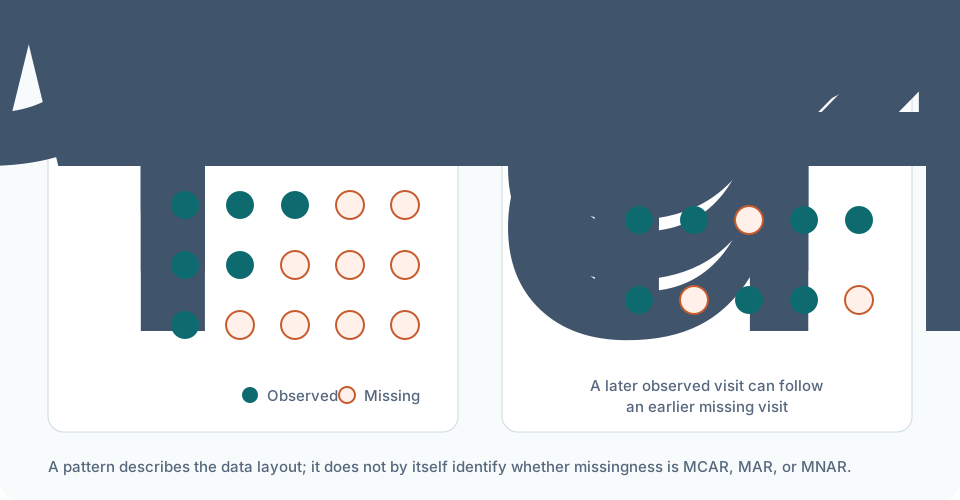
These patterns may reflect different clinical or operational mechanisms.
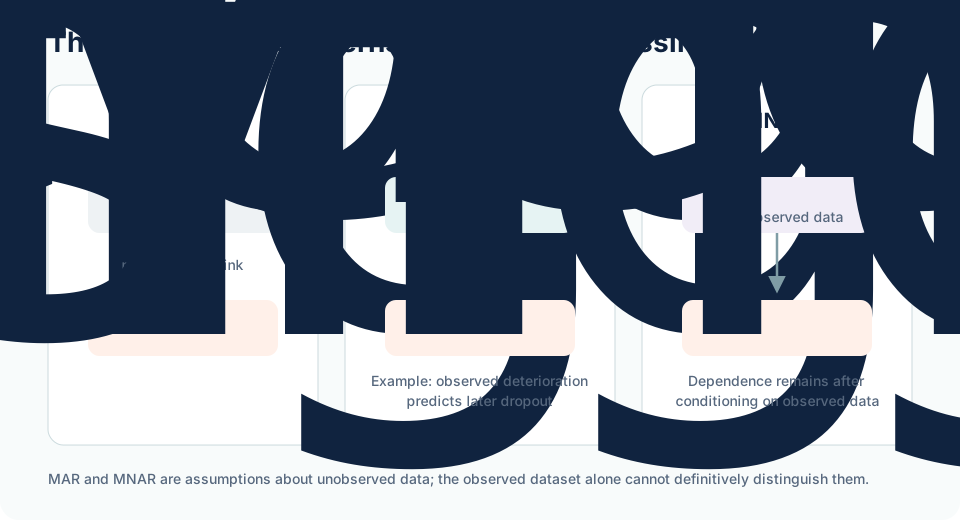
MCAR
Under Missing Completely At Random, missingness is unrelated to observed and unobserved values relevant to the outcome process.
This is a strong assumption.
MAR
Under Missing At Random, missingness may depend on observed information, but conditional on that observed information does not additionally depend on the missing outcome itself.
If observed deterioration is adequately represented in the model, MAR may be plausible.
Likelihood-based mixed models such as MMRM are frequently used under MAR assumptions.
MNAR
Under Missing Not At Random, missingness still depends on unobserved outcome information after conditioning on observed data.
Example:
Patients with severe unobserved deterioration are especially likely to discontinue follow-up.
The missingness mechanism generally cannot be proven from the observed dataset alone.
MMRM does not solve missing data
A common misconception is:
MMRM handles missing data, therefore missingness is no longer a problem.
This is incorrect.
MMRM can use available longitudinal observations under likelihood-based estimation, but valid inference still depends on assumptions such as MAR and correct model specification.
Therefore:
Intercurrent events are different from missing data
Suppose a participant stops treatment because of toxicity.
Scenario A
There is an intercurrent event but no missing Week-24 outcome.
Scenario B
There is both:
- an intercurrent event;
- missing outcome data.
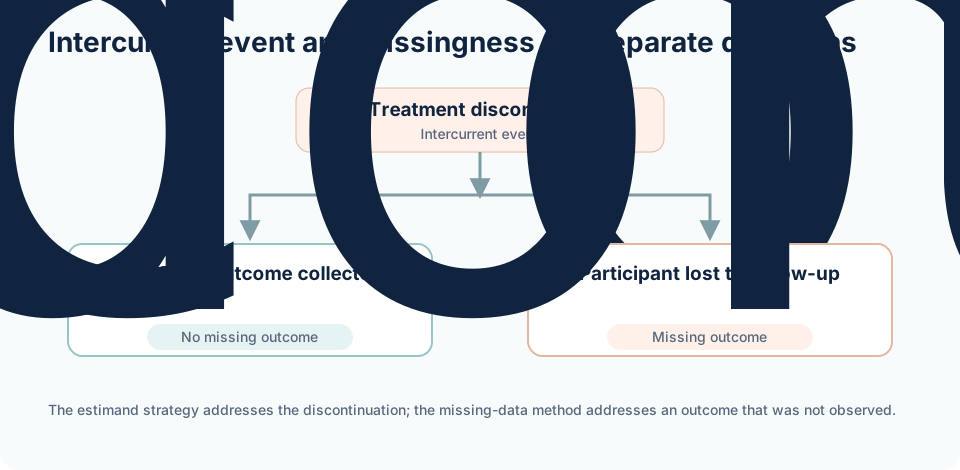
The five intercurrent-event strategies
ICH E9(R1) describes five broad strategies.[1]
Treatment policy
The treatment effect is defined regardless of whether the intercurrent event occurs.
Example:
What is the effect of treatment assignment in practice, including treatment discontinuation?
Hypothetical
The treatment effect is defined under a hypothetical scenario in which the intercurrent event would not occur.
Example:
What would the outcome have been had rescue medication not been used?
Composite
The intercurrent event becomes part of the endpoint definition.
Example:
Death or hospitalisation is defined as treatment failure.
While on treatment
The effect is defined using outcomes before the intercurrent event.
Principal stratum
The effect is defined within a subgroup characterised by potential intercurrent-event status under one or more treatment conditions.
| Strategy | Basic question |
|---|---|
| Treatment policy | What is the effect regardless of the event? |
| Hypothetical | What would happen if the event did not occur? |
| Composite | Can the event become part of the outcome? |
| While on treatment | What is the effect before the event? |
| Principal stratum | What is the effect in a subgroup defined by potential event status? |
Why this matters for analysis
The statistical method should follow the estimand.
For example, treatment discontinuation does not automatically imply that post-discontinuation measurements should be excluded.
If a treatment-policy estimand is targeted, continued outcome collection after discontinuation may be essential.
Sensitivity analysis
Sensitivity analysis asks:
Would the clinical conclusion change if important assumptions underlying the primary analysis were violated?
Suppose the primary analysis is MMRM under MAR.
A weak sensitivity analysis would be:
Repeat the analysis using RM-ANOVA.
This does not necessarily challenge the MAR assumption.
More relevant approaches may include:
- multiple imputation;
- delta-adjusted multiple imputation;
- pattern-mixture models;
- reference-based imputation;
- tipping-point analyses.
ICH E9(R1) distinguishes sensitivity analyses from supplementary analyses that address a different clinical question.[1]
Reference-based multiple imputation
Reference-based methods impose assumptions about unobserved outcomes after events such as treatment discontinuation.
Examples include:
Jump to Reference
After discontinuation, future mean trajectory resembles the reference arm.
Copy Reference
Post-discontinuation outcomes are drawn using the reference-group distribution.
Copy Increments in Reference
Post-discontinuation changes follow increments observed in the reference group.
These approaches are specialised assumptions, not automatic replacements for MMRM.
Tipping-point analysis
A tipping-point analysis asks:
How extreme would the unobserved outcomes need to be before the trial conclusion changes?
This can be clinically informative because it directly assesses robustness.
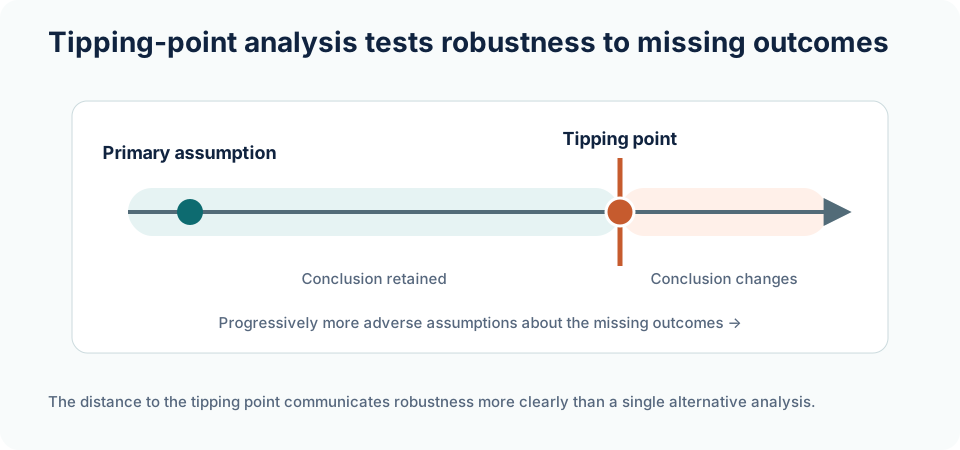
Prevention is better than statistical repair
Modern guidance emphasises reducing missingness through trial design and conduct.[2]
Important practices include:
- continue outcome collection after treatment discontinuation when scientifically relevant;
- record reasons for missingness;
- distinguish withdrawal of treatment from withdrawal of follow-up;
- prespecify missing-data assumptions;
- document protocol deviations and rescue treatments.
Common mistakes
”Dropouts should be removed”
Removing all incomplete participants can create bias and reduce efficiency.
”Last observation carried forward is conservative”
LOCF is not inherently conservative and can impose unrealistic assumptions.
”MAR can be tested from the dataset”
MAR is fundamentally an assumption about unobserved outcomes and cannot generally be verified directly.
”Missing data and treatment discontinuation are the same”
They are not.
”Any alternative model is a sensitivity analysis”
A useful sensitivity analysis should challenge important assumptions of the primary analysis.
Practical checklist
- What outcomes are missing?
- Why are they missing?
- Are post-discontinuation outcomes collected?
- What intercurrent events occurred?
- What strategy is used for each intercurrent event?
- What missingness assumption supports the primary model?
- What variables predict missingness?
- What sensitivity analyses challenge the primary assumptions?
- Is the tipping point clinically plausible?
Key takeaways
- Missing data and intercurrent events are different concepts.
- MMRM commonly relies on MAR-type assumptions and does not prove MAR.
- Intercurrent-event strategy must be defined according to the estimand.
- Sensitivity analysis should challenge assumptions that could change the primary conclusion.
- Prevention and continued outcome collection are often more important than post hoc statistical repair.
References
-
International Council for Harmonisation of Technical Requirements for Pharmaceuticals for Human Use. ICH E9(R1): Addendum on Estimands and Sensitivity Analysis in Clinical Trials. 2019. Available from: https://database.ich.org/sites/default/files/E9-R1_Step4_Guideline_2019_1203.pdf
-
European Medicines Agency. Guideline on Missing Data in Confirmatory Clinical Trials. 2010. Available from: https://www.ema.europa.eu/en/missing-data-confirmatory-clinical-trials-scientific-guideline
These personal study materials support learning and research planning. They do not replace formal teaching, current authoritative guidance, or study-specific methodological and statistical consultation.