
My Learning Space · Study guide
Clinical Trial Statistics · Part 1
Foundations of Modern Statistical Analysis in Clinical Trials
A practical introduction to the modern estimand-led framework for selecting and interpreting statistical analyses in randomised clinical trials.
Introduction
Modern clinical-trial analysis should not begin with the question:
Which statistical test should I use?
A better starting point is:
What treatment effect does the trial intend to estimate, what is the structure of the data, and which statistical method estimates that effect under scientifically defensible assumptions?
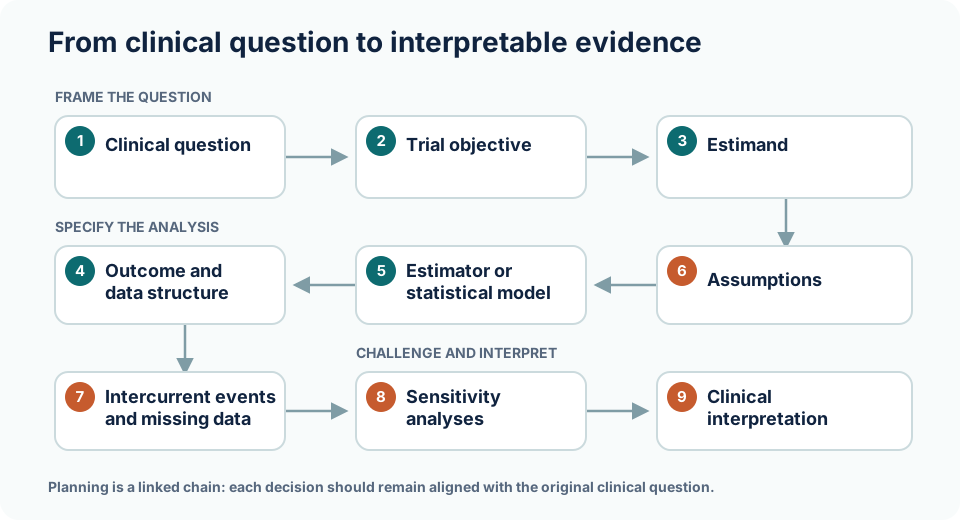
This reflects the modern framework promoted by ICH E9 and the ICH E9(R1) estimand addendum.[1][2]
A useful conceptual sequence is:
Learning objectives
By the end of this study guide, the reader should be able to:
- Distinguish a clinical question, estimand and estimator.
- Identify the five attributes of an estimand.
- Match common outcome types with appropriate modelling families.
- Explain why correlation and trial design affect model choice.
- Use a structured framework before selecting a statistical method.
Estimand versus estimator
An estimand describes the treatment effect of scientific interest.
An estimator is the statistical procedure used to estimate it.
Therefore:
For example:
Estimand
Difference between randomised treatment groups in mean Week-24 systolic blood pressure, regardless of treatment discontinuation.
Possible estimator
ANCOVA or MMRM, depending on the longitudinal structure and prespecified analysis strategy.
The model is therefore selected after the estimand is defined.
The five attributes of an estimand
ICH E9(R1) describes an estimand using five attributes.[2]
| Attribute | Question |
|---|---|
| Treatment condition | Which treatments or strategies are compared? |
| Population | In whom is the treatment effect defined? |
| Variable | What endpoint is measured? |
| Intercurrent-event strategy | How are post-randomisation events handled conceptually? |
| Population-level summary | How is the effect summarised? |
Clinical example
Suppose a randomised trial compares an antihypertensive drug with placebo.
A possible estimand could be:
- Treatment: drug versus placebo
- Population: eligible adults with uncontrolled hypertension
- Variable: systolic blood pressure at Week 24
- Intercurrent event: treatment discontinuation handled using a treatment-policy strategy
- Summary: difference in mean Week-24 systolic blood pressure
This is more informative than simply saying:
The primary analysis will use MMRM.
Start with the outcome structure
Outcome type narrows the modelling family.
| Outcome | Common approaches |
|---|---|
| Continuous, single post-randomisation endpoint | ANCOVA / linear regression |
| Continuous, repeated | MMRM / LMM / cLDA |
| Binary | Logistic regression |
| Repeated binary | GEE / GLMM |
| Ordinal | Ordinal logistic model |
| Count | Poisson / negative binomial |
| Repeated count | GEE / GLMM |
| Time-to-event | Cox / parametric survival / RMST |
| Clustered continuous | LMM / GEE |
| Clustered binary | GLMM / GEE |
Outcome type alone is not enough. The analyst must also identify the dependence structure.
Why repeated measurements require special methods
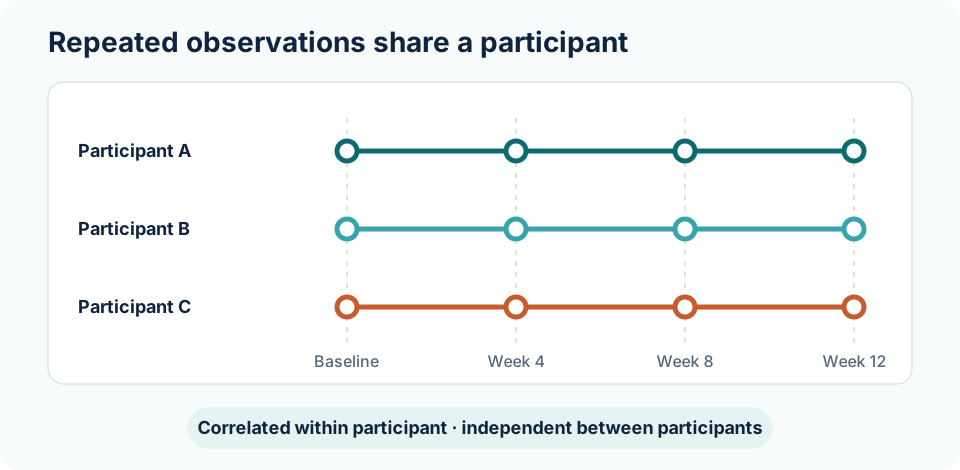
Suppose each participant has repeated outcomes:
Measurements from the same participant are usually correlated:
Ignoring this correlation may underestimate uncertainty.
The modern model-selection hierarchy
A useful framework is:
This is more appropriate than choosing a test from a normality result and then reporting only a p-value.
Common mistakes
Starting from the software menu
The availability of a procedure in SPSS, SAS, Stata or R does not determine whether it estimates the intended treatment effect.
Treating repeated data as automatically requiring RM-ANOVA
Repeated measurements create correlation, but RM-ANOVA is only one possible approach.
Treating MMRM as universally superior
MMRM is highly useful, but ANCOVA may be entirely adequate when one post-randomisation endpoint is primary.
Confusing analysis population with estimand
“ITT analysis” alone does not specify how treatment discontinuation, rescue therapy or missing outcomes are handled.
Practical checklist
Before choosing a model, ask:
- What was randomised?
- What is the primary clinical question?
- What is the estimand?
- What is the outcome type?
- Is the outcome measured repeatedly?
- What creates dependence?
- What treatment contrast is clinically important?
- What intercurrent events may occur?
- What missing-data assumptions are required?
- What sensitivity analyses challenge those assumptions?
Key takeaways
- Modern clinical-trial analysis is estimand-led, not test-led.
- The statistical model is chosen only after the clinical question and estimand are defined.
- Repeated measurements require explicit attention to within-participant correlation.
- Trial design, outcome type and inferential target jointly determine model choice.[3]
- Missing data and intercurrent events must be considered separately.
References
-
International Council for Harmonisation of Technical Requirements for Pharmaceuticals for Human Use. ICH E9: Statistical Principles for Clinical Trials. 1998. Available from: https://database.ich.org/sites/default/files/E9_Guideline.pdf
-
International Council for Harmonisation of Technical Requirements for Pharmaceuticals for Human Use. ICH E9(R1): Addendum on Estimands and Sensitivity Analysis in Clinical Trials to the Guideline on Statistical Principles for Clinical Trials. 2019. Available from: https://database.ich.org/sites/default/files/E9-R1_Step4_Guideline_2019_1203.pdf
-
International Council for Harmonisation of Technical Requirements for Pharmaceuticals for Human Use. ICH E8(R1): General Considerations for Clinical Studies. 2021. Available from: https://database.ich.org/sites/default/files/E8-R1_Guideline_Step4_2022_0204%20%281%29.pdf
These personal study materials support learning and research planning. They do not replace formal teaching, current authoritative guidance, or study-specific methodological and statistical consultation.