
My Learning Space · Study guide
Clinical Trial Statistics · Part 5
Selecting Statistical Models According to Clinical-Trial Design
A practical framework linking randomisation design, repeated outcomes, multiplicity, superiority, non-inferiority and equivalence to statistical model selection.
Introduction
Clinical-trial analysis cannot be separated from trial design.
A useful principle is:
The randomisation structure determines which observations are independent, which are correlated, which treatment effects are identifiable and which statistical models are appropriate.
Learning objectives
By the end of this guide, the reader should be able to:
- Link common trial designs to appropriate statistical structures.
- Distinguish superiority, non-inferiority and equivalence hypotheses.
- Recognise when multiplicity control is required.
- Explain why analysis populations must be prespecified.
- Apply a practical model-selection workflow.
Parallel-group randomised trial
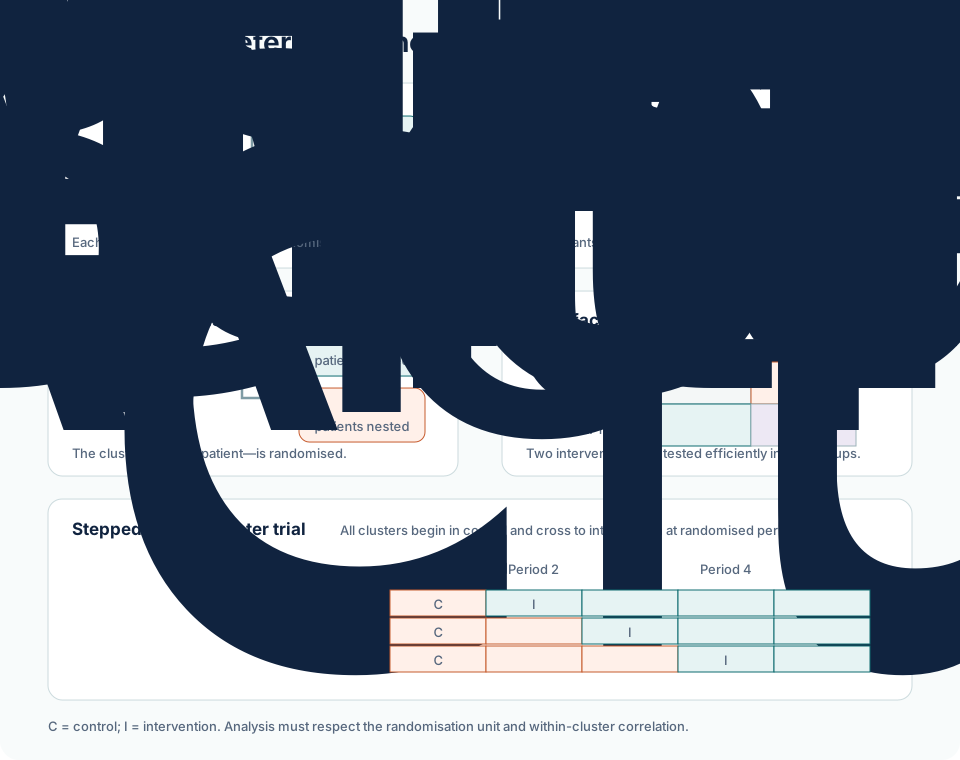
Treatment is usually a between-participant factor.
For a single continuous outcome, ANCOVA may be sufficient.
For repeated continuous outcomes, MMRM or LMM may be considered.
Crossover trial
Analysis may need to account for:
- treatment;
- period;
- sequence;
- repeated observations within participant.
The participant serves as their own control, but carryover and period effects require careful consideration.
Cluster-randomised trial
Patients within the same hospital are correlated.
Possible approaches include:
- LMM;
- GLMM;
- GEE;
- cluster-level analysis.
The number of independent clusters is often more important for inference than the total number of individual participants.
Factorial trial
For a factorial design:
Potential effects include:
- main effect of A;
- main effect of B;
- A × B interaction.
Stepped-wedge cluster trial
Time and cluster effects are integral to the design and analysis.
Superiority trials
For a two-sided treatment effect:
versus:
Superiority is often most clearly interpreted using the estimated treatment effect and confidence interval.
Non-inferiority trials
Suppose higher values favour the new treatment.
With non-inferiority margin :
versus:

The non-inferiority margin must be clinically and methodologically justified.[2]
Equivalence trials
Equivalence asks whether the true effect lies within prespecified lower and upper margins:
The hypotheses may be written:
versus:
A conventional approach is the two one-sided tests procedure, represented by the two-margin criterion in Figure 2.
A non-significant superiority test does not establish equivalence.
Analysis populations
Intention-to-treat principle
Participants are analysed according to randomised assignment.
Full analysis set
A practical implementation intended to remain close to the ITT principle.
Per-protocol population
Includes participants meeting prespecified adherence and protocol criteria.
Safety population
Often based on treatment actually received.
These populations should be prespecified.
Why non-inferiority requires particular care
In superiority trials, nonadherence often dilutes treatment differences toward the null.
In non-inferiority trials, this same dilution can make treatments appear more similar and may favour a false conclusion of non-inferiority.
Therefore, interpretation often considers multiple prespecified analyses rather than selecting whichever result is most favourable.
Multiplicity
Multiplicity arises when a trial contains multiple opportunities to declare success.
Examples:
- multiple primary endpoints;
- multiple doses;
- multiple treatment arms;
- multiple confirmatory time points;
- multiple key secondary endpoints.
Common procedures include:
- Bonferroni;
- Holm;
- Hochberg;
- fixed sequence;
- hierarchical testing;
- gatekeeping;
- Dunnett procedures;
- closed testing;
- graphical procedures.
Fixed sequence example
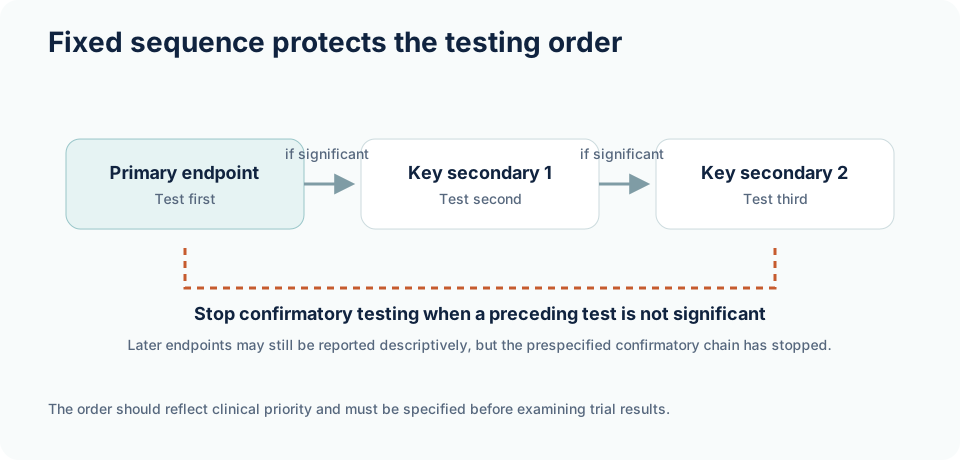
Multiplicity is part of the confirmatory strategy, not merely a post hoc p-value adjustment.[1]
Survival outcomes
If outcome is time-to-event, the analysis may involve:
Kaplan-Meier estimation
Cox model
Restricted mean survival time
RMST provides an absolute time-based treatment effect up to a prespecified horizon.
Practical model-selection workflow
Step 1 — What was randomised?
- individual;
- cluster;
- treatment sequence.
Step 2 — What is the objective?
- superiority;
- non-inferiority;
- equivalence;
- dose response.
Step 3 — What is the estimand?[4]
Define:
- treatment;
- population;
- variable;
- intercurrent-event strategy;
- summary measure.
Step 4 — What is the outcome type?
- continuous;
- binary;
- ordinal;
- count;
- time-to-event.
Step 5 — Is it repeated or clustered?
If yes, identify the dependence structure.
Step 6 — What is the inferential target?
Examples:
- target-visit treatment difference;
- slope difference;
- population-average odds ratio;
- conditional effect;
- hazard ratio;
- RMST difference.
Step 7 — Select the modelling family
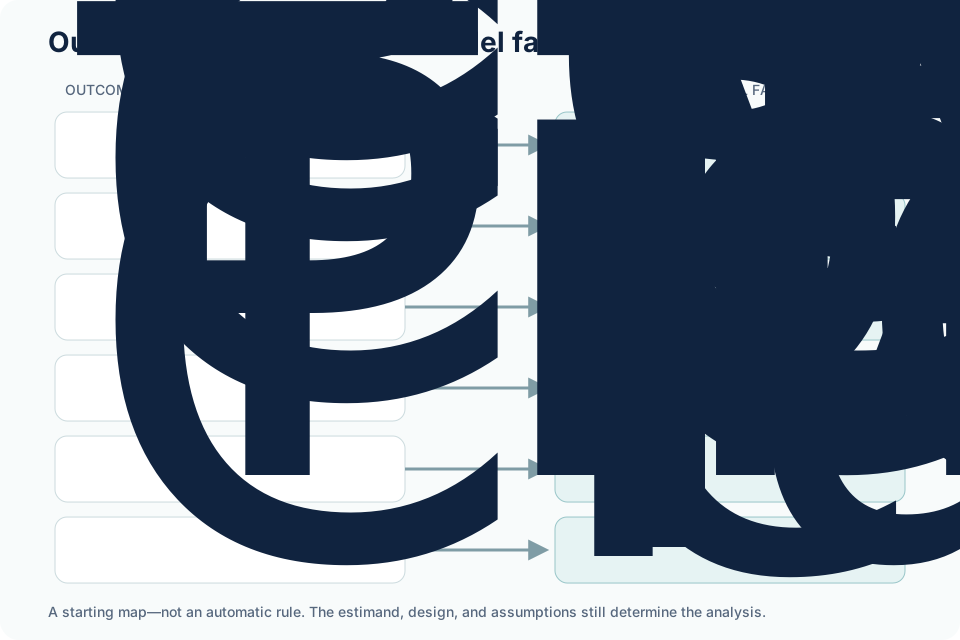
Step 8 — Specify covariance or random effects
Examples:
- random intercept;
- random slope;
- AR(1);
- compound symmetry;
- Toeplitz;
- unstructured.
Step 9 — Address intercurrent events and missingness
Prespecify the strategy.
Step 10 — Address multiplicity
Define which hypotheses are confirmatory and how error rates are controlled.
Step 11 — Prespecify
Important analysis decisions should be documented before unblinding when appropriate.
Common mistakes
”The statistical model can be chosen independently of randomisation design”
Incorrect. Randomisation defines the fundamental dependency structure.
”Non-significant superiority implies equivalence”
Incorrect. Equivalence requires a prespecified equivalence framework.
”Multiplicity only matters if many p-values are reported”
Multiplicity concerns the number of opportunities for confirmatory success, not merely the number of displayed p-values.
”ITT and PP should be run and whichever is significant should be accepted”
Analysis populations and interpretation should be prespecified.[3]
Practical checklist
- What is the unit of randomisation?
- What is the estimand?
- Is the trial superiority, NI or equivalence?
- What is the endpoint distribution?
- Is the endpoint repeated?
- Is the trial clustered?
- What treatment contrast is clinically meaningful?
- Is multiplicity present?
- Are analysis populations prespecified?
- Are missing-data and intercurrent-event strategies defined?
- Are sensitivity analyses planned?
Key takeaways
- Trial design determines the correlation and inferential structure.
- Superiority, non-inferiority and equivalence answer different questions.
- Multiplicity is part of the confirmatory design, not simply an adjustment after analysis.
- Analysis populations must be prespecified and interpreted with the estimand.
- Model selection should proceed from design and estimand to outcome structure and only then to statistical procedure.
References
-
US Food and Drug Administration. Multiple Endpoints in Clinical Trials: Guidance for Industry. 2022. Available from: https://www.fda.gov/regulatory-information/search-fda-guidance-documents/multiple-endpoints-clinical-trials
-
US Food and Drug Administration. Non-Inferiority Clinical Trials to Establish Effectiveness: Guidance for Industry. 2016. Available from: https://www.fda.gov/regulatory-information/search-fda-guidance-documents/non-inferiority-clinical-trials
-
International Council for Harmonisation of Technical Requirements for Pharmaceuticals for Human Use. ICH E9: Statistical Principles for Clinical Trials. 1998. Available from: https://database.ich.org/sites/default/files/E9_Guideline.pdf
-
International Council for Harmonisation of Technical Requirements for Pharmaceuticals for Human Use. ICH E9(R1): Addendum on Estimands and Sensitivity Analysis in Clinical Trials. 2019. Available from: https://database.ich.org/sites/default/files/E9-R1_Step4_Guideline_2019_1203.pdf
These personal study materials support learning and research planning. They do not replace formal teaching, current authoritative guidance, or study-specific methodological and statistical consultation.